


Visioni di Impresa – 2026 Series | Page II
The Journey Continues
With this page, the editorial journey of Visioni di Impresa 2026, conceived and hosted by Luigi Carfora, continues.
The episodes featured here explore the key challenges shaping today's business landscape, including innovation, artificial intelligence, research, institutions, economic development, sustainability, education and competitiveness, through discussions with entrepreneurs, institutional representatives, university professors, professionals and leading experts.
To read the introduction to the series, access the complete episode index and watch Episodes 1–26, simply return to Page I.
◀ Back to Visioni di Impresa – 2026 Series | Page I
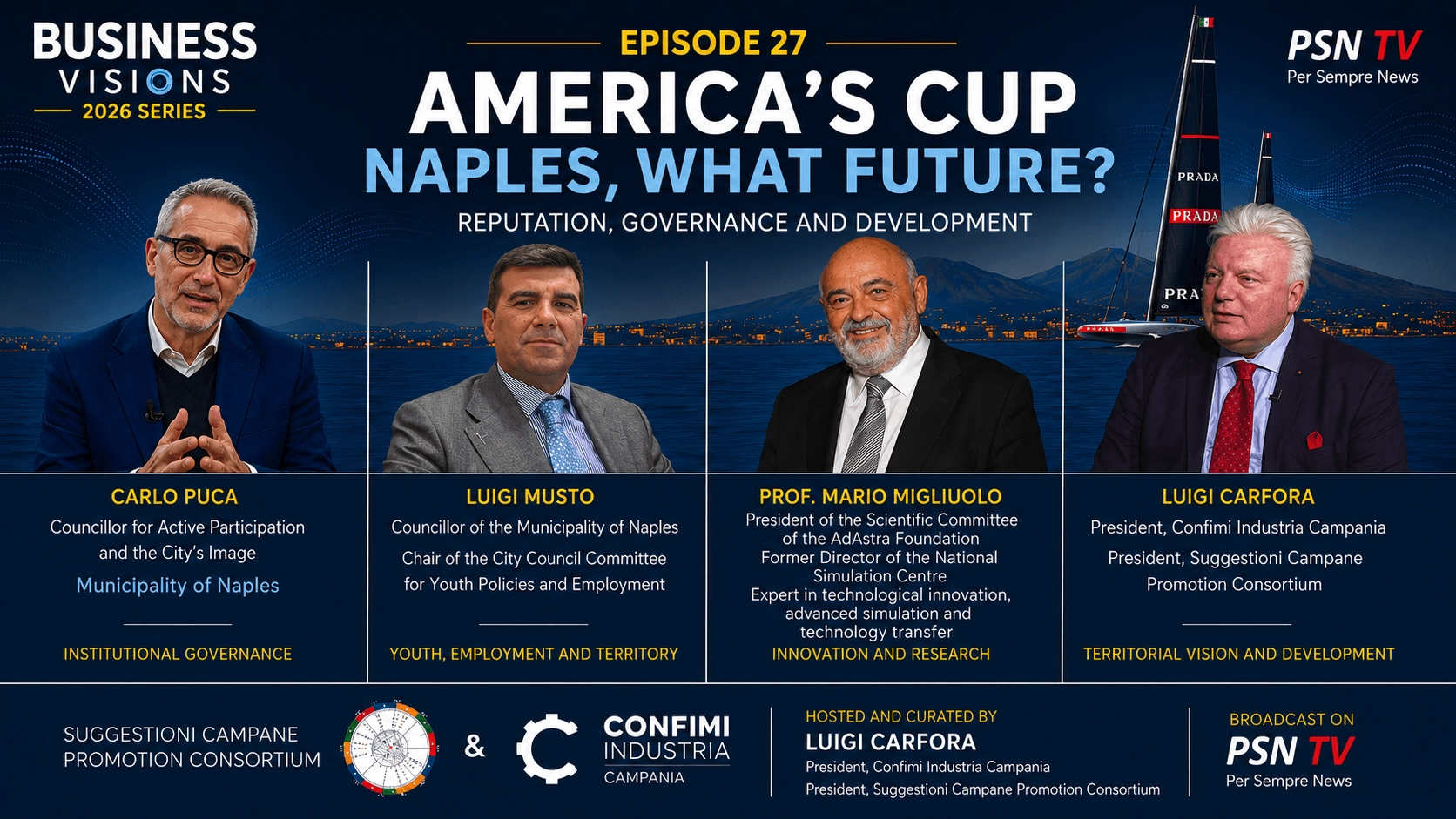
🎥 BUSINESS VISIONS – Episode 27 | 2026 Series
NAPLES, THE AMERICA'S CUP AND THE FUTURE OF CITIES
From International Reputation to Development Governance: Transforming a Major Event into a Lasting Economic, Cultural and Social Legacy
Theme
America's Cup, urban governance, territorial development, Destination Management Organizations (DMOs), maritime economy, Blue Economy, place branding, international reputation, innovation, research, human capital, enterprises, infrastructure, sustainability, public-private cooperation, competitiveness, strategic planning, tourism, culture, education and economic development.
✦ Guiding Thought
"Cities do not become protagonists of the future simply because they host a major event. They become protagonists when they are able to transform that event into a shared vision, a long-term strategy and a lasting legacy capable of generating value for people, businesses and future generations. The real challenge is not to organize a successful event, but to build a development model that continues to create opportunities long after the spotlight has faded."
This is the question that will guide today's discussion.
The America's Cup is one of the world's most prestigious sporting events and will offer Naples an opportunity of extraordinary international significance.
Yet every major event raises a question that goes far beyond its organization.
What will remain for the city once the event is over?
The infrastructure created.
The skills acquired.
The partnerships established.
The investments attracted.
The ability to work as an integrated system.
Or simply the memory of a successful event?
This question concerns Naples, but in reality it concerns every city facing the major transformations of the twenty-first century.
Today, a territory's competitiveness is no longer measured solely by its ability to attract visitors.
It is measured by its ability to attract businesses.
Talent.
Investment.
Research.
Innovation.
Human capital.
And, above all, by its ability to transform these resources into stable, inclusive and long-term development.
Naples is not starting from scratch.
Its more than twenty-five centuries of history, its extraordinary cultural heritage, its strategic role in the Mediterranean and the international recognition it already enjoys represent an intangible asset of exceptional value.
Today's challenge is not to build a reputation that already exists, but to strengthen Naples' contemporary international positioning by transforming this historical and cultural heritage into lasting economic, social and cultural opportunities for the entire territory.
The recognition of Naples' Historic Centre as a UNESCO World Heritage Site stands as one of the clearest symbols of this remarkable legacy.
From this perspective, the America's Cup will not be analysed merely as a sporting event.
It will be considered a case study.
An opportunity to reflect on the relationship between major international events, governance, territorial development, the maritime economy, innovation and the quality of public policies.
Because major events do not automatically generate development.
Development emerges from the ability of institutions, businesses, the research community and civil society to build a shared vision and translate it into tangible results.
And this is precisely the reflection we intend to develop throughout this episode.
"A major event lasts only a few days. A great vision can change the destiny of a city."
Three Perspectives for Understanding Change
Three different experiences brought together to address a single question:
How can an extraordinary international opportunity be transformed into a permanent strategy for development?
Guests
To explore such a broad and strategic topic, we have chosen to bring together three different yet highly complementary professional experiences.
Three perspectives representing three essential dimensions of territorial development:
The institutional dimension.
The administrative dimension.
The scientific dimension.
Because understanding the future of a city requires the ability to connect different areas of expertise, capable of contributing to the construction of a shared vision.
Carlo Puca, Councillor of the Municipality of Naples for Active Participation and the City's Image, with responsibility for the City's public image, participatory democracy, citizens' councils, co-design processes and citizen engagement, will offer the institutional perspective on how Naples can strengthen its contemporary identity, civic participation and international positioning through a major global event such as the America's Cup.
Luigi Musto, Member of the Naples City Council and Chair of the City Council Committee for Youth Policies and Employment, will offer the perspective of someone who is directly involved in the city's institutional and administrative life. Drawing on his experience in local government, the discussion will explore the urban transformations that the America's Cup may generate for Naples, with particular attention to their impact on quality of life, citizen participation, employment opportunities, younger generations, and the broader balance between economic development, sustainability and urban liveability. The discussion will also examine the role that public institutions can play in guiding and governing these changes, helping to ensure that the opportunities created by this major international event translate into lasting benefits for the city and its communities.
Professor Mario Migliuolo, President of the Scientific Committee of the AdAstra Foundation, former Director of the National Simulation Centre and internationally recognised expert in technological innovation, advanced simulation and technology transfer, will guide the discussion towards the role of research, knowledge, innovation ecosystems and emerging technologies as drivers of long-term territorial development.
Together, these three perspectives allow us to explore a common question:
How can the America's Cup become not merely an international sporting event, but the catalyst for a lasting model of development for Naples?
Three different experiences.
One shared perspective.
Understanding how a city can transform an extraordinary international opportunity into a project capable of generating lasting economic, social and cultural value for its territory and for future generations.
Because the future cannot be built through a single field of expertise.
It is built when institutions, businesses, research and communities learn to share the same vision of development.
Naples Does Not Need to Reinvent Itself.
It Must Govern Its Own Future.
Throughout history, many cities have built their international reputation by hosting major global events.
World Expositions.
Olympic Games.
European Capitals of Culture.
Major sporting competitions.
International events.
For some cities, these occasions marked the beginning of a profound transformation.
For others, they remained nothing more than a lasting memory.
The difference has never depended solely on the importance of the event itself.
It has always depended on the quality of the vision that accompanied it.
And it is precisely here that our reflection begins.
Naples is not a city that needs to build an international identity.
Its history spans more than twenty-five centuries.
It was once the capital of one of Europe's most influential kingdoms.
It preserves one of the richest cultural heritages in the Mediterranean.
Its Historic Centre has been recognized as a UNESCO World Heritage Site.
For centuries, its artistic, musical, theatrical, scientific and gastronomic traditions have been internationally acknowledged as distinctive expressions of excellence.
Its geographical position continues to make Naples one of the principal gateways linking Europe, the Mediterranean and Africa.
Naples, therefore, does not need to be introduced to the world.
The world already knows Naples.
The real challenge is not to become better known.
It is to transform an already recognized historical, cultural and human heritage into a permanent driver of competitiveness, innovation and sustainable development.
The real challenge is another.
To transform this historic reputation into a contemporary competitive advantage.
Today, cities compete not only as tourist destinations.
They compete in their ability to attract investment.
Businesses.
Researchers.
Students.
Skills.
Emerging technologies.
Creative industries.
International events.
Human capital.
In other words, they compete in their ability to create an ecosystem that supports sustainable development.
This is precisely the difference between a city that merely hosts a major event and a city that uses that event to accelerate its long-term development.
The America's Cup offers Naples an extraordinary opportunity.
Yet the event itself will not determine the city's success.
Success will depend on the ability of public institutions, businesses, universities, the research community and civil society to transform an international event into a shared development project.
Because the competitiveness of a territory is not measured by the duration of an event.
It is measured by the quality of the legacy that event is capable of leaving behind.
That is the legacy we must learn to design.
Because the future of cities does not belong to those that organize the greatest number of events.
It belongs to those that build the greatest vision.
The value of a major event is not measured by the days during which it takes place.
It is measured by the years of value it continues to generate.
Every major event inevitably attracts attention.
It draws visitors.
Generates investment.
Engages public institutions.
Mobilises businesses.
Places an entire territory under the international spotlight.
Yet none of this, by itself, is enough.
History teaches us that some major events have profoundly transformed the cities that hosted them.
Others have left little more than the memory of an extraordinary occasion.
The difference does not lie in the event itself.
It lies in the ability to transform a temporary opportunity into a permanent strategy.
And this is precisely where we wish to focus our reflection.
The America's Cup is undoubtedly one of the world's most prestigious sailing competitions.
For Naples, however, it should be viewed as much more than a sporting event.
It can become a laboratory.
An accelerator.
A testing ground.
An opportunity to rethink the relationship between economic development, urban planning, innovation, tourism, culture, enterprise and quality of life.
Because contemporary cities no longer compete exclusively through their infrastructure.
They compete through the quality of their organisation.
Their ability to cooperate.
To build networks.
To pursue shared objectives.
To plan for the future.
Every major event should leave at least five lasting legacies.
The first.
Better infrastructure.
The second.
New skills.
The third.
Stronger international partnerships.
The fourth.
Greater institutional and administrative capacity.
The fifth.
A community that is more aware of its own role in shaping the city's future.
If even one of these legacies is missing, there is a real risk of having organised an extraordinary event without creating equally extraordinary development.
For this reason, the America's Cup should not be regarded as the finish line.
It should be seen as the starting point.
The moment when a city is called upon to demonstrate not only its organisational capability,
but above all its ability to imagine the future.
Because the success of a major event does not end with the closing ceremony.
It begins the following day.
When infrastructure continues to be used.
When investments continue to generate value.
When businesses discover new opportunities.
When young people find new professional pathways.
When the territory becomes more competitive.
When a community realises that it has created something capable of generating benefits for generations to come.
That is the moment when an event truly becomes development.
Destination Management Organizations
Destination Management Organizations
From Tourism Management to Destination Governance
Over the past few years, the concept of the Destination Management Organization, more commonly known by the acronym DMO, has increasingly become part of the debate on territorial tourism development.
But what exactly is a DMO?
Is it simply a new organizational entity?
An administrative instrument?
Or does it represent an entirely different model of destination governance?
This is the question we wish to explore.
According to unofficial sources, three applications have reportedly been submitted within the Metropolitan City of Naples for the recognition of three separate Destination Management Organizations. Pending the conclusion of the regional assessment process and the publication of the official decisions, it would be inappropriate to express any opinion regarding their recognition.
However, the central point of our reflection is not the number of DMOs.
It is their mission.
Because a tourist destination is not synonymous with tourism.
A destination is an ecosystem.
It is the result of the interaction between people.
Businesses.
Public institutions.
Cultural heritage.
The environment.
Mobility.
Public services.
Hospitality.
Education and training.
Research.
Innovation.
Security.
Quality of life.
A destination is not simply visited.
It is experienced.
Crossed.
Narrated.
Remembered.
Chosen.
And it is precisely this overall experience that determines its international competitiveness.
For this reason, a DMO should not limit itself to promoting a destination.
It should contribute to governing its development.
By coordinating strategies.
Connecting expertise.
Encouraging collaboration between the public and private sectors.
Building a shared vision.
Promoting balanced and sustainable growth.
It is from this perspective that a DMO truly demonstrates its value.
Not through its ability to manage a single project.
But through its ability to generate a long-term development strategy.
Because the success of a destination is not measured by the number of events it organizes.
It is measured by the quality of the experience it offers.
By the average length of visitors' stays.
By its ability to attract new investment.
By the growth of local businesses.
By the enhancement of its cultural heritage.
By the integration of tourism with industry, trade, craftsmanship, agriculture, research and innovation.
In other words,
by the economic, social and cultural value it is capable of generating over time.
This is precisely where the extraordinary opportunity represented by the America's Cup comes into play.
If interpreted merely as an event, its benefits will inevitably be temporary.
If, instead, it becomes part of a comprehensive destination strategy, it can serve as the catalyst for a much broader development process—one capable of strengthening Naples' international positioning while engaging the entire metropolitan area in a shared vision of sustainable growth.
Because destinations do not grow solely through financial resources.
They grow when they are capable of transforming every investment—whether public or private—into lasting value for the territory.
This is the difference between managing a project and governing a destination.
Beyond Tourism
The America's Cup as a Platform for Economic Development
When discussing major international events, attention is almost always focused on their most visible aspects.
The number of visitors.
Hotel occupancy.
Side events.
Tourism promotion.
These are undoubtedly important indicators.
But they are not sufficient to understand the true impact of an event of this magnitude.
A territory's economy does not grow simply because visitor numbers increase.
It grows when the value created increases.
When new businesses are established.
When productive supply chains become stronger.
When innovation capacity expands.
When knowledge and skills remain within the territory.
When investments continue generating development long after the event itself has ended.
This is the perspective from which we wish to examine the America's Cup.
Not merely as a sporting competition.
But as an economic platform.
Because every major event activates a far broader system than most people perceive.
It involves the sea.
But also industry.
Logistics.
Shipbuilding.
Recreational boating.
Port activities.
The Blue Economy.
Research.
Universities.
Innovative enterprises.
Digital services.
Artificial Intelligence.
Security.
Education and training.
Communication.
Culture.
The audiovisual industry.
Design.
Craftsmanship.
Food and wine excellence.
Hospitality.
Mobility.
Professional services.
Every one of these sectors contributes, directly or indirectly, to the success of the event.
And it is precisely this complexity that makes the America's Cup an extraordinary opportunity for growth.
Provided that the territory is capable of recognising these interconnections and transforming them into a shared development strategy.
Because no business grows in isolation.
Just as no territory can grow if its different stakeholders continue to operate independently.
The world's most competitive economies are those capable of building ecosystems.
Places where businesses.
Universities.
Research centres.
Public institutions.
Professionals.
Business associations.
The financial system.
The third sector.
Work together in pursuit of a common vision.
The America's Cup can become exactly that.
Not merely a competition between sailing teams.
But a competition between development models.
Between territories capable of building cooperation.
Between cities capable of transforming an international event into a permanent economic legacy.
This is the challenge awaiting Naples.
And, more broadly, Italy as a whole.
Because the success of the America's Cup will not concern only the city that hosts it.
It will concern Italy's ability to demonstrate how a major international event can become a powerful instrument for innovation, competitiveness and shared growth.
This is where the discussion naturally leads to the contribution of Professor Mario Migliuolo.
At This Point, Professor Mario Migliuolo Enters the Discussion
Not because he is an expert in sailing.
But because he represents one of the central themes of this episode.
Innovation as a driver of development.
Through his contribution, the discussion naturally expands to encompass:
- the knowledge economy;
- innovation ecosystems;
- technology transfer;
- universities;
- skills development;
- Artificial Intelligence;
- intelligent data management;
- the digitalisation of public services;
- smart cities;
- sustainability.
In other words,
the America's Cup becomes merely the point of entry.
The real subject is the future of cities.
The City as a Community of Purpose
No transformation is possible without a shared vision.
Every city possesses a tangible heritage.
Its streets.
Its squares.
Its buildings.
Its monuments.
Its infrastructure.
Yet there is another heritage that is even more valuable.
Its intangible heritage.
The trust that exists between people.
The ability of institutions to engage in dialogue.
Collaboration among businesses.
The quality of its universities.
The strength of voluntary organisations.
The commitment of civic associations.
The responsibility of political leadership.
The active participation of citizens.
It is this invisible heritage that ultimately determines a community's capacity to face major transformations.
For this reason, every major urban project should not be regarded merely as an economic investment.
Above all, it should be seen as a social investment.
Because cities do not change simply when new infrastructure is built.
They change when a culture of collaboration begins to flourish.
When public institutions engage constructively with the productive sector.
When universities transfer knowledge to businesses.
When research is transformed into innovation.
When education equips people with the skills demanded by the labour market.
When citizens recognise that they are part of a common project.
This is the difference between a city that organises an event and a city that builds its future.
The America's Cup can provide an extraordinary opportunity to strengthen this collaborative spirit.
But only if it succeeds in engaging every stakeholder across the territory.
Public institutions.
Businesses.
Universities.
ITS Academies.
Research centres.
Professional organisations.
Business associations.
The third sector.
Local communities.
Because development does not belong exclusively to public administration.
Nor does it belong exclusively to businesses.
Nor exclusively to the research community.
Development is the outcome of these different actors recognising themselves as members of the same community of purpose.
And this is precisely the challenge awaiting Naples.
To transform a major event into a great collective project.
A project in which every citizen can recognise his or her own contribution.
Every business its own opportunity.
Every young person a pathway for growth.
Every institution a shared responsibility.
Because a city truly grows when every part of its community understands that the common good is not merely the sum of individual interests.
It is the ability to direct diverse energies toward a shared objective.
This is the highest expression of governance.
Not governance that decides on behalf of others.
But governance that creates the conditions enabling everyone to contribute to the development of the territory.
Governing Change
From Emergency Management to a Culture of Strategic Planning
Every generation is called upon to face transformations that redefine its own era.
In the past, these transformations took the form of the great Industrial Revolutions.
Then came globalisation.
Followed by the digital revolution.
Today, we are confronted with challenges that are even more complex.
Artificial Intelligence.
Sustainability.
The energy transition.
Demographic change.
International competitiveness.
The evolution of global markets.
The growing competition among territories.
Within this context, cities themselves are also called upon to change.
They can no longer limit themselves to administering the present.
They must learn to design the future.
This is the fundamental difference between administration and governance.
Administration manages what already exists.
Governance creates what does not yet exist.
It plans.
Measures results.
Coordinates.
Engages.
Listens.
Adapts.
Builds relationships.
Generates trust.
Every major event represents an extraordinary opportunity to test this capability.
Yet it would be reductive to regard it merely as an organisational challenge.
Above all, it is a cultural challenge.
Because it requires public institutions, businesses, universities, associations and citizens to move in the same direction.
To share a common vision.
A common method.
A shared responsibility.
From this perspective, planning itself acquires a new meaning.
It is no longer simply a matter of defining a schedule of activities.
It is about building a strategy capable of integrating public policies, private investment, scientific research, education, innovation and economic development.
Because no transformation is ever the result of a single decision.
It is the outcome of continuity.
Consistency.
And the ability to maintain a clear direction over time.
This is the true meaning of governance.
And it is perhaps the most important capability that cities will need to develop in the years ahead.
From the City to the Territorial System
The America's Cup offers an opportunity to take an even broader perspective.
Not to think only about Naples.
But about the entire Metropolitan Area.
About Campania.
About Southern Italy.
And, in many respects, about the Italian national system as a whole.
A major international event can generate benefits that extend far beyond the city in which it takes place.
It can strengthen industrial supply chains.
Encourage cooperation among territories.
Create new business networks.
Stimulate investment.
Promote research.
Support the development of new skills.
Yet none of this happens automatically.
It requires a shared vision.
A multi-level governance approach.
A genuine capacity for coordination among national, regional and local institutions, universities, businesses and civil society.
For this reason, the true success of the America's Cup will not be measured solely by the efficiency of its organisation.
It will be measured by its ability to leave behind a collaborative framework capable of generating development for many years after the event itself has ended.
Because the future does not belong to the territories that react the fastest.
It belongs to those that learn to plan together.
Three Perspectives. One Shared Vision.
Major transformations never belong to a single sector.
They cannot be understood from a single perspective.
Every transformation involves public institutions.
Businesses.
Research.
Universities.
Citizens.
Professionals.
Associations.
For this reason, we have chosen to explore the theme of this episode through three different yet profoundly complementary perspectives.
The first concerns the institutional dimension.
Every city continuously communicates its identity.
Through its public policies.
Its choices.
Its public services.
The quality of its public spaces.
Its capacity to welcome.
Its ability to engage with the world.
A city's image is not the result of a communication campaign.
It is the outcome of the consistency between what a community truly is and what it is capable of conveying.
The second concerns the administrative dimension.
Every development strategy must ultimately become concrete action.
Mobility.
Public services.
Participation.
Accessibility.
Safety.
Urban quality.
Strategic planning.
Because a city becomes competitive when it succeeds in making simple what remains complex elsewhere.
The third concerns knowledge.
No transformation will ever be possible without research.
Innovation.
Education.
Technology transfer.
New skills.
The cities that will lead the future are those capable of connecting universities, businesses, public institutions and younger generations.
These are different perspectives.
Yet they all tell the same story.
The story of a city that chooses to build its future through collaboration.
And it is precisely within this collaboration that every major event finds its deepest meaning.
Because the America's Cup is far more than an organisational challenge.
It is an extraordinary opportunity to test a territory's real capacity to work as an integrated system.
When expertise begins to interact.
When responsibilities become complementary.
When differences become strengths.
That is when a genuine development strategy begins to emerge.
And this is precisely the reflection we wish to share with our guests.
Not to ask them to predict what will happen.
But to understand what future we can build together.
The Most Important Legacy Is Not Infrastructure. It Is Human Capability.
When a major event comes to an end, what usually remains visible is what has been physically built.
A new infrastructure.
A regenerated public square.
A modernised port.
A public work.
These are important achievements.
Yet they represent only the most visible part of the legacy.
There is another heritage that is far more valuable.
The one that cannot be seen.
Skills.
Professional expertise.
Relationships.
The ability to work together.
A culture of strategic planning.
The experience that has been acquired.
Every major project leaves a lasting mark when it contributes to the growth of people.
When it creates new professions.
When it strengthens the capabilities of businesses.
When it brings universities closer to the productive system.
When it stimulates research.
When it encourages innovation.
When it offers young people new opportunities to build their future without being forced to seek it elsewhere.
This is the most important legacy that any city can leave behind.
Because infrastructure may age.
Technologies may become obsolete.
Events inevitably come to an end.
Skills, however, continue to generate value.
They are transferred.
They evolve.
They generate new knowledge.
New businesses.
New employment.
New opportunities.
Every public investment should also be evaluated from this perspective.
Not only for what it builds.
But above all for what it teaches.
Because the true wealth of a territory is not determined solely by the assets it possesses.
It is determined by what its citizens are capable of creating.
This is precisely where schools, universities, research institutions, businesses and public authorities become part of the same project.
A project in which education is not merely a preliminary stage of development.
It becomes development itself.
For this reason, the America's Cup can become far more than a sporting event.
It can become a permanent laboratory of knowledge and skills.
For young people.
For professionals.
For businesses.
For public administration.
For the university system.
For the territory as a whole.
Because the success of a city will not depend solely on its ability to organise major events.
It will depend on its ability to transform every experience into new knowledge.
And every piece of knowledge into new opportunities for growth.
From a Major Event to the Naples Model
When a City Transforms an Opportunity into a Strategy
Throughout this episode we have spoken about reputation.
Governance.
Development.
Business.
Research.
Education.
Community.
Different themes.
Yet profoundly interconnected.
Because they all express the same aspiration.
To build a city capable of looking beyond the present.
Every major event represents an extraordinary opportunity.
Yet no event, by itself, is capable of changing the destiny of a territory.
Transformation begins when a territory chooses to build a method.
A method capable of transforming every investment into knowledge.
Every piece of infrastructure into opportunity.
Every international relationship into lasting cooperation.
Every innovation into development.
Every project into shared value.
This is the perspective from which we would like to view Naples.
A city that already possesses extraordinary assets.
A history recognised throughout the world.
A unique cultural capital.
A strategic position in the Mediterranean.
A university system of excellence.
A business community rich in expertise.
An extraordinary creative capacity.
A strong social identity.
The challenge is not to create these resources.
They already exist.
The challenge is to connect them.
To make them interact.
To enable them to grow together.
Because today competitiveness no longer belongs to individual actors.
It belongs to ecosystems.
Networks.
Communities that learn to share knowledge, responsibilities and common objectives.
And it is precisely here that what we might ideally define as the "Naples Model" could emerge.
Not a model designed exclusively for this city.
But an approach capable of inspiring many other territories.
A model founded upon a number of essential principles.
The ability to measure results.
Collaboration between public institutions and businesses.
Dialogue between universities and the productive system.
The enhancement of human capital.
The promotion of research and innovation.
The protection of cultural identity.
Openness to international markets.
Economic, social and environmental sustainability.
The ability to plan beyond the duration of individual events.
Because a city grows when every decision contributes to the next.
When every project becomes part of a broader vision.
When every generation prepares the ground for the one that follows.
It is this continuity that transforms good administration into a genuine development strategy.
The America's Cup represents an extraordinary opportunity.
But the real success will be the ability to build a model capable of continuing to generate value long after the event has come to an end.
Because great cities are remembered not only for the events they have hosted.
They are remembered for the ideas they have been able to transform into the future.
The Question That Will Shape the Future
Are We Ready to Govern Opportunity?
Throughout this episode, we have reflected on the true meaning of a major international event.
We have spoken about development.
Governance.
Business.
Innovation.
Research.
Community.
Human capital.
We have sought to understand how a city can transform an extraordinary opportunity into a strategy capable of generating lasting benefits.
Yet every reflection on the future inevitably leads to one fundamental question.
Are we truly prepared to govern opportunities of this magnitude?
The answer will not depend solely on the quality of our projects.
It will depend on our ability to pursue them consistently over time.
Because opportunities do not automatically generate development.
They require expertise.
Strategic planning.
The ability to cooperate.
Vision.
Responsibility.
Above all, they require the ability to build a culture of strategic planning.
A culture in which success is not measured solely by the successful delivery of an event,
but by the quality of the results that event continues to generate in the years that follow.
This is the challenge facing Naples.
But it is equally the challenge facing every city called upon to confront the great transformations of our time.
International competition.
Digital transformation.
Sustainability.
The evolution of global markets.
The changing nature of tourism.
The Artificial Intelligence revolution.
The Blue Economy.
The enhancement of cultural heritage.
The development of new skills.
These are not phenomena that can be addressed in isolation.
They require an ever-greater capacity to connect different forms of knowledge.
Different competencies.
Different responsibilities.
Because the future does not belong to the territories that simply possess greater resources.
It belongs to those that learn how to make better use of the resources they already have.
And this, perhaps, is the greatest challenge of all.
To recognise the value of who we already are.
And transform it into what we are capable of becoming.
Perhaps this is the question that will accompany Naples in the years ahead.
But it is also the question that will accompany many other cities around the world.
Will we be able to transform opportunities into lasting development,
or will we continue to regard them merely as events destined to fade with time?
The answer will not depend solely on public institutions.
Nor solely on businesses.
Nor solely on universities.
It will depend upon the willingness of all of us to recognise ourselves as part of a common project.
Because every city builds its future when an entire community chooses to build it together.
✦ FINAL REFLECTION
"Every generation inherits a territory shaped by those who came before it. Yet no generation has the right merely to administer that inheritance. It has the responsibility to understand it, enhance it and prepare it for those who will come after.
Cities do not grow solely because of their infrastructure. They grow through the ideas they are able to transform into projects, through the knowledge they succeed in sharing, and through the trust they build among public institutions, businesses, universities and citizens. They grow when they choose to place the common good at the heart of their decisions.
Every major event represents an opportunity. But opportunities do not automatically generate development. Development begins when vision becomes method, method becomes collaboration, and collaboration becomes value for the community.
For this reason, the future of a city does not depend solely on the resources it possesses. Above all, it depends on the quality of its people, the responsibility of its institutions, the capacity of its businesses to innovate, the courage of research to explore new frontiers, and the willingness of its citizens to recognise themselves as part of a shared project.
Naples possesses a history that the world already knows and respects. The challenge of our time is not to build that reputation, but to transform it into a permanent driver of development, innovation, employment, and cultural, economic and social growth. The America's Cup may represent an important milestone along this journey, but its deepest significance will depend upon its ability to leave behind a legacy that continues generating value long after the event itself has ended.
To understand change means accepting the responsibility to govern it. To govern it means connecting knowledge, experience, ideas and people. It means building communities capable of facing the challenges of the future together. Because the most enduring progress is never the result of a single individual. It is the result of an entire community recognising itself as part of a shared destiny.
Development is not a destination. It is a continuous process of learning, collaboration and responsibility. It is this culture that can transform today's opportunities into tomorrow's prosperity.
Perhaps this is the greatest responsibility before us: not merely to imagine the future, but to contribute every day to building it. Because the future does not belong to those who wait for change. It belongs to those who choose to govern it—with competence, responsibility and a vision capable of reaching beyond their own time."
🎙 EPISODE 27 – 2026 SERIES
🎙 Format Created, Hosted and Curated by
Luigi Carfora
President, Confimi Industria Campania
President, Suggestioni Campane Promotion Consortium
👤 Guests
Carlo Puca
Councillor of the Municipality of Naples for Active Participation and the City's Image
Responsibilities include:
-
Public Image of the Municipality
-
Participatory Democracy
-
Citizens' Councils
-
Co-design Processes
-
Citizen Engagement
Luigi Musto
Member of the Naples City Council
Chair of the City Council Committee for Youth Policies and Employment
Professor Mario Migliuolo
President of the Scientific Committee of the AdAstra Foundation
Former Director of the National Simulation Centre
Expert in Technological Innovation, Advanced Simulation and Technology Transfer
🎬 Directed by
Pino Fontana
📰 Publisher
Dino Cautiero
📺 Broadcast on Per Sempre News
📍 Recorded at the Per Sempre News Studios
📺 Available on Per Sempre News and across our social media channels.
https://psntv.it/visioni-dimpresa
📺 All episodes of Business Visions are available on the official portal of the Suggestioni Campane Promotion Consortium and Confimi Industria Campania.
🌐 https://www.suggestioni.eu/en/en-enterprise-visions/
Because understanding change is the first step toward governing it.
Because the future is not predicted. It is built.
🎥 VISIONI DI IMPRESA – EPISODE 28 | CYCLE 2026
FROM CONSULAR DIPLOMACY TO ECONOMIC DIPLOMACY
Naples, the Mediterranean, Europe and new opportunities for businesses
From international relations to the growth of territories: how knowledge, diplomacy and institutional networks can be transformed into concrete opportunities for businesses and for Southern Italy.
Theme
Consular diplomacy, economic diplomacy, international relations, business internationalisation, Europe, the Mediterranean, Luxembourg, Campania, Southern Italy, the blue economy, ports and maritime infrastructure, tourism, yachting, education and training, universities, law, inheritance, succession planning, generational transition, human capital, institutional networks, international cooperation, investment attraction, territorial competitiveness and economic development.
✦ GUIDING THOUGHT OF THE EPISODE
«International relations acquire their most concrete meaning when they succeed in becoming knowledge, cooperation and opportunities. A territory does not grow simply by opening new markets, but by building the relationships, skills and trust needed to compete in them.»
This is the perspective from which the twenty-eighth episode of Visioni di Impresa takes shape.
An Encounter That Begins with a Story
There are encounters that, although taking place for the first time, seem to fit naturally into a story that has already begun.
This is how our encounter with Notary Giancarlo Iaccarino, Honorary Consul of the Grand Duchy of Luxembourg and Dean of the Consular Diplomatic Corps of Naples and Campania, also begins.
I had the pleasure of meeting him personally last 30 July, in Naples, on the occasion of the 27th Anniversary of the Throne Day of the Kingdom of Morocco.
The encounter took on a particular meaning for me because Giancarlo's face immediately brought back to my memory that of his father, Notary Carlo Iaccarino, whom I had the privilege of knowing personally and with whom I shared part of my journey as a fellow member of the Equestrian Order of the Holy Sepulchre of Jerusalem.
The generational difference and Carlo's subsequent passing meant that this journey was only one part of a broader path, but the memory of his person, of the moments we shared and of his humanity has remained with me over time.
Carlo Iaccarino belongs to the history of the notarial profession and of Naples' consular life.
His figure also represents part of the family and professional history from which Giancarlo comes and within which he has developed his own experience, with his own identity and personal responsibilities.
And it is precisely this transition — from memory to responsibility, from the legacy received to the ability to build the future — that offers us the first point of entry into the reflection of this episode.
From Personal History to the International Dimension
Giancarlo Iaccarino brings together different dimensions in his professional and institutional experience.
He is a Notary in Massa Lubrense.
He has served as Honorary Consul of the Grand Duchy of Luxembourg in Naples since 1995.
His consular district today comprises Campania, Abruzzo, Molise, Basilicata, Apulia and Calabria, thus representing a territorial responsibility that extends well beyond the boundaries of the Naples area alone. The renewal of his exequatur is documented by the Italian Ministry of Foreign Affairs in 2022. (Italian Ministry of Foreign Affairs)
He is also involved in the university sector and in legal education.
The Suor Orsola Benincasa University identifies him as a Notary and lecturer at the School of Specialisation for Legal Professions. (UniSob)
The University also documents his role as editor of the Treatise on Succession and Donations, whose second edition was presented in 2024 as part of a study day dedicated to the evolution of succession law. (UniSob)
These experiences are not simply three different activities.
They represent three dimensions of the same idea:
law, institutions and knowledge.
And it is precisely at the point where these three dimensions meet that this episode finds its meaning.
The Consular Corps and the History of Naples' International Relations
To understand the role of a Consul and the meaning of the consular world, it is necessary to start from history.
Naples has a particularly significant consular tradition, consistent with its history as a Mediterranean city, an international port and a meeting point for peoples, cultures and economies.
In 2024–2025, the Consular Corps of Naples celebrated the fiftieth anniversary of its foundation, dating back to 1974. The anniversary was accompanied by institutional initiatives focusing on Naples' role as a capital of the Mediterranean and on the ability of diplomacy to strengthen relations and attract investment. (RaiNews)
This history represents an important part of the city's heritage of international relations.
Alongside this experience stands the Consular Diplomatic Corps of Naples-Campania, an association to which Giancarlo Iaccarino is connected and within which he currently serves as Dean. It is important, however, to keep the different levels distinct: an association bringing together representatives of the consular world is not the same as a consular office and does not constitute an organ of the Italian State or an intergovernmental diplomatic body.
This distinction is essential. On the one hand, there are consular offices and Consuls, whose functions derive from international law, the laws of the sending State and the authorisations of the receiving State; on the other, there are associations and organisations bringing together members of the consular community, which operate on an associative, cultural, relational and cooperative level.
Yet this associative nature does not make these organisations irrelevant. On the contrary, it can enable the creation of networks of relations among representatives of different countries, institutions, universities, professional communities, businesses and the territory.
The Consular Diplomatic Corps of Naples-Campania provides, in this respect, several concrete examples. In 2024, the association promoted a charitable initiative for Ukrainian students, with the participation of the Ambassador of Ukraine, the Rector of the University of Naples Federico II and the Mayor of Naples; in the same year, the Order of Engineers of Naples formally recorded the association's patronage of the initiative. (Order of Engineers of Naples)
Its activities also intersect with universities, education and international relations. In November 2024, for example, the Consular Diplomatic Corps of Naples-Campania participated together with FE.N.CO. in the presentation of the Second-Level Master's Degree in International Relations, Diplomacy and Development Cooperation at the University of Naples Federico II, at an event hosted by the Institute of Southern Culture. (FE.N.CO.)
Even more significant from our perspective is what emerges from the official documentation concerning initiatives for Naples 2500. In that context, the Italian Ministry of Foreign Affairs records among the proposals submitted by consular corps "DIPLOMATIC ART NAPOLI", identifying the Consular Diplomatic Corps of Naples-Campania as the proposer; the same document separately includes a proposal from the Consular Corps of Naples. This confirms the existence of distinct associative paths, while also demonstrating their ability to interact with a broader institutional initiative aimed at enhancing the city's international profile. ("DIPLOMATIC ART NAPOLI")
And in 2026, this dimension takes on an additional significance precisely in the area that interests us most: Naples, the Mediterranean, the blue economy and the ability of the territory to project itself internationally. A meeting promoted by the Consular Diplomatic Corps of Naples-Campania at the Institute of Southern Culture addresses the America's Cup and the international dimension of Naples; on that occasion, the change of leadership of the Neapolitan body is also announced, with Giancarlo Iaccarino identified as its new Dean. (America's Cup)
It is precisely here that our reflection moves beyond the purely consular dimension.
This is not about establishing a ranking among associative experiences, nor about attributing to any organisation an institutional representativeness that belongs to States and the competent authorities.
Rather, it is about understanding how a network of international relations can become an intangible infrastructure of a territory.
In a world in which competitiveness no longer depends solely on physical infrastructure, logistics and productive capacity, but also on the ability to know interlocutors, build trust, understand cultures and legal systems, and open channels of cooperation, consular networks can represent a particularly interesting point of observation.
And this applies to Naples and Campania, but also to Southern Italy and the Italian economic system as a whole.
Because a city aspiring to play a leading role in the Mediterranean cannot limit itself to having a port, an airport, a cultural heritage or a strategic geographical position. It must be capable of building relationships with countries that look to the Mediterranean as a space for exchange, investment, knowledge and development.
And this is where our guiding thread returns to businesses.
Relationships are not yet economics. But they can create the conditions for economic development: knowledge generates dialogue, dialogue generates trust, trust generates cooperation, and cooperation can create new opportunities for businesses.
This is the perspective from which Visioni di Impresa looks at the consular world: not as a substitute for the State's economic diplomacy, nor as a commercial promotion agency, but as a possible relational network capable of connecting territories, institutions, cultures and economic systems.
And so the fundamental question of our episode becomes broader: how can Naples and Southern Italy's international position, together with the wealth of relationships that already exist, be transformed into a concrete capacity to internationalise our businesses?
It is on this passage — from representation to relationships, from relationships to opportunities, from opportunities to development — that our conversation with Giancarlo Iaccarino begins.
But what does it actually mean to be an Honorary Consul of a foreign State?
An Honorary Consul is not simply a person who bears the name of a foreign country within the territory where they operate. They are a consular representative operating within a specific framework of international law and of relations between the appointing State and the receiving State.
Their activities are carried out within the scope of the consular functions assigned to them and the authorisations provided for by the legal system of the receiving State. In Italy, in fact, the establishment and exercise of the functions of foreign honorary consular offices are subject to the procedures and checks provided for by the Ministry of Foreign Affairs and International Cooperation.
This introduces an important distinction: an Honorary Consul represents the institutional and consular interests of the State that has appointed them, but operates within the rules of the host country and within the scope of the functions recognised to them.
It is precisely at this intersection between international representation, institutional relations, territories and the economy that the role of an Honorary Consul can be of particular interest to the business community.
Without confusing consular functions with those of a commercial or economic promotion agency, the presence of a consular representation can in fact contribute to creating relationships, facilitating institutional dialogue, fostering mutual understanding between economic and cultural systems, and creating more favourable conditions for the development of relations between the represented country and the territory in which the Consul operates.
And it is precisely on this ground that our reflection extends from Campania to Southern Italy and the Italian system as a whole: how can consular relations also become a resource for the internationalisation of businesses, for economic cooperation and for building new relationships between territories?
The answer cannot be reduced to formal representation.
An honorary consular office is governed by the Vienna Convention on Consular Relations and by the Italian legislation applicable to honorary consular offices.
The documentation of the Ministry of Foreign Affairs also confirms the formal nature of the appointment and of the authorisation to exercise consular functions.
In the case of Luxembourg in Naples, the Italian Ministry of Foreign Affairs officially identifies Giancarlo Iaccarino as Honorary Consul, with a consular district covering six regions of Southern Italy. (Ministry of Foreign Affairs)
This means that the consular function operates within a precise institutional framework.
But it also means that, in everyday practice, the Consul can become a point of connection between countries, institutions, people, businesses and territories.
And it is precisely this dimension that is of interest to Visioni di Impresa.
From Representation to Opportunities
The central question is therefore not only:
what does a Consul do?
The question that interests us is:
how can a consular network contribute to the economic development of a territory?
Because an international relationship acquires concrete value when it generates knowledge.
Knowledge becomes value when it makes it possible to understand a market.
A market becomes an opportunity when it enables a business to establish relationships with new counterparts.
And an economic relationship becomes development when it generates investment, partnerships, employment, innovation and growth.
This is the transition from consular diplomacy to economic diplomacy.
A particularly important transition for a region such as Campania and, more broadly, for Southern Italy.
Luxembourg Beyond Finance
From this perspective, the Grand Duchy of Luxembourg represents a particularly interesting case.
Its international image is often associated primarily with finance.
But a highly international European country can also be viewed through other dimensions:
logistics;
advanced services;
technology;
innovation;
the knowledge economy;
infrastructure;
the blue economy;
education and training;
investment attraction;
business internationalisation.
The Consulate of Luxembourg in Naples has a consular district covering a very substantial part of Southern Italy.
This opens up a reflection that concerns not only Naples, but the entire Southern Italian productive system.
What concrete opportunities exist today for a Campania-based business looking towards Luxembourg?
And, conversely:
what opportunities can Southern Italy offer to a highly international European country?
Because internationalisation should not be conceived solely as exporting.
It is also the ability to attract.
Capital.
Skills.
Technology.
Partnerships.
Knowledge.
Investment.
It is about building reciprocal relationships.
Naples, Southern Italy and Europe
This perspective naturally takes us from Naples to Southern Italy.
Naples is not simply an Italian city.
It is a Mediterranean city.
It is a European city.
A city that, by virtue of its history, geographical position and economic vocation, can play a connecting role between Europe, the Mediterranean and Africa.
Consular diplomacy can operate precisely within this space.
Not by replacing the institutions of the State.
Not by replacing official diplomacy.
But by contributing, with due respect for the respective areas of competence, to the building of relationships, knowledge and opportunities for dialogue.
This is a fundamental distinction.
Because the value of a network does not depend on overlapping functions.
It depends on the ability to connect different functions.
The Sea as an Infrastructure of Relations
And this is where another dimension of Giancarlo Iaccarino's experience enters our reflection.
The one connected to the sea.
Notary Iaccarino is in fact President of the Circolo Nautico Marina della Lobra in Massa Lubrense.
From our perspective, the sea is not simply tourism.
It is the economy.
It is ports.
It is yachting.
It is shipbuilding.
It is logistics.
It is culture.
It is research.
It is education and training.
It is innovation.
It is international relations.
Luxembourg's experience offers another element of interest: in 2016, the Luxembourg Maritime Register was presented in Naples in the presence of Honorary Consul Giancarlo Iaccarino and Luxembourg institutional representatives. (Informazioni Marittime)
This episode helps us understand how consular relations can intersect with a strategic sector such as the maritime economy.
From here emerges a possible ideal axis:
Naples – Massa Lubrense – Luxembourg – Mediterranean.
Not simply as a geographical connection.
But as a network of economic, cultural, tourism and institutional relations.
Law as the Invisible Infrastructure of the Economy
There is another dimension of Giancarlo Iaccarino's experience that deserves attention.
The law.
When we talk about economic development, we often focus on physical infrastructure.
Roads.
Ports.
Airports.
Digital networks.
But there is also an invisible infrastructure without which an economy cannot function:
legal certainty.
Within the Italian legal system, the notary plays a role in contributing to the certainty and legal security of deeds and transactions.
And when this professional experience is combined with university teaching, it creates a further connection between professional practice and education.
It is the relationship between knowledge and responsibility.
Family, Succession and Business Continuity
This theme becomes particularly relevant when we enter the fields of family law, succession and donations.
Because behind a succession there may also be the history of a business.
Behind an estate there may be the work of several generations.
Behind a family-owned company there may be a wealth of skills, relationships and knowledge that risks being dispersed if the generational transition is not properly planned.
Generational transition is therefore not merely a legal issue.
It is an economic issue.
It is a managerial issue.
It is a cultural issue.
It is a question of continuity.
And here we return to one of the fundamental themes of Visioni di Impresa:
how can what one generation has built be transformed into a resource for the next?
The Suor Orsola Benincasa University specifically documents Giancarlo Iaccarino's work in the field of succession law and his academic contribution connected with the Treatise on Succession and Donations. (University Press – Suor Orsola Benincasa)
Education as an Investment in the Future
University teaching naturally introduces another theme.
Education.
There can be no internationalisation without skills.
There can be no economic diplomacy without people capable of understanding different cultures, legal systems, markets and languages.
There can be no competitiveness without human capital.
For this reason, the university cannot be considered merely a place where knowledge is transmitted.
It is one of the places where the ability to face the future is built.
The relationship between universities, professions and businesses therefore becomes a fundamental component of development.
And here too, Giancarlo Iaccarino's professional experience offers a concrete point of observation: the relationship between the notarial profession, research, education and the transmission of skills to the younger generations. (UniSob)
From Campania to Southern Italy
Our reflection, however, does not intend to stop at Campania.
If there is a lesson we can draw from the role of a Consul whose consular district includes Campania, Abruzzo, Molise, Basilicata, Apulia and Calabria, it is precisely the need to think on a broader scale. (Italian Ministry of Foreign Affairs)
Southern Italy cannot be viewed merely as a sum of territories.
It must learn to present itself as a system.
A productive system.
A university system.
A logistics system.
A tourism system.
A cultural system.
A system of skills and expertise.
A system of international relations.
Because businesses in the South do not need only to be supported in reaching international markets.
They need a territory capable of creating the conditions in which they can compete.
Economic Diplomacy as an Intangible Infrastructure
In this sense, we can speak of a genuine intangible infrastructure for development.
Physical infrastructure connects places.
Digital infrastructure connects information.
Economic networks connect businesses.
Institutional networks connect countries.
And international relations can connect different economic systems.
This is the function we want to explore.
Not by attributing to Consuls functions that do not belong to them.
But by understanding what value can be generated by the relationships that develop around their institutional functions.
A New Idea of Internationalisation
The internationalisation of businesses can no longer be interpreted solely as the ability to sell abroad.
It is the ability to understand the world.
To build relationships.
To understand legal systems.
To identify counterparts.
To build trust.
To attract investment.
To develop partnerships.
To participate in international networks.
And, above all, to transform the international dimension into a structural component of a company's business strategy.
This applies to large companies.
But even more so to small and medium-sized enterprises, which represent a fundamental part of the productive fabric of Campania and Southern Italy.
The Role of Institutions and Businesses
An international relationship, however, cannot depend solely on the goodwill of individuals.
It requires institutions capable of engaging in dialogue.
Associations capable of building networks.
Universities capable of transferring knowledge.
Businesses capable of seizing opportunities.
Professionals capable of supporting these processes.
And people capable of building trust.
This is the logic of the ecosystem.
No single actor can do everything.
But every actor can contribute something.
And when these different skills are brought together, a new capacity emerges.
The ability to transform a network of relationships into a development strategy.
From Memory to Responsibility
The relationship between father and son also takes on a broader meaning from this perspective.
It is not simply a matter of professional continuity.
Every generation receives something from the previous one.
A profession.
An inheritance.
A reputation.
A network of relationships.
A culture.
But inheritance does not consist in preserving unchanged what has been received.
It consists in knowing how to interpret it and transform it.
This is the deeper meaning of continuity.
Not repeating the past.
But using it to build the future.
And this reflection applies to individuals, families, businesses and institutions.
The Future of Relations between Italy and Luxembourg
After thirty years of activity as Honorary Consul of Luxembourg in Naples, Giancarlo Iaccarino's experience also offers an opportunity to look towards the future.
How can relations between Luxembourg and Campania evolve?
What opportunities can be created for businesses?
What role can the port, yachting, tourism and the blue economy play?
What opportunities exist for young people who look to Europe to study, work and build their future?
And above all:
how can we ensure that international relations do not remain the preserve of a few, but become a resource accessible to the entire productive system?
This is the challenge.
Naples as the Gateway to the Mediterranean
Naples possesses a position that history has assigned to it and that the present can once again enhance.
A European city.
A Mediterranean city.
A port city.
A university city.
A cultural city.
An entrepreneurial city.
A city that can once again fully embrace its role as a bridge between different worlds.
But to do so, it is not enough to possess a privileged geographical position.
A strategy must be built.
Connections must be created.
The productive system must be brought into dialogue with the institutional system.
Universities and businesses must be connected.
International networks must be strengthened.
The Mediterranean vocation must be transformed into concrete economic capacity.
From Territory to Networks
This is where Visioni di Impresa returns to its fundamental question.
How can we transform what we have into what we can become?
Campania has businesses.
It has universities.
It has professionals.
It has culture.
It has ports.
It has tourism.
It has human capital.
It has an extraordinary geographical position.
It has an international history.
But all these resources generate development only when they are brought together.
The real value therefore lies not only in the individual resources.
It lies in the ability to build ecosystems.
A Network that Creates Value
A consular relationship can become knowledge.
Knowledge can become an economic relationship.
An economic relationship can become investment.
Investment can become a business.
A business can generate employment.
Employment can generate skills.
Skills can generate new innovation.
And innovation can, in turn, strengthen the territory.
It is a circular process.
And it is precisely this ability to transform a relationship into value that lies at the heart of our reflection.
The Question that Accompanies the Future
We therefore arrive at the concluding question of this episode.
Are we truly capable of transforming our international relationships into economic development?
Not merely into meetings.
Not merely into ceremonies.
Not merely into protocols.
But into businesses, investment, knowledge, employment, innovation and new opportunities.
Because the true value of economic diplomacy is not measured solely by the number of relationships a territory possesses.
It is measured by the quality of the opportunities it succeeds in generating through those relationships.
✦ FINAL REFLECTION
Every territory inherits from its history a wealth of relationships, knowledge and opportunities. But no generation can simply preserve it. It has a duty to transform it into a resource for the future.
International relations are not merely a dimension of foreign policy. They can become a concrete component of economic development when they succeed in connecting people, institutions, universities, businesses and territories.
Naples and Campania possess an international vocation that is rooted in their history. The Mediterranean, Europe and relations with other countries are a natural part of our identity. But a vocation becomes a strategy only when it is organised, supported and transformed into opportunities.
The task of institutions is to create the conditions. The task of businesses is to seize the opportunities. The task of universities is to produce and transfer knowledge. The task of professional communities is to support the processes. The task of international networks is to build bridges.
None of these elements is sufficient on its own. But together they can build an ecosystem capable of transforming relationships into development.
Perhaps this is precisely the challenge of our time: not merely to have relations with the world, but to learn how to transform those relations into value for our communities.
Because internationalisation does not begin when a business enters a foreign market. It begins much earlier: when a territory learns to understand the world, engage in dialogue with it and build relationships founded on trust.
And when a relationship becomes knowledge, knowledge becomes an opportunity, and an opportunity becomes a business, economic diplomacy ceases to be merely a relationship between countries and becomes a concrete instrument of development.
This is the culture that can enable Campania, Southern Italy and Italy to transform their international vocation into genuine competitive capacity.
Because the future does not belong to territories that simply possess relationships. It belongs to those that know how to transform them into bridges, opportunities and shared value.
🎙 EPISODE 28 – CYCLE 2026
🎙 Hosted and curated by
Luigi Carfora
President, Confimi Industria Campania
President, Consorzio Suggestioni Campane Promotion
👤 Guest of the episode
Notary Giancarlo Iaccarino
Honorary Consul of the Grand Duchy of Luxembourg
Dean of the Consular Diplomatic Corps of Naples and Campania
Notary in Massa Lubrense
President of the Circolo Nautico Marina della Lobra
Lecturer at the Suor Orsola Benincasa University of Naples
🎬 Directed by
Pino Fontana
📍 Recorded at
The Per Sempre News Studios
📺 Broadcast on
Per Sempre News
https://psntv.it/visioni-dimpresa
📱 Available on our social media channels
🌐 All episodes of Visioni di Impresa are available on the official portal of Consorzio Suggestioni Campane Promotion and Confimi Industria Campania.
Visioni di Impresa – Official Portal:
https://www.suggestioni.eu/en/en-enterprise-visions/
Because understanding change is the first step towards governing it.
Because the future is not predicted. It is built.
🎥 VISIONI DI IMPRESA – EPISODE 29 | 2026 SERIES
ARTIFICIAL INTELLIGENCE: THE MACHINE, HUMAN BEINGS AND THE FUTURE OF WORK
From creativity to knowledge, from technology to economic and social transformation
✦ Theme
Artificial intelligence is transforming the relationship between technology, human creativity, knowledge and work. From music and the creative professions to production processes and decision-making, the development of AI raises fundamental questions about the future of employment, the value of human skills, the distribution of the wealth generated by technological innovation, and the concentration of technological and cognitive power.
The episode explores these transformations by comparing scientific knowledge, professional experience, economic and social dynamics, and institutional responsibility, asking what we know today, what we can reasonably foresee, and what must still be verified through evidence and observation.
✦ Guiding Thought of the Episode
The future of artificial intelligence cannot simply be predicted: it must be understood, questioned and governed.
Technology can expand human capabilities, increase productivity and open new possibilities. But the real challenge is to ensure that technological progress does not become a process in which human responsibility, professional skills, economic value and decision-making are progressively transferred to machines or concentrated in the hands of a few.
The question is not whether the machine will become increasingly capable. The question is whether human beings will remain capable of governing what the machine becomes.
From Creativity to Knowledge
Artificial intelligence has now entered our daily lives with a speed that, only a few years ago, would have been difficult to imagine.
We use it to search for information, translate, write, program, analyse data, produce images, generate music and support decision-making. Businesses are introducing it into their production and organisational processes; universities are studying its potential and limitations; institutions are being called upon to establish rules capable of accompanying its development.
But precisely as this transformation accelerates, a question emerges that cannot be answered simply by observing what technology is capable of doing.
We must ask ourselves what happens to people, professions and society when a machine begins to perform activities that, until yesterday, necessarily required human intervention.
It is a question that concerns the economy, employment and the competitiveness of businesses, but it also concerns something deeper: knowledge, creativity and the very way in which we define what distinguishes human beings from machines.
And it is precisely from creativity that we have chosen to begin this twenty-ninth episode of Visioni di Impresa.
Not by chance.
Because there is one sector in which artificial intelligence is already producing a particularly evident transformation: music.
Music as the first laboratory of transformation
To address this subject, we wanted to start from the experience of someone who knows music not merely as a consumer or observer, but as a profession, a practice and a form of expression.
Gianni Scognamiglio began his musical journey at the age of nine and for more than fifty-five years has experienced music in different capacities: musician, multi-instrumentalist, composer, arranger, and music and singing teacher.
His experience has taken him from playing instruments to composition and arranging, and then to music education and the transmission of skills to younger generations.
Over time, this experience has also expanded into computer-based music and, today, research into the possibilities offered by artificial intelligence applied to music.
His presence therefore allows us to observe the transformation from within a profession in which technology and creativity meet directly.
And this is precisely why music is not being used merely as an example of an application of artificial intelligence, but as the first concrete observatory of a transformation that simultaneously affects creativity, professions, economic value and human labour.
And this is precisely where the first question of our episode arises.
When a machine is capable of generating a melody, a voice, an arrangement or an entire song, what remains of human creativity?
And above all: is a machine's ability to produce something new sufficient to define it as creative in the same sense in which we describe a human being as creative?
The question is not merely philosophical.
It already has very concrete economic consequences.
Because if a technology is capable of producing content that previously required the work of musicians, composers, arrangers, performers, technicians and other professionals, the issue is no longer merely about how we will listen to music.
It concerns who will produce that music, who will derive value from it, and what space will remain for the people who today professionally create that value.
When the machine enters creativity
Artificial intelligence can generate astonishing results. It can recognise structures, learn patterns, combine elements, transform user instructions into new content and produce results that, when heard or viewed, may appear indistinguishable from those created through traditional processes.
This fact must not be denied.
On the contrary, this is precisely where a serious reflection must begin.
A machine can produce something new without this automatically resolving the question of what we mean by creativity.
In the case of human beings, creativity is not only the final result. It is also connected to experience, intention, memory, sensitivity, the ability to attribute meaning to what is created, and the ability to use knowledge to imagine something that does not yet exist.
For this reason, we can recognise machines as having an extraordinary ability to generate content without necessarily concluding that they possess the same creative experience that we associate with human beings.
This distinction is important because it allows us to avoid two opposite errors.
The first would be to regard artificial intelligence as a mere machine incapable of producing genuinely new results.
The second would be to automatically attribute human characteristics to it simply because its results may appear intelligent, original or creative.
Between these two extremes lies the space of knowledge, research and doubt.
And it is precisely this space that we want to explore.
From creativity to knowledge
At this point, our reflection naturally moves from music to science.
Because to understand what we are actually building, it is not enough to observe the result produced by artificial intelligence. We need to understand how these systems work, what capabilities they possess, and what differences remain between computational processing and human thought.
It is from this perspective that the dialogue with Professor Luigi Verolino, Full Professor of Electrical Engineering at the Department of Electrical Engineering and Information Technologies of the University of Naples Federico II, takes on particular significance.
Professor Verolino brings to the discussion the perspective of a scientist and engineer, developed through extensive academic and research experience, including work at CERN in Geneva and at the INFN Laboratories in Frascati. (Unina Faculty)
The question therefore becomes more precise.
When we say that a machine "thinks", what are we actually describing?
An artificial intelligence system can process enormous quantities of information, identify correlations, recognise patterns, calculate probabilities and generate extremely complex responses.
This capability is real and represents one of the most important technological transformations of our time.
But processing information does not necessarily mean possessing consciousness of that information.
And producing a coherent response does not necessarily mean attributing meaning to it in the sense in which human beings attribute meaning to their own experiences.
We currently have no scientific evidence that would allow us to attribute to artificial intelligence systems a consciousness analogous to that of human beings.
The question, therefore, is not to establish through a slogan whether a machine is or is not "intelligent".
The question is to understand what forms of intelligence we are building, what capabilities we are transferring to machines, and which dimensions of human experience remain instead connected to consciousness, responsibility, intention and relationships with others.
It is from this distinction that we can begin to understand the next step.
Because when a technology becomes capable not only of calculating, but also of producing content, carrying out professional activities and intervening in decision-making processes, the question is no longer merely about technology.
It begins to concern work.
And from there, inevitably, the economy.
The First Sector to Be Affected: Music
If we want to understand what the impact of artificial intelligence on work might be, music today represents a particularly significant field of observation.
Not because it is the only sector affected by this transformation, but because in music technology has entered directly into the creative and production process. A machine can now generate, from a description, a musical composition, a melodic line, an arrangement, an artificial voice and even a complete song.
This changes a fundamental characteristic of the market: the scarcity of content.
For decades, producing music professionally required time, skills, instruments, recording studios, musicians, composers, arrangers, technicians and performers. Today, part of this process can be carried out through digital tools and artificial intelligence systems, with radically different costs and timeframes.
This transformation therefore concerns not only how music is produced, but also the economic value of the work required to produce it.
And this is precisely why Gianni Scognamiglio's experience becomes particularly important.
Someone who began studying music at the age of nine and has spent more than fifty years within this profession has experienced several technological transformations: from the evolution of instruments to digital recording, from music technology to new distribution platforms.
Artificial intelligence, however, represents something different.
For the first time, a technology is not limited to providing musicians with a tool with which to create: it can go as far as directly producing part of the content that previously required professional human intervention.
And this is where the question of creativity meets the question of work.
When Content Becomes Almost Limitless
The most recent data help us understand the scale of the phenomenon.
In 2026, Deezer reported that fully AI-generated tracks had, during periods of peak growth, exceeded half of the platform's daily new uploads, reaching approximately 90,000 AI-generated tracks per day.
The figure is striking, but it must be interpreted correctly.
It does not mean that half of the music listened to by users is generated by artificial intelligence. The platform itself points out that these productions still account for a much smaller share of total listening.
The difference between production volume and listening volume is fundamental.
But precisely this difference makes the phenomenon even more interesting.
If a machine can produce a potentially enormous quantity of content at very low marginal cost, the issue is not only how much of that content will be listened to.
It is understanding how the economic value of human-created content will change in a market in which supply can grow much faster than demand.
And this is a question that goes beyond music.
Because the same mechanism may apply to images, texts, translations, video, advertising, graphic design, software and many other activities in which the final product can be transformed into a set of instructions that a machine can process.
Music, in this sense, could be one of the first laboratories in which we observe a transformation destined progressively to affect a much broader part of the economy.
The Problem Is Not Only Production: It Is Who Receives the Value
The issue becomes even more evident when we look at the relationship between artificial intelligence and copyright.
Technology can use enormous quantities of works and content produced by human beings to develop systems capable of generating new results. This raises a fundamental economic question: how should value be recognised and distributed when a new technology also emerges from the processing of a creative heritage built over time by millions of people?
The discussion concerns not only artists.
It concerns the economic model we intend to build.
If a platform or technological system can produce millions of pieces of content at a very low marginal cost, while the economic value of human creative production is progressively compressed, who benefits from the greater efficiency?
The question therefore becomes broader:
technology increases productivity, but how is the additional value generated by that productivity distributed?
This is a question that will return later in our reflection on work.
In the music sector, however, there is already an initial quantitative indication.
CISAC, based on an economic study commissioned from PMP Strategy on the impact of GenAI in the creative sectors, has estimated that, in the scenario considered, 24% of music creators' revenues could be at risk by 2028.
[Source: CISAC – Global economic study on the impact of generative AI]
The figure is often summarised as a potential risk affecting 24% of music creators' revenues.
[Source: CISAC – Key findings of the CISAC/PMP Strategy AI Study]
It is important, however, to be precise: this does not mean that 24% of musicians will lose their jobs. It is an estimate concerning revenues potentially at risk under the scenario considered by the study.
And this is precisely the distinction that interests us.
Because a serious discussion about artificial intelligence cannot turn a forecast into a fact, but neither can it ignore a forecast when it points to an economically significant risk.
It must do something more difficult:
put it to the test of reality.
Creativity as Work
It is at this point that Gianni Scognamiglio's presence takes on an even more concrete meaning.
Because behind the word creativity lies an entire professional world.
There are years of study.
There are skills.
There are experiences.
There are people who have built their professional lives through music.
When a technology changes the cost and speed at which creative content can be produced, it does not merely change the tool.
It can change the relationship between skills, time and economic value.
And this is one of the issues we must address without nostalgia and without prejudice.
There would be no point in asking technology to stop.
But neither would it make sense to regard every consequence produced by its introduction as inevitable.
The task of economics, politics and institutions is precisely to examine the consequences of this transformation and the conditions under which it can create value without becoming simply a redistribution of value from labour towards those who own the technology.
This is where the discussion about music begins to broaden.
Because if a technology can intervene in a profession based on creativity, skills and experience, we inevitably have to ask what might happen when similar tools enter activities in which human labour is more easily considered replaceable.
And at that point the question will no longer be merely:
what can artificial intelligence do?
It will be:
what will happen to people when what a machine can do becomes economically more convenient than what a person does today?
It is the transition from creativity to work.
And it is the transition in which our reflection enters its most delicate phase.
The question concerns music first and foremost, because it is perhaps one of the areas in which the transformation is currently most immediately observable. The possibility of artificially generating a composition, a voice, an arrangement or an entire musical production changes not only the tools used by the artist, but also the time, costs and processes through which creative content can be produced and brought to market.
The scale of the phenomenon is not merely theoretical. In July 2026, Deezer reported that fully AI-generated tracks had reached approximately 90,000 new tracks per day, accounting for more than half of daily new uploads on the platform during the peaks recorded in June 2026. The same figure must, however, be interpreted carefully: these contents still account for only approximately 1% to 3% of total streams.
The figure therefore shows us two phenomena simultaneously. On the one hand, the ability of artificial intelligence to produce musical content on a scale that would have been unthinkable using traditional tools alone; on the other, the fact that an enormous volume of production does not necessarily coincide with public recognition, listening and the value attributed to that content.
But the issue is not only the number of tracks produced. It concerns the economic value generated throughout this transformation. A study conducted by CISAC and PMP Strategy estimated, in the scenario considered, that by 2028 a significant share of music creators' revenues could be at risk of loss as a result of generative music, with an estimated cumulative loss of approximately €10 billion over five years and approximately 24% of music creators' revenues at risk in 2028.
These are, of course, estimates and not facts that have already occurred. But this is precisely why they are useful: they do not necessarily tell us what the future will be; they allow us to measure the economic scale of one of the scenarios that we must be capable of observing and governing.
Primary source:
CISAC/PMP Strategy: the study specifically refers to 24% of music creators' revenues at risk in 2028 and to a cumulative loss of €10 billion over five years, under the scenario considered (CISAC)
And this is where the presence of Gianni Scognamiglio takes on particular significance. His experience as a musician, multi-instrumentalist, composer, arranger and teacher allows us to observe this transformation not only through numbers, but from the perspective of someone who has experienced music for decades as a profession, creativity, expertise and work.
Because when a technology becomes capable of producing an increasing share of what previously required human skills, experience and time, the question is not simply whether the technology is capable of doing it. We must ask what happens to the value of human expertise when the market has an artificial alternative capable of producing content in quantities and at costs that are radically different.
It is a question that begins with music, but cannot remain confined to music.
"But if technology is progressively capable of replacing some human activities, what happens to work?"
Sources:
Deezer – AI-generated music exceeds 50% of daily uploads
CISAC – CISAC/PMP Strategy AI Study
If a technology becomes capable of producing content that until yesterday required professional skills, experience and human time, the issue does not concern only the fate of a single profession. It concerns the way in which the economic system will absorb a transformation that may simultaneously affect creative, administrative, technical, professional and industrial activities.
This is where the discussion must necessarily become broader. There are, in fact, authoritative forecasts according to which artificial intelligence will not necessarily lead to a generalised destruction of employment, but will primarily produce a transformation of tasks and jobs. The International Labour Organization, in its 2025 update, estimates that approximately one worker in four worldwide is in an occupation potentially exposed to GenAI and considers the transformation of work, rather than its complete replacement, to be the more likely outcome.
But this is precisely where a question arises that we cannot avoid. Exposure does not automatically mean job loss, just as transformation does not necessarily mean maintaining the same number of workers, the same income or the same professional position. The ILO itself has recently drawn attention to the limitations of exposure indicators, stressing that they cannot, on their own, be interpreted as forecasts of future employment losses or actual labour-market outcomes. (International Labour Organization)
The question then becomes even more concrete: what happens during the period between the transformation of a task and the emergence of a new employment opportunity?
Because saying that a worker will be trained to perform a new activity presupposes that this new activity exists, that the company has an economic incentive to employ them, that the worker has the time and resources to acquire the new skills, and that the economic system is capable of absorbing all those who are progressively displaced from their previous activities.
This is the gap we must observe between a forecast and reality. A forecast may describe a future equilibrium in which new jobs compensate for those transformed or eliminated; but for people and businesses, the transition takes place in the present, with timeframes, costs and consequences that cannot simply be erased by the word "reskilling".
And this is precisely why Visioni di Impresa does not seek to set science against reality, nor to replace one forecast with another. It seeks to put forecasts to the test of facts, observing what is actually happening in markets, companies and professions and asking institutions to prepare also for less favourable scenarios.
Because if today we can still debate the future scale of technological substitution, one thing is already certain: the speed at which artificial intelligence is evolving makes it necessary to ask these questions before the effects have become irreversible.
From Creativity to the Transformation of Work
And it is precisely here that our reflection on music leads us to a broader question, one that concerns the future of work as a whole.
When a technology enters a production process, we should not ask only which new professions will emerge. We must simultaneously observe which activities are being reduced, which skills are losing economic value, and which people are actually being replaced or displaced from production processes.
This is an important distinction, because in recent years a narrative has emerged according to which artificial intelligence will not lead to genuine destruction of employment: it will eliminate certain tasks, but create new jobs and, through training, enable workers to move into new roles.
It is a possibility.
But, at the present stage, it is not a scientifically demonstrated certainty about the future.
And this is precisely why we believe it is necessary to compare forecasts with what is happening in the present.
Not to deny technological progress, nor to argue that every dismissal is caused by artificial intelligence, but to prevent a forecast about the future from being used to minimise employment phenomena that are already observable.
The case of InvestCloud Italy in Marghera is emblematic precisely because it calls for caution in interpretation.
In March 2026, the company, belonging to a US financial technology group, initiated a collective redundancy procedure for its 37 employees in connection with the closure of its Italian office. The company's communication referred to a shift towards an organisational model based on systems integrated with artificial intelligence. (ANSA.it)
But the Veneto Region subsequently clarified that it would not be correct to attribute the situation exclusively to AI: the documentation examined also pointed to an international reorganisation and the relocation of activities, particularly to India. (Veneto Region)
And it is precisely this complexity that makes the case interesting.
Because the future of work may not simply be characterised by a machine replacing a human being.
It may be characterised by a combination of artificial intelligence, automation, corporate reorganisation, relocation and the concentration of activities.
From the worker's point of view, the result may nevertheless be the loss of a job.
In May 2026, in fact, an agreement was signed for the incentivised departure of InvestCloud Italy's 37 employees, following the group's decision to close the Marghera office. (Veneto Region)
We therefore cannot use this episode to prove that "AI destroys 37 jobs."
But we can use it to raise a much more serious question:
what will happen when artificial intelligence becomes one of the factors through which companies decide where to produce, how many people to employ and which activities to retain?
This is a question we cannot postpone to the future, because the process has already begun.
And it does not concern only less-skilled workers.
It can also concern highly specialised professionals, as demonstrated by the Marghera case, where the Veneto Region highlighted the high professional profile of the programmers involved. (Veneto Region)
It is therefore necessary to move beyond an overly simplistic opposition between "jobs that will disappear" and "new jobs that will emerge."
The real issue is the time of transition.
If one profession disappears today and a new profession emerges five years from now, who supports the worker in the meantime?
If the new skills required are possessed by only part of the population, what happens to those who are unable to reskill?
And above all: who guarantees that the new job will be quantitatively sufficient, geographically accessible and economically equivalent to the one that has been lost?
These are questions that technology alone cannot answer.
They must be answered by the economy, businesses, institutions and politics.
And this is precisely the point at which the discussion with Professor Luigi Verolino and Regional Councillor Franco Picarone takes on particular significance: bringing scientific knowledge into dialogue with what is happening in the productive economy and with the responsibility of institutions.
Because science must help us understand what is happening; politics must have the courage to govern its consequences; businesses must be able to innovate without losing sight of the social responsibility of transformation.
And citizens, workers and entrepreneurs must be able to know the data without reality being replaced by narrative.
The Problem of Forecasting the Future
Here a methodological question emerges that we consider fundamental.
There are authoritative studies and analyses that, in the medium and long term, envisage a transformation of the labour market in which some jobs may be replaced, others transformed and others created, including through new tasks, new skills, and training and reskilling processes.
These positions must be heard.
But precisely because they must be heard, they must also be open to verification.
A forecast does not become true because it comes from an authoritative person.
The authority of the scholar deserves respect.
Reality deserves verification.
And this is where the role of Visioni di Impresa returns: not to choose a thesis in advance and seek to prove it, but to compare research, data, concrete experience and the capacity for discernment.
Because there is a substantial difference between saying:
"AI will create new jobs"
and demonstrating that the net employment balance will be positive, within what timeframe, for which professional categories, in which territories, and with what distribution of income.
The first is a forecast.
The second requires evidence.
The research available today does not allow us to turn this forecast into a certainty. The International Labour Organization reports that approximately one worker in four worldwide is in an occupation with some degree of exposure to GenAI, but stresses that, because most occupations comprise tasks that continue to require human involvement, the transformation of jobs is the more likely outcome compared with their complete replacement. This is, however, an assessment of occupational exposure and potential transformation, not a demonstration of the future net employment balance. [Primary source: ILO, Generative AI and Jobs: A Refined Global Index of Occupational Exposure, 2025.]
The empirical evidence already available also shows differentiated effects. An experimental study of the use of a GenAI-based assistant by 5,172 customer-support agents found an average productivity increase of 15%, with particularly significant effects among less-experienced workers, but it does not demonstrate that an increase in productivity automatically translates into a net increase in employment. [Primary scientific source: The Quarterly Journal of Economics – Generative AI at Work] [Working paper: NBER – Generative AI at Work]
And as long as this evidence is not sufficiently robust to establish what the overall balance will be over time, it is legitimate to maintain a position of attention and caution.
It is not technophobia.
It is method.
The Historical Precedent of Tobacco and the Value of Doubt
At this point, with the necessary qualifications, we can recall a historical precedent that teaches us something about the relationship between knowledge, economic interests and public communication.
It is neither a legend nor merely a retrospective interpretation that, during the twentieth century, the tobacco industry organised research initiatives and communication strategies through which it intervened in the public and scientific debate over the risks of smoking.
Historical documentation and the archives made public through tobacco litigation have made it possible to reconstruct strategies through which the industry sought to influence the scientific and public debate concerning the harms of smoking.
In January 1954, the leading American tobacco companies published A Frank Statement to Cigarette Smokers in US newspapers. The document announced the creation of the Tobacco Industry Research Committee and publicly maintained that no causal relationship between smoking and disease had been demonstrated. The document is preserved in the Truth Tobacco Industry Documents Library at the University of California, San Francisco. [Primary source: A Frank Statement to Cigarette Smokers, January 4, 1954, Tobacco Industry Research Committee.]
The industry's internal documentation also makes it possible to reconstruct the role played by the public-relations firm Hill & Knowlton in organising the industry's response to growing scientific and public attention to the relationship between tobacco and health. [Primary sources: Hill & Knowlton documentation, 1953–1954, Truth Tobacco Industry Documents Library – UCSF.]
In 1969, an internal document of Brown & Williamson, entitled Smoking and Health Proposal, explicitly described the strategic value attributed to doubt and controversy in confronting the body of evidence already present in public debate. The document is preserved in the public tobacco-industry archives and bears Bates numbers 690010951–690010959. [Primary source: Brown & Williamson, Smoking and Health Proposal, 1969, Truth Tobacco Industry Documents Library – UCSF.]
This documentation does not justify automatically transferring that episode to the contemporary debate on artificial intelligence.
We have no basis for claiming that scientists who today express positive assessments of AI are pursuing an analogous strategy.
It would be scientifically incorrect to make such a claim in the absence of evidence.
The lesson of tobacco is different.
It teaches us that significant economic interests can intervene in the relationship between research, communication and public opinion and that, precisely for this reason, claims supported by authoritative experts must be open to transparency, verification and comparison with data.
This is an essential distinction.
We do not want to replace one narrative with another.
We want to defend the right to doubt when doubt is grounded in facts.
And today the doubt we raise is very precise:
if we are already observing cases in which the introduction of AI is accompanied by reorganisations that reduce human labour, on what basis can we state with certainty that, in the future, this transformation will necessarily produce more employment than it destroys? [ILO: the source refers to transformation and does not allow us to infer a future net employment balance.]
We are not saying that the opposite will happen.
We are saying that we do not know yet.
And it is precisely because we do not know that we must also prepare for the worst-case scenario.
From Forecasting to Political Responsibility
This is the point at which our reflection becomes an institutional question.
If artificial intelligence were actually to produce, in some sectors, a structural reduction in the need for human labour, it would not be enough to tell people:
"You will have to train for the new jobs."
We would have to ask which new jobs, where, at what level of remuneration, within what timeframe, and with what system of protection during the transition.
Because training is indispensable, but training alone does not automatically create jobs.
A person may acquire new skills and still find a labour market unable to absorb them.
And this leads us to an even deeper reflection.
If artificial intelligence allows a company to produce more with fewer people, productivity may increase.
But does an increase in productivity necessarily produce greater collective well-being?
Only if the value produced is distributed in a way that maintains economic and social balance.
Otherwise, we may find ourselves facing a paradoxical situation: increasingly efficient companies, increasingly powerful technologies, and a growing share of the population with a reduced ability to participate in the creation and distribution of wealth.
This is where the question of AI becomes a question of the economic and social model.
And it also becomes a question of sovereignty.
Because if the fundamental technologies, data, platforms, models and infrastructures through which an increasing share of the world's knowledge passes are concentrated in the hands of a very small number of large private operators, the issue is no longer merely about the market.
It concerns who owns the tools through which knowledge is produced, organised and distributed.
And it is precisely from here that we can understand the next step in our reflection: from technology that changes work to technology that can change the very relationship between knowledge, economic power and human freedom.
When Technology Enters the Realm of Decision-Making
If the problem were simply that of using a faster, more precise or more efficient machine, the issue would be relatively straightforward.
But artificial intelligence is progressively entering a different dimension: one in which it does not merely perform a task, but suggests, selects, classifies, predicts and guides.
This is where technology encounters human discernment.
A machine can compare millions of pieces of information in a matter of seconds. It can identify correlations that an individual would be physically unable to see. It can construct probabilistic scenarios and provide extremely sophisticated answers.
But precisely because it can do all this, the temptation to attribute to it a capability that it does not necessarily possess becomes greater: the ability to know what is right to do.
Knowing does not necessarily mean understanding.
Calculating does not mean judging.
Predicting a probability does not mean assuming responsibility for a decision.
This distinction becomes fundamental when artificial intelligence is used in areas where a decision can concretely alter a person's life: access to credit, recruitment, education, healthcare, security and the administration of justice.
In these cases, it is not enough to know whether the algorithm is efficient.
We need to know according to which criteria it was built, what data it used, what interests it reflects, and who is accountable for the consequences of its decisions.
And this is precisely where a question that runs throughout this entire episode returns:
who determines the criteria?
When AI Becomes a Mirror
There is another aspect, apparently simpler, but actually very profound.
Artificial intelligence can adapt its responses to the context of a conversation, the information it receives and the preferences expressed by the user.
The more a person interacts with a system, the more they can build a relationship in which language, needs and criteria become part of the context through which the machine responds.
In this sense, the user can come to shape their own AI.
But precisely for this reason, AI can also become a mirror.
If we use it to challenge ourselves, to look for objections, to test our beliefs and to discover what we do not know, that mirror can help us see more clearly.
If, instead, we seek only someone willing to agree with us, the result can be completely different.
We may end up using an extraordinarily powerful tool not to test our thinking, but to reinforce what we already think.
The question then becomes:
what happens if, instead of looking for someone willing to correct us, we look for a tool whose primary function is to confirm us?
This is a problem that concerns not only artificial intelligence.
It concerns the human relationship with knowledge.
Because knowing also means accepting the possibility of discovering that one's own belief was wrong.
And a truly useful technology should not merely give us answers.
When necessary, it should help us ask better questions.
If the Machine Were to Reach the Point of Judging
But the question becomes even deeper when we imagine future developments.
If today we ask artificial intelligence to help us understand, compare and choose, what would happen if tomorrow we also entrusted it with decisions involving human responsibility?
We might come to think that a machine, precisely because it is capable of analysing an enormously greater quantity of data than a single individual, could also be more just than human beings.
But justice does not consist merely in correctly applying a rule.
A person is not merely a set of data or a behaviour to be classified.
They have a history.
They have responsibilities.
They have a conscience.
They can recognise their own mistake, repent, ask for forgiveness and change.
A machine can analyse behaviour.
It can calculate a probability.
It can apply a criterion.
But the human meaning of repentance, forgiveness and the possibility of starting again belongs to a different dimension.
Mercy is not a system error. It is a dimension of human relationships.
For this reason, we must ask ourselves a question that directly concerns the future we are building:
would justice entrusted to machines necessarily be more human justice?
Or would it risk becoming a form of justice capable of applying rules perfectly, but incapable of fully understanding the person whom those rules are being used to judge?
This is not a question against technology.
It is a question about human responsibility in the use of technology.
Who Controls the Criteria Controls a Part of Power
And so we return to the initial question.
If we entrust machines with an increasing share of our discernment, who decides the criteria according to which these machines are designed, trained and directed?
Who determines what should be considered correct or incorrect, relevant or irrelevant, just or unjust?
And above all:
who controls the power of those who control these technologies?
Because the problem could become much greater than simply delegating a decision to an algorithm.
It could concern the concentration, in the hands of a few private actors, of the ability to influence knowledge, information, technology and capital.
And this is where we can introduce a reflection that is not intended to be an apocalyptic prediction, but rather a political and economic question.
If an increasing share of the infrastructures of knowledge is controlled by a few large operators, these actors could acquire an unprecedented capacity to influence economic and social choices.
It would not be the feudalism of the past.
There would no longer be only control over land.
There would be control over intangible infrastructures on which knowledge, information, communication, production and decision-making depend.
This is why we can speak, as a critical hypothesis, of the risk of technological neo-feudalism.
Not because the phenomenon has already been completed, but because the concentration of essential tools in the hands of a few can produce a concentration of power that transcends the geographical borders of states.
And if this power were not adequately governed by democratic institutions, it could affect the sovereignty of states, the economic autonomy of citizens and businesses, and the distribution of wealth.
This is no longer merely a prospective hypothesis on our part. The question of the speed at which artificial intelligence is developing, and of humanity's ability to govern that development, has now entered the international institutional debate. United Nations Secretary-General António Guterres has warned that artificial intelligence is advancing at a pace so rapid that societies and institutions are struggling to keep up. He has therefore raised a question that goes directly to the relationship between technology and power: will we govern this transformation, or will the transformation govern us?
And this is not only a Western concern. China has likewise addressed the issue in its official documents on global artificial intelligence governance, stressing the need for AI systems to remain under human control and for the risks associated with increasingly advanced models to be monitored, assessed and governed.
The political contrast is equally significant: while a growing part of the technology and institutional community is calling for serious consideration of the risks posed by increasingly autonomous systems, U.S. President Donald Trump has recently dismissed concerns about the possibility of artificial intelligence becoming uncontrollable as a "hoax."
We are therefore not facing an already existing "world government" run by machines. We are facing a much more concrete question: if an increasing share of economic, social, informational and even strategic decisions were entrusted to systems designed and controlled by a limited number of actors, who would ultimately govern that power?
The greatest risk, then, would not be having increasingly intelligent machines.
It could be having people who are progressively less responsible for their own decisions and centres of power that are progressively more capable of directing them.
And it is precisely at this point that the discussion with Franco Picarone acquires its institutional significance.
Because a transformation of this magnitude cannot be left solely to the market, nor can it be addressed solely by technology developers.
It must become part of democratic debate.
It must become a matter of knowledge, discussion and regulation.
And it must begin with the concrete reality of people and businesses.
From Observed Reality to Institutions
This, ultimately, is the method we want to adopt.
Not to claim that we possess the definitive answer today about the future of artificial intelligence.
But to observe what is happening, compare it with predictions, listen to science, verify the data and bring these questions into the institutions where such transformations must be governed.
This is the role that the dialogue between the different worlds represented in this episode can play.
Gianni Scognamiglio brings the concrete experience of someone who has lived with music for more than fifty years and who today directly observes the arrival of artificial intelligence in the creative process.
Professor Luigi Verolino brings the perspective of a scientist and academic, and therefore the need to understand technology through the method of knowledge.
Franco Picarone, instead, represents the institutional and political dimension, whose task is to take these concerns into account and address the consequences of technological transformation.
And Visioni di Impresa seeks to bring these worlds into communication.
Not to construct a predetermined truth.
But to try to distinguish what we know from what we predict, what we observe from what we imagine, and what technology can do from what we decide to allow it to do.
This, perhaps, is the most important form of artificial intelligence literacy:
not merely learning how to use a machine,
but learning to discern what the machine proposes to us.
Technology Must Not Replace Discernment
This reflection therefore leads us to distinguish between two concepts that are too often conflated: innovation and progress.
Innovation describes what a technology makes possible.
Progress, instead, concerns what that technology produces in people's lives and in society.
Not everything we can technically do necessarily represents human progress, just as not every technological transformation should be rejected simply because it changes established balances.
The point is another one: who decides the direction of change, and according to which criteria?
Artificial intelligence can certainly increase productivity, support research, assist businesses, improve services and open up new creative possibilities. But its introduction cannot be assessed solely through speed, cost or efficiency.
We must also consider what happens to people, professions, businesses and communities.
Because if a technology makes a process more efficient while simultaneously eliminating part of the workforce without creating real conditions for new employment, that transformation produces a problem that cannot be hidden behind the word innovation.
Likewise, if a machine becomes capable of generating music, images, texts or other forms of expression, we must ask ourselves not only how extraordinary its technical capabilities are, but what place we want to continue to assign to human beings in the production of culture and creativity.
Technology should expand human possibilities.
It should not become the criterion by which we determine how necessary human beings still are.
Preparing Also for What We Would Not Want to Happen
It is possible that the most optimistic predictions about the future of work will prove correct.
It is possible that artificial intelligence will generate new professions, new markets and new opportunities, and that through education and training a substantial proportion of workers will be able to transfer their skills into new sectors.
But responsible policy cannot prepare only for the best-case scenario.
It must also consider the worst.
If there is a possibility that some professions will be replaced faster than the economic system can create new opportunities, we must prepare before the problem becomes structural.
If there is a risk that a significant share of the value generated by artificial intelligence will become concentrated among a small number of technology owners, we must ask ourselves what to do before that concentration becomes irreversible.
If there is a risk that human creativity will gradually be devalued by the artificial production of content, we must address it before entire professional sectors lose their economic sustainability.
And if there is a risk that human beings may begin to delegate to machines not only their work, but also part of their judgment, we must establish where the limits of delegation should lie.
This does not mean being afraid of the future.
It means being responsible enough to prepare even for the consequences we do not want.
From Music to a Problem That Concerns Everyone
Music, therefore, is not the endpoint of our reflection.
It is the vantage point from which we can observe what might happen further ahead.
Gianni Scognamiglio represents a profession in which technology has entered directly into the creative process.
His experience allows us to understand a transformation that cannot be interpreted solely through employment statistics.
Because when a machine enters the realm of creativity, the question is not only how many jobs will be replaced.
It also concerns the economic and cultural meaning of human expertise.
If a musician has devoted fifty years to their training, that experience is not simply a quantity of data that can be replicated.
It is a personal history.
It is sensitivity.
It is interpretation.
It is culture.
It is the ability to listen and to choose.
It is a relationship with other people.
And this brings us to a broader consideration.
Perhaps the future will not be characterised by a simple opposition between human beings and machines.
It could instead be characterised by the distinction between what we can entrust to machines and what we must continue to assume as a human responsibility.
And this distinction must be established before the market, on its own, determines it.
The Responsibility of Institutions
This is where the significance of Franco Picarone's presence lies.
The dialogue with institutions does not arise from a claim to already have a solution.
It arises from the need to bring into institutional settings what emerges from observing reality.
The proposed law to establish the Regional Observatory on Artificial Intelligence of Campania (ORIAC) fits precisely within this need: to create a space in which technological transformation can be observed, studied and assessed, including in terms of its economic and social consequences. (ORIAC – Regional Council of Campania)
Because governing artificial intelligence begins, first and foremost, with knowledge.
Knowledge means collecting data.
Comparing data means identifying what is actually happening.
And only after understanding what is happening can we decide which policies to adopt.
This is the difference between governing change and being subjected to it.
Politics must not replace science.
Science must not replace politics.
Business must not be regarded merely as the user of technology.
Workers cannot be regarded merely as those who will have to adapt.
All these worlds must enter the same dialogue.
Because artificial intelligence is not merely a technological issue.
It is simultaneously an economic, employment, cultural, legal, political and anthropological issue.
Knowing Before Deciding
And this is probably the deeper reason why we wanted to bring together, in the same episode, music, science, creativity, business, work and institutions.
They are different perspectives which, when considered separately, risk presenting only part of the problem.
Gianni Scognamiglio takes us inside the transformation of creativity.
Luigi Verolino helps us look at technology through the scientific method.
Franco Picarone represents the place where society's questions can become institutional and political debate.
And we, through Visioni di Impresa, seek to do what we believe is most important:
to bring these experiences together without deciding in advance what the answer should be.
Because doubt, too, when it arises from observing the facts, is a form of knowledge.
And perhaps the most important task when faced with a technology that is changing so rapidly is not to predict the future with absolute precision.
It is to build the cultural, scientific and institutional tools that enable us to correct course when reality shows that a prediction was wrong.
✦ FINAL REFLECTION
Artificial intelligence is confronting us with a transformation that we can neither stop nor simply accept without understanding it. But we can choose how to govern it.
Music is already showing us part of what is happening: a technology capable of entering directly into the creative process and producing content at a speed and cost that were previously unimaginable. But behind this transformation are people, professions, skills and cultural heritage that cannot be regarded merely as economic variables.
For this reason, it is not enough to ask how many new jobs will be created. We must also observe how many jobs are changing, which ones are disappearing, which skills are losing economic value and how much time will be needed for new opportunities to actually absorb those who are displaced from existing production processes.
We do not yet know what the final impact of artificial intelligence on employment will be. But precisely because we do not know, we have a duty to observe reality without prejudice, verify predictions and prepare ourselves even for the most difficult scenarios.
The history of tobacco reminds us that enormous economic interests can influence the way in which a society perceives a risk. This does not mean automatically transferring that episode to the present, nor accusing the scientific community in general. It means remembering that no authority can replace the verification of facts, and that doubt, when grounded in evidence, should not be censored but studied.
The same principle must apply to artificial intelligence. We should believe neither those who tell us that it will necessarily be the solution to every problem, nor those who claim that it will inevitably be the cause of every crisis. We must understand, verify, compare and decide.
Because the real risk is not only that machines become more intelligent. It is that human beings progressively relinquish their responsibility to decide how that intelligence should be used.
Technology can calculate. Human beings must still choose what direction to give to the result of that calculation.
It can generate music. But we are the ones who must decide what value to attribute to creativity.
It can analyse a worker. But we are the ones who must determine which rights and what dignity must be protected.
It can suggest a decision. But responsibility for that decision cannot simply disappear inside an algorithm.
And above all, if knowledge becomes the principal infrastructure of the new power, we must prevent its control from becoming concentrated in the hands of a few actors, because the concentration of knowledge can become a concentration of economic, social and political power.
The future of artificial intelligence, therefore, will not be decided only by the engineers who build it or the businesses that use it. It will also be decided by institutions, culture, society and the ability of citizens to understand what is happening.
Perhaps the real challenge is not to prevent the machine from becoming ever more capable. It is to ensure that human beings remain capable of governing what the machine becomes.
Because the future does not belong to technology. It belongs to the people who will know how to govern it.
🎙 EPISODE 29 – 2026 SERIES
🎙 Hosted and curated by
Luigi Carfora
President of Confimi Industria Campania
President of Consorzio Suggestioni Campane Promotion
👤 Guests of the Episode
Franco Picarone
Regional Councillor of Campania
Vice President of the 8th Standing Committee of the Regional Council of Campania
First signatory of the bill proposing the establishment of the Regional Observatory on Artificial Intelligence of Campania
Prof. Luigi Verolino
Full Professor of Electrical Engineering
Department of Electrical Engineering and Information Technologies – DIETI
University of Naples Federico II
Gianni Scognamiglio
Musician · Multi-instrumentalist · Composer · Arranger
Music and Singing Teacher
🎬 Directed by
Pino Fontana
📍 Recorded at
Per Sempre News Studios
📺 Broadcast on
Per Sempre News
https://psntv.it/visioni-dimpresa
📱 Available on Per Sempre News and on our social media channels
📺 All episodes of Visioni di Impresa are available on the official portal of Consorzio Suggestioni Campane Promotion and Confimi Industria Campania.
🌐 Visioni di Impresa – Official Portal
https://www.suggestioni.eu/en/en-enterprise-visions/
Because understanding change is the first step towards governing it.
Because the future is not predicted. It is built.
🔒 CONTENT, REFLECTIONS AND ORIGINAL WORK PROTECTION NOTICE
The content, reflections, arguments, analyses, forward-looking assessments, interpretations, conceptual elaborations and scenarios developed as part of this episode of Visioni di Impresa constitute an integral part of the editorial and cultural work of the format.
The considerations expressed, including those concerning artificial intelligence, technological transformation, creativity, the future of work, the economic and employment effects of automation, and the possible evolution of the relationship between technology, society, the economy and institutions, are presented as reflections, analyses and hypotheses for consideration, and not as statements of future events that have already been determined.
The original elaborations, conceptual connections, argumentative approaches, forward-looking questions and interpretative scenarios developed in the episode are the result of the study, research, discussion and dissemination activities of Visioni di Impresa and are protected under applicable copyright and intellectual property laws.
The citation, use or reproduction of data, information and documentation originating from external sources does not constitute a claim of ownership over content belonging to the respective authors, entities or institutions. Such elements are used exclusively as documentation and support for the arguments developed during the episode and, where necessary, will be accompanied by an indication of the relevant source.
By contrast, the original selection, organisation, interpretation, connection and narrative development of the materials and information, as well as the reflections and scenarios developed from them, constitute part of the editorial work of Visioni di Impresa.
The reproduction, in whole or in part, reworking, dissemination, publication or commercial use of the original elaborations, argumentative structures and forward-looking scenarios developed herein is therefore prohibited without prior authorisation, except for uses permitted by law.
The publication of the episode is intended for information, educational, research and public discussion purposes. Forward-looking reflections should be assessed in light of the sources indicated, the evolution of available data and the subsequent development of the phenomena analysed.
The objective of Visioni di Impresa is not to provide predetermined truths, but to contribute to a documented, open and responsible discussion of the changes affecting our time.
🎥 VISIONI DI IMPRESA – EPISODE 30
NEAPOLITAN SONG AROUND THE WORLD: FROM CULTURAL HERITAGE TO ECONOMIC OPPORTUNITY
From the UNESCO candidacy to copyright protection: how to transform an internationally recognized musical heritage into culture, tourism, business and value for Naples and Italy
THEME
Neapolitan song is one of the Italian cultural heritages that has most profoundly transcended the borders of its land of origin, becoming over time one of the most recognizable musical expressions of Italian identity around the world.
Yet this extraordinary international recognition raises a question that goes beyond the artistic and emotional dimension: how much cultural, economic and entrepreneurial value does Neapolitan song actually generate, and how much of that value remains in Naples and Italy?
The proposed candidacy of classical Neapolitan song for inscription on UNESCO's Representative List of the Intangible Cultural Heritage of Humanity opens up a new perspective. Any potential recognition should not be regarded simply as an honorary title, but as an opportunity to build a strategy for the protection, enhancement and internationalization of a heritage that is already known throughout the world.
The challenge, however, is to transform cultural reputation into an organized value chain: from music to artists, from authors to rights, from music production to events, from education and training to audiovisual production, from cultural tourism to creative enterprises, and ultimately to the new digital platforms and transformations introduced by Artificial Intelligence.
It is at this point that culture meets business.
The central question therefore becomes:
Can Naples and Italy transform the worldwide recognition of Neapolitan song into a heritage that is economically valued, legally protected and capable of generating new opportunities for the local area, artists and businesses?
Episode 30 starts from this question and brings together musical memory and tradition, their continuity in the present, and the legal instruments necessary to protect their value, leading to a broader strategic issue: how to build the economic future of what Naples already possesses.
✦ Guiding Thought of the Episode
A culture known throughout the world is not, simply because of this, an organized economy.
Neapolitan song has already conquered the world through the strength of its identity; the real challenge is to ensure that this identity can be protected, enhanced and transformed into cultural, economic and entrepreneurial value for Naples and Italy.
UNESCO can contribute to giving visibility and recognition to this heritage; but recognition alone does not create development.
Development comes from the ability to build a value chain around this heritage: artists, authors, rights, production, education and training, events, tourism, innovation, businesses and internationalization.
Because preserving a tradition means safeguarding its memory; enhancing it means giving it a future.
👤 GUESTS
🎙 Mario Maglione
Professional singer and interpreter of Neapolitan song
A leading performer in international tours and recitals across Europe, Asia, the Middle East, Australia, North America, South America and Africa, he has brought Neapolitan song to countries including Japan, Australia, Canada, Germany, England, the United Arab Emirates, Argentina, South Korea and Kenya.
He is the first interlocutor because he represents musical heritage in its artistic and international dimension. The story begins with him: what Neapolitan song truly is, what value it preserves, why it continues to speak to Italian and international audiences, and what position it occupies in the world today.
🎙 Gennaro De Crescenzo
Professional singer and interpreter of Neapolitan song
He represents the second logical step: from tradition to contemporary continuity. His presence allows us to explore how this heritage can be transmitted, reinterpreted and brought to new generations without losing its identity, while also becoming a contemporary and international cultural proposition.
⚖️🎙 Avv. Enrico Mosiello
Lawyer, singer, guitarist and songwriter
His contribution comes at the strategically most important point: when cultural heritage becomes value that must be protected.
This is where copyright, related rights, the use of works and recordings, the protection of artists and authors, economic exploitation, new forms of digital distribution, and all the legal issues that become decisive when a musical tradition takes on an economic and international dimension come into focus.
NEAPOLITAN SONG AROUND THE WORLD
A heritage that Naples has already exported, but has yet to fully transform into value
Neapolitan song did not emerge as a simple musical genre intended for local consumption. Throughout its history, it has become one of the Italian cultural expressions most widely recognized beyond national borders, carrying with it the language, musicality, identity and image of Naples.
Its strength lies precisely in its ability to be immediately recognizable even outside the context in which it originated. It is a form of culture that has crossed generations, continents and languages, continuing to be reinterpreted by different artists and to enter the worlds of entertainment, tourism and the promotion of Italy's image.
The starting point of our reflection, therefore, cannot be to ask whether Neapolitan song has international value.
That value, from the standpoint of culture and recognition, is already a reality.
The question Visioni di Impresa must ask is a different one:
How much of this international value is currently being transformed into economic, professional and entrepreneurial opportunities for Naples and Italy?
From Tradition to Contemporary Culture
The candidacy of Classical Neapolitan Song for UNESCO intangible cultural heritage status is meaningful precisely because the tradition is not presented as something that simply belongs to the past.
The parliamentary documentation from February 2026 emphasizes, in fact, that Classical Neapolitan Song is still alive, through performers, cultural associations, masters and enthusiasts, and highlights its connection with the identity of the Neapolitan community. The same resolution refers to the potential value of Neapolitan song as an element of Italian identity and as an instrument of cultural diplomacy.
This aspect is fundamental to our thesis.
A cultural heritage does not generate value simply because it is preserved.
It generates value when it continues to be known, practiced, transmitted, interpreted and responsibly used in the present.
And this is precisely where the presence of Mario Maglione and Gennaro De Crescenzo takes on strategic importance in the episode.
Mario Maglione — The Living Memory of Tradition
Mario Maglione represents in this episode the direct connection with Classical Neapolitan Song and its interpretative tradition.
His official biography emphasizes his origins in Mergellina and his profound connection with Neapolitan musical culture; the artist's website also presents him as an interpreter of the Neapolitan tradition and as the spiritual heir of Roberto Murolo.
This allows us to raise a first fundamental question:
What do we really need to preserve when we speak of musical heritage?
Not only scores, recordings and lyrics.
We must preserve the ability to interpret and transmit it.
The presence of a professional artist such as Maglione therefore allows us to approach heritage not as a photograph of the past, but as a living tradition, in which the performer's expertise itself becomes part of its cultural value.
Gennaro De Crescenzo — The Continuity of a Tradition in the Present
The second step is represented by Gennaro De Crescenzo.
His family history is deeply connected to Neapolitan music: his father Luigi, known professionally as Gino Deck, was a member in the 1970s of the group Eduardino e i Casanova; his uncle Vincenzo De Crescenzo was the author, among other works, of Luna Rossa; the same musical family also includes Eduardo De Crescenzo.
But what is most relevant to our analysis is the transition from family heritage to contemporary artistic activity.
De Crescenzo entered the music world directly in 2016 and subsequently developed a recording and concert career also documented in international contexts. Among the most significant milestones are his participation in Casa Sanremo in 2018, the presentation of Luna Rossa at the Italian Chamber of Deputies in 2024, the presentation of the same song in Madrid and, in 2025, his artistic activities in Romania.
This journey allows us to introduce an essential concept:
a heritage remains alive when it succeeds in moving from memory to new cultural production.
It is therefore not enough to ask how we can preserve the great songs of the past.
We must ask how to create the conditions that enable Neapolitan musical culture to continue producing new performers, new works, new shows, new markets and new opportunities to engage with international audiences.
The Real Problem: Recognition Does Not Equal Valorization
And this is where the episode must make the leap from culture to business.
We can have:
a recognized heritage → without an organized economic value chain.
We can have:
artists → without a structured international strategy.
We can have:
a very strong cultural identity → without being able to properly transform its cultural strength into economic value.
We can have:
an international audience → without building products, services, events and tourism experiences around that audience.
And we can even have:
UNESCO recognition → without a subsequent strategy capable of transforming that greater visibility into development.
This is the point on which we must be particularly rigorous.
UNESCO is not a business model, and inscription does not automatically mean funding, revenue or increased tourism.
Recognition can, however, increase visibility, awareness and the capacity to enhance the heritage; the 2003 UNESCO Convention specifically identifies greater visibility and awareness-raising as among the objectives of the Representative List.
Therefore, any potential recognition should be viewed as a reputational accelerator, not as the final economic outcome.
THE UNESCO CHALLENGE
From Candidacy to World Heritage: What Does It Really Mean?
The proposal to bring Classical Neapolitan Song toward UNESCO recognition represents an important step not only from a cultural perspective, but also in terms of territorial strategy.
It is necessary, however, to begin with the facts.
On 24 February 2026, the VII Commission of the Italian Chamber of Deputies approved Resolution 7-00307 Cangiano, dedicated to the Enhancement of Classical Neapolitan Song. The text recognizes Classical Neapolitan Song as one of the world's best-known and most appreciated musical heritages and commits the Government to examining, within the broader framework of Neapolitan Classical Music, the possibility of a future candidacy for inscription on UNESCO's Representative List of the Intangible Cultural Heritage of Humanity.
This means that we must correctly speak of a candidacy and a process toward UNESCO, not of recognition that has already been obtained.
The distinction is fundamental.
What Would UNESCO Actually Recognize?
The objective would not simply be to obtain an international label to attach to the word "Naples."
According to the 2003 UNESCO Convention, the Representative List of the Intangible Cultural Heritage of Humanity has a specific purpose: to increase the visibility of intangible cultural heritage, raise awareness of its importance and foster dialogue while respecting cultural diversity.
And this completely changes the perspective.
UNESCO would not be saying:
"This is the best music."
Nor would it grant Naples exclusive rights over Neapolitan song.
Inscription on the Representative List does not establish an intellectual property right, does not grant exclusivity and does not certify that one heritage is superior to others. UNESCO expressly makes this clear.
We must therefore avoid a dangerous oversimplification:
UNESCO ≠ copyright.
UNESCO ≠ economic ownership.
UNESCO ≠ cultural monopoly.
UNESCO ≠ automatic funding.
Its value lies above all in international visibility, awareness, safeguarding and the ability to connect communities, institutions and heritage.
Candidacy Requires More Than Recognition
And this is precisely what makes the issue particularly interesting for Visioni di Impresa.
For inscription on the Representative List, UNESCO requires, among other elements, that the nomination demonstrate that the heritage:
- is effectively an element of intangible cultural heritage;
- can contribute, through inscription, to its visibility and to greater awareness of its importance;
- has concrete safeguarding measures in place;
- has been nominated with the widest possible participation of the community concerned and with its free, prior and informed consent;
- is included in the intangible cultural heritage inventory of the nominating State.
This approach already contains an important strategic lesson.
It is not enough to demonstrate that the world knows Neapolitan song.
It is necessary to demonstrate that we know how to keep it alive, transmit it and safeguard it.
And this is precisely where the cultural discussion meets the economic one.
Recognition Must Not Become the End of the Journey
Let us imagine that, following the necessary procedure, the candidacy ultimately leads to inscription.
What would we have achieved?
We would have obtained an important international lever for visibility and enhancement.
But immediately afterwards, the real responsibility would arise:
What do we do with this new visibility?
Because international recognition can be leveraged through a strategy capable of connecting heritage and territory.
It can contribute to strengthening:
cultural promotion
↓
tourist attractiveness
↓
events and festivals
↓
music production
↓
education and training
↓
archives and research
↓
audiovisual production
↓
cultural and creative enterprises
↓
internationalization.
But this is a strategic perspective, not an automatic outcome produced by UNESCO.
UNESCO itself warns against the risks of purely commercial exploitation: among the possible negative consequences of inscription, it identifies excessive commercialization, unsustainable tourism, the loss of meaning for communities and the unfair appropriation of benefits.
This clarification is particularly valuable for our format.
The Problem Is Not Commercializing Culture.
It Is How We Do It.
A living culture can naturally generate economic activity.
The problem arises when economic value becomes the only criterion, erasing the cultural meaning from which that value originates.
For this reason, our perspective must be different:
not to turn Neapolitan song into a commodity, but to build around Neapolitan song a value chain capable of properly distributing the value it generates.
And here we reach the decisive point of Episode 30.
Because when we speak of value, we necessarily have to speak of rights.
A song can be cultural heritage.
But a musical work may have authors, composers, performers, producers, publishers, rights holders and users.
And in the digital economy, the same work can be listened to, reproduced, synchronized, transformed, distributed and commercially used in many different ways.
The question then becomes:
Who protects the economic value generated by Neapolitan music when that music crosses platforms, markets and borders?
And this is precisely the point at which the figure of Avv. Enrico Mosiello, simultaneously a legal professional and an artist, assumes a strategic role in the episode.
PROTECTING VALUE: COPYRIGHT, RELATED RIGHTS AND THE NEW MUSIC ECONOMY
When Cultural Heritage Also Becomes Economic Value, the First Question Is: Who Protects Its Rights?
Neapolitan song has crossed generations and borders, but today it also crosses digital platforms, international markets and new systems for producing and distributing content.
This fundamentally changes the issue.
A musical work is not merely an artistic expression that is listened to. Around that music there may be copyright, performers' and execution rights, producers' rights, publishing rights and different forms of economic exploitation.
And when music is distributed through radio, television, cinema, digital platforms, streaming, social networks, advertising, events and audiovisual productions, the value of a work can multiply through different forms of use.
For this reason, the enhancement of Neapolitan song cannot stop at promotion.
It must also include the ability to understand, protect and manage the rights through which this heritage generates value.
Culture Does Not Become Ownerless Simply Because It Is Heritage
Here, an essential distinction must be made.
The possible inscription of Neapolitan song on the UNESCO Representative List would concern intangible cultural heritage and its safeguarding.
Copyright, on the other hand, concerns intellectual works and the rights granted to their respective holders.
These are therefore two different dimensions.
Any potential UNESCO recognition would not replace copyright and would not create a new form of ownership over songs.
On the contrary, precisely because the heritage could gain greater international visibility, it would become even more important to understand which rights still exist, who holds them and under what conditions they may be used.
This becomes particularly important when dealing with historical repertoires.
Neapolitan song includes works belonging to different periods: some may still be protected, while others may be subject to different legal conditions.
We therefore cannot speak generically of "Neapolitan song" as though every piece were governed by the same legal framework.
And it is precisely this complexity that makes proper rights management essential.
The Role of Avv. Enrico Mosiello
This is where the third guest enters the episode.
Enrico Mosiello brings a dual perspective to the discussion: that of the artist and that of the legal professional.
His musical experience provides an inside perspective on the relationship between performer, repertoire and audience; his legal background, meanwhile, allows the issue to be examined from the standpoint of the protection and proper use of musical works.
His contribution therefore becomes fundamental in raising a question that often remains in the background:
When a song becomes famous around the world, who actually benefits from the economic value generated by that recognition?
The answer cannot simply be "the artist."
Behind a song there is a value chain of different stakeholders and rights.
Author.
Composer.
Performer.
Execution artist.
Publisher.
Producer.
Distributor.
User.
Platform.
And, in certain cases, also the territory that this cultural production identifies and promotes.
From Individual Protection to a System-Wide Strategy
And this is where our reasoning must take another step forward.
If we were talking only about protecting individual rights, we would have an episode about copyright law.
But Visioni di Impresa aims to raise a broader question.
Can we build a system in which the protection of individual rights becomes part of an overall strategy for enhancing this heritage?
Let us imagine, for example, a major international project dedicated to Neapolitan song.
It could involve:
- concerts and festivals;
- music productions;
- digital archives;
- documentaries;
- film and television;
- streaming platforms;
- tourism experiences;
- museums and places connected to musical heritage;
- education and training;
- schools and conservatories;
- research;
- publishing;
- international events;
- new artistic productions;
- digital tools;
- cultural and creative enterprises.
Each of these sectors can generate economic and professional activities.
But each activity must be developed while respecting the ownership of rights and ensuring that the value generated is properly recognized by the individuals and organizations contributing to the value chain.
Digital Technology Has Changed the Scale of the Challenge
In the past, the international distribution of a song primarily required physical media, distribution networks, publishing, radio, television and the organization of live performances.
Today, a musical work can reach a global audience through a digital platform in an extremely short time.
This represents an extraordinary opportunity.
But it also means that the ability to control and monitor how content is used has become more complex.
A recording can be used in a video.
A song can be included in an audiovisual production.
Content can be distributed across multiple platforms.
A work can be reinterpreted.
An archive can be digitized.
Content can be used for commercial purposes.
And Artificial Intelligence introduces further questions concerning the reproduction, transformation and use of musical content.
For this reason, legal protection is not an accessory element of cultural enhancement.
It is one of its infrastructures.
UNESCO and Copyright: Two Different Tools, One Shared Responsibility
At this point, we can bring the two dimensions together without confusing them.
UNESCO
→ recognition and enhancement of intangible cultural heritage
→ greater visibility
→ safeguarding and transmission
→ international awareness.
Copyright and related rights
→ protection of works and performances
→ regulation of their use
→ economic recognition of rights holders
→ the ability to authorize and receive remuneration for uses.
They are different instruments.
But they can contribute to the same strategy:
to ensure that the growing recognition of Neapolitan song does not result only in greater cultural consumption, but also in greater capacity to protect and enhance those who create, perform, preserve and transmit that culture.
The Question Then Becomes Economic
If potential UNESCO recognition were to increase international attention toward Neapolitan song, who would be ready to transform that attention into an economic value chain?
Who will organize major events?
Who will produce the content?
Who will train new performers?
Who will manage the archives?
Who will develop tourism experiences?
Who will produce audiovisual content?
Who will bring the repertoire into international markets?
Who will protect the rights?
And above all:
who will coordinate all of this so that we do not proceed through isolated initiatives, but through a genuine system-wide strategy?
This is the question that naturally leads us to the next stage.
FROM SONG TO THE ECONOMIC VALUE CHAIN
True Heritage Is Not Only What We Have Inherited, but What We Are Capable of Building Around What We Have Inherited
At this point in our analysis, a decisive issue emerges.
Neapolitan song already possesses some of the fundamental elements upon which a cultural economy is normally built: identity, international recognition, repertoire, artists, audiences, history, places, tradition and the ability to immediately evoke Naples and Italy.
The problem, therefore, is not to create a cultural product from scratch.
The problem is to organize and connect what already exists.
This is the difference between a culturally significant tradition and a true cultural and economic value chain.
From Heritage to an Ecosystem
If we look at Neapolitan song from an entrepreneurial perspective, we discover that a wide range of activities can develop around a musical work.
A performer creates a performance.
An author creates a work.
A producer creates a recording.
A publisher manages a catalogue.
An organization produces a concert.
A broadcaster transmits content.
A digital platform distributes it.
A director transforms it into an audiovisual product.
A tourism operator can build an experience around the places and history of the music.
An educational institution transmits skills.
A technology company can digitize archives and repertoires.
An international event can use music as a tool for territorial promotion.
Every step can generate employment, professional expertise, services and economic value.
And this is precisely the perspective we want to bring into Visioni di Impresa.
Neapolitan Song as Naples' Intangible Cultural Infrastructure
We are accustomed to considering infrastructure to be roads, ports, airports, railways, metro systems and digital networks.
But a city also possesses intangible infrastructure.
Reputation.
Knowledge.
Culture.
Language.
Creativity.
International relationships.
The ability to attract people and investment.
In this sense, Neapolitan song can be considered one of the most powerful intangible cultural infrastructures built throughout the history of the city.
It does not need to be explained every time.
In many cases, just a few notes are enough to immediately evoke an association with Naples.
And it is precisely this power of recognition that can become a strategic asset.
From Recognition to Cultural Tourism
This connects directly with what we explored in Episode 27, dedicated to Naples, the America's Cup and the future of cities, and in particular with the issue of the ability to transform territorial attractiveness into organized economic development.
A visitor does not choose a destination based solely on a monument.
They also choose it through a narrative.
And Naples already possesses a musical narrative that the world knows.
This means that Neapolitan song could become part of a broader tourism proposition:
places → music → history → gastronomy → entertainment → experience → territory.
Not simply visiting Naples.
Experiencing Naples through its culture.
And this opens up a market that goes beyond conventional seaside tourism or an occasional visit to the historic city centre.
We are talking about cultural and experiential tourism, in which music can become an element capable of extending visitors' stays, diversifying the offer and creating new opportunities for cultural consumption.
But We Must Be Careful: We Must Not Build a Theme Park
This is an important point to include in our analysis.
Enhancing Neapolitan song cannot mean turning Naples into a stereotypical representation of itself.
If culture is reduced to an image created exclusively for tourists, it risks losing precisely the authenticity that constitutes its strength.
The challenge is the opposite:
bringing visitors into a genuinely living culture, rather than creating an artificial culture for visitors.
Therefore, economic value must be a consequence of cultural vitality, not its replacement.
An International Market That Already Exists
There is another strategic consideration.
Neapolitan song does not need to wait for UNESCO recognition to be brought abroad.
Artists are already doing so.
Recordings have already done so.
Radio and television have already done so.
Cinema has already done so.
The Italian diaspora has already done so.
Tourism has already done so.
The real opportunity, therefore, lies in moving from spontaneous and fragmented dissemination toward a more structured internationalization strategy.
And here we can imagine a model:
NAPLES → REPERTOIRE → PRODUCTION → EVENTS → INTERNATIONAL MARKETS
with coordination capable of connecting cultural operators, businesses, institutions and professionals.
Value Must Not Remain Only Downstream
There is, however, an economic issue that we cannot avoid.
When a culture becomes famous, economic value can be generated far from the place where that culture originated.
The question, therefore, is not only:
"How well known is Neapolitan song?"
But:
"Where is the economic value generated by its recognition actually produced?"
If a song originating in Naples is used in an international product, if musical content generates millions of views, if an event creates tourism value, or if a music catalogue is commercially exploited, we need to understand what share of that value returns to the authors, artists, industry professionals and the territory.
This is the difference between having a heritage and knowing how to enhance it economically.
Potential UNESCO Recognition as an Accelerator
It is within this context that we can understand the potential strategic value of UNESCO.
If the candidacy were to conclude successfully, Neapolitan song could benefit from greater international visibility and awareness of its cultural value.
But recognition should be used as the starting point for a broader strategy.
Not:
UNESCO → more tourists → more money.
That would be an oversimplification.
But:
UNESCO → greater visibility → greater international attention → enhancement strategy → new cultural products → new activities → new markets → potentially greater economic value.
The difference is fundamental.
Economic return is not automatic.
It depends on the ability to build an industrial and cultural policy around the heritage.
And This Is Where the Real Vision of Visioni di Impresa Begins
If the UNESCO candidacy moves forward, why not accompany it with a genuine system-wide project for Neapolitan song around the world?
A project whose sole objective is not to celebrate the past, but to build a contemporary platform capable of bringing together:
CULTURE
preservation, research, archives, memory;
ARTISTS
performers, authors, musicians, new generations;
RIGHTS
copyright, related rights, licensing and protection;
BUSINESS
production, publishing, record production, events, services;
TOURISM
itineraries, experiences, places, festivals;
EDUCATION AND TRAINING
schools, conservatories, master's programmes, new professional skills;
TECHNOLOGY
digitization, archives, platforms, audiovisual production and new tools;
INTERNATIONALIZATION
foreign markets, Italian communities around the world, events and partnerships;
TERRITORIAL BRAND
Naples and Campania as the place of origin and contemporary production of this cultural heritage.
The Issue Therefore Becomes Cultural Industrial Policy
And here the discussion becomes even broader.
Italy possesses an extraordinary wealth of cultural heritage.
But possessing heritage does not automatically mean having an industrial strategy to enhance it.
Our proposal is therefore not to put a price on culture.
It is exactly the opposite:
to give culture the economic, organizational and legal tools it needs so that its value is not lost.
Neapolitan song can become an emblematic case.
A tradition born locally.
Become international.
Recognized around the world.
Potentially a candidate for UNESCO intangible cultural heritage status.
And therefore capable of raising a question that concerns not only Naples, but the entire country:
Are we capable of transforming our cultural heritage into a strategic resource without losing control of its value?
NEAPOLITAN SONG AS A TOOL FOR INTERNATIONALIZATION
If Neapolitan Song Is Already Around the World, the Real Challenge Is to Build the System Capable of Reaching That World
At this point, the question is no longer merely cultural.
We have established that Neapolitan song possesses international recognition built over generations. We have seen that there is now an institutional process toward a UNESCO candidacy. We have highlighted that enhancement must be accompanied by rights protection and by the ability to organize an economic value chain.
Now we must address the next step:
Where is the market for Neapolitan song, and how can we reach it in an organized way?
Because one thing is to have a culture known around the world.
Another is to have a strategy for the world.
From Spontaneous Dissemination to an International Strategy
The history of Neapolitan song demonstrates a capacity for international dissemination that long predates the age of social media and digital platforms.
The music was taken beyond national borders through Italian emigrants, theatres, concerts, the recording industry, radio, television and cinema.
Today, however, the system has changed completely.
An artist can reach an international audience directly.
A recording can be listened to simultaneously in different countries.
A video can become global content.
A historic song can be rediscovered by a new generation through a digital platform.
This means that geographical borders are no longer necessarily the limit to the dissemination of culture.
But precisely for this reason, understanding the audience becomes even more important.
We Must Not Simply Look for "Tourists" or "Foreigners"
Here we return to a logic that we already addressed in the previous episode on tourism.
It is not enough to say:
"Let us take Neapolitan song abroad."
The question must become:
Who do we want to speak to?
There are different audiences.
Italians living abroad.
Communities of Italian origin.
Music enthusiasts.
Visitors interested in culture.
Researchers and scholars.
Young people discovering the repertoire through digital platforms.
International audiences attending events.
Cultural operators.
Institutions.
The audiovisual sector.
Tourism businesses.
Festival organizers.
Digital platforms.
Each of these audiences requires a different language, product and strategy.
Song Can Become a Gateway to Naples
And this is where music can take on a role that goes beyond entertainment.
A person can discover Naples through a song.
They may listen to 'O sole mio, Torna a Surriento, Funiculì Funiculà, Luna Rossa or another great work from the repertoire and develop an emotional connection with a place they may never have visited.
That connection can become curiosity.
Curiosity can become research.
Research can become travel.
Travel can become an experience.
And the experience can become an economic and cultural relationship with the territory.
Naturally, we should not present this sequence as a statistical certainty.
It is a possible value-creation chain.
And it is precisely this chain that a territorial strategy should be capable of organizing.
From Song to Experiential Tourism
Let us imagine, then, a visitor who does not come to Naples simply to see a monument, but to discover musical Naples.
They could encounter:
- the places where particular songs were born or set;
- archives and collections;
- traditional musical instruments;
- live performances;
- music workshops;
- meetings with artists;
- itineraries dedicated to songwriters;
- historic theatres;
- experiences connected with the Neapolitan language;
- audiovisual productions;
- festivals and cultural events.
Music would thus become a connecting element between tangible and intangible heritage.
And this is particularly important because Naples simultaneously possesses places, history, gastronomy, art, theatre, music and identity.
Neapolitan song can become one of the keys through which these elements are brought together.
But the International Market Is Not Just Tourism
This is another point that must remain central.
If we reduced Neapolitan song to a tool for attracting tourists, we would lose much of its potential.
There is, in fact, a genuine international cultural economy.
We can speak of:
international concerts
festivals
record productions
licensing
music publishing
film and audiovisual production
documentaries
music education and training
cultural exchanges
theatrical productions
television formats
digital content
archives and research
cultural merchandising
international partnerships
Music therefore becomes a gateway to multiple sectors.
The Italian Diaspora as an International Network
There is also an element that Naples and Italy possess in a particularly significant way: the presence of Italian and Italian-descendant communities around the world.
This network should not be viewed simply as a nostalgic audience.
It can become a cultural and economic bridge.
The first generation may know these songs through family memory.
Subsequent generations may rediscover them through new interpretations.
Younger generations may encounter Neapolitan culture through digital platforms.
And the relationship can evolve:
memory → identity → curiosity → culture → travel → connection → market.
The challenge, therefore, is to transform an already existing cultural presence into a contemporary international network.
Digital Technology Also Changes the Concept of Audience
Here we once again find the connection with Episode 29.
In the digital age, the audience is no longer simply someone who buys a ticket or purchases a record.
It is also someone who:
listens,
shares,
comments,
reposts,
creates content,
participates,
discovers,
researches,
purchases,
travels.
This means that the value of cultural content can develop along multiple different pathways.
And Artificial Intelligence adds a new dimension: today, the technological ability to process, reproduce and transform musical content makes knowledge of the rights and rules governing its use even more important.
And this is where the issue addressed with Avv. Mosiello once again becomes central.
Internationalization Also Means Protection
Taking Neapolitan song to the world also means taking into the world:
works, recordings, performances, trademarks, images, productions and content.
For this reason, a serious international strategy must provide for all of these simultaneously:
promotion + distribution + protection + remuneration.
We cannot think only about how to make a song heard.
We must also think about how to ensure that the use of the song takes place correctly and that the value generated is recognized by the legitimate rights holders.
This is particularly important in a market where the circulation of content has become global, while rights continue to be governed by rules, ownership structures and management mechanisms that must be carefully identified.
From Naples to the World and from the World Back to Naples
And this is where we can arrive at an even more ambitious vision.
The strategy should not simply be:
Naples exports its culture.
It should be:
Naples builds an international network through its culture and uses that network to bring value, people, knowledge, investment and new opportunities back to the territory.
It is a circular model:
NAPLES
creates and safeguards its heritage
↓
THE WORLD
discovers, listens to and experiences it
↓
INTERNATIONAL NETWORK
creates relationships and opportunities
↓
NAPLES
receives new cultural, tourism and economic flows
↓
LOCAL VALUE CHAIN
artists, businesses, professionals and the territory generate new value
↓
THE WORLD
receives new contemporary productions.
This is the leap that interests us.
The Potential Role of UNESCO in This Strategy
At this point, we can better understand why the UNESCO candidacy has significance beyond symbolic recognition.
If the process ultimately leads to inscription, Naples and Italy would have a new opportunity to present and enhance internationally a heritage that is already widely known.
But UNESCO should not become the entity that "does the marketing" for us.
From our perspective, it should be regarded as one element within a broader strategy.
Recognition can increase visibility.
Culture produces content.
Artists produce interpretations.
Businesses organize.
The territory welcomes.
Technology distributes.
Law protects.
Institutions coordinate.
And the international market can generate demand.
It is the combination of these elements that can produce value.
NEAPOLITAN SONG IN THE AGE OF ARTIFICIAL INTELLIGENCE
When Technology Can Reproduce Music, the Real Challenge Becomes Protecting the Identity and Value of Those Who Created It
The connection with Episode 29 should be direct.
In the previous episode, we explored Artificial Intelligence as a technology capable of profoundly transforming creativity, knowledge, work and content production.
With Episode 30, we can apply that reflection to a concrete case: Neapolitan song.
Because if technology is now capable of analyzing, processing and generating musical content, the question is no longer only about the future of music.
It also concerns the destiny of the musical heritage we have inherited.
Technology Can Amplify Culture
Artificial Intelligence should not necessarily be interpreted only as a threat.
It can become an extraordinary tool for preservation, research, digitization and dissemination.
Consider the possibility of:
- digitizing sound archives;
- cataloguing historical repertoires;
- making musical collections searchable;
- recovering deteriorated materials;
- creating educational tools;
- translating and contextualizing content;
- making musical heritage accessible to an international audience;
- developing new tools for musicological research;
- promoting knowledge of the Neapolitan language and culture.
From this perspective, technology can become a multiplier of memory.
But precisely because it can multiply and distribute content, it must be accompanied by rules and responsibility.
The Problem Arises When Reproduction Goes Beyond Protection
One thing is to use technology to preserve and disseminate heritage.
Another is to use works, recordings, performances or elements associated with specific artists without properly verifying the relevant rights and the necessary authorizations.
And this is where the issue addressed with Enrico Mosiello takes on a new dimension.
The question is no longer simply:
"Who owns the rights to the song?"
But also:
"How do rights change when a technology can process and generate new content from pre-existing content?"
This is an issue that concerns the entire contemporary music industry.
And for a heritage such as Neapolitan song, it can become even more sensitive, precisely because there is an extensive repertoire, a long history of interpretation and an international circulation of the works.
Cultural Heritage and Artificial Intelligence Should Not Be Pitted Against Each Other
Our position must be balanced.
We should not say:
tradition versus technology.
We should say:
tradition + technology + protection.
Technology can help tradition reach new audiences.
Tradition can provide technology with content, knowledge and identity.
The law must establish the conditions that ensure this relationship does not turn into misappropriation or unlawful exploitation.
And businesses must find ways to transform this innovation into new products and new services, while maintaining a connection with the authors, artists and communities that constitute this heritage.
The Most Delicate Question: Can We Innovate Without Losing Identity?
Let us imagine a new generation discovering Neapolitan song not through an old record, but through a digital platform.
Or through a documentary.
A video game.
An immersive experience.
An audiovisual production.
An international concert.
An AI-based educational system.
Technology can change the way audiences encounter tradition.
But it should not erase the cultural authenticity from which that tradition derives its meaning.
This is also a central point from the UNESCO perspective: safeguarding intangible cultural heritage does not mean freezing it in time, but ensuring that it continues to be transmitted and practiced by the communities concerned.
The Risk of Uncontrolled Transformation
There is, however, an opposite risk.
If technology makes it possible to generate endless reinterpretations of a cultural heritage, we could reach a situation in which:
the quantity of content increases → while the ability to distinguish the original from the transformation decreases.
And this can have both cultural and economic consequences.
Who created the original performance?
Who wrote the music?
Who wrote the lyrics?
Who owns the recording?
Who authorizes its use?
Who receives the remuneration?
What actually constitutes a new work?
What constitutes a transformation?
What constitutes technological processing?
These are questions that cannot be resolved through technology alone.
They require legal expertise, cultural awareness and entrepreneurial capability.
The Real Opportunity: Digitize Before It Is Lost
This reflection leads to a concrete proposal.
If Neapolitan song is to be considered a heritage that must be safeguarded, one of the priorities should be the creation of a major digital infrastructure for the musical memory of Naples.
A system in which the following can be collected, catalogued and studied:
scores
lyrics
recordings
photographs
posters
documents
archives
biographies
testimonies
instruments
audiovisual materials
the stories of performers
the stories of authors
naturally, in compliance with the applicable rights and the different legal conditions governing the materials.
This infrastructure would not simply be an archive.
It could become a foundation for research, education and training, cultural production and innovation.
And This Is Where a New Economy Emerges
Once the heritage has been digitized and organized, new activities can emerge.
Musicological research.
Audiovisual production.
Documentaries.
Podcasts.
Educational platforms.
Digital exhibitions.
Immersive experiences.
Festivals.
Tourism applications.
Publishing products.
New artistic productions.
Services for universities and cultural institutions.
International projects.
And, where permitted by applicable rights and intended uses, new models for distribution and commercial enhancement.
Therefore:
digitizing memory does not simply mean preserving it; it means creating the conditions for producing new knowledge and new economic opportunities.
But Who Should Govern This Ecosystem?
And here we return once again to the question that runs throughout Episode 30.
It is not enough to have the artists.
It is not enough to have the heritage.
It is not enough to have UNESCO.
It is not enough to have technology.
It is not enough to have tourism.
It is not enough to have businesses.
We need a strategy that connects all these elements.
And this is where Visioni di Impresa returns to its original question:
How can we transform an existing resource into a competitive capability for the territory?
The Real Challenge Is Not Simply to Preserve Neapolitan Song
It is to make it contemporary without distorting it.
It is to protect its rights without preventing its dissemination.
It is to use technology without erasing the authors and performers.
It is to internationalize it without losing its identity.
It is to attract tourism without turning it into a stereotype.
It is to create economic value without impoverishing its cultural meaning.
It is to achieve potential UNESCO recognition without considering it the final destination.
It is to build an ecosystem in which culture, law, technology and business work together.
THE PROPOSAL: BUILDING THE NEAPOLITAN SONG VALUE CHAIN AROUND THE WORLD
It Is Not Enough to Recognize a Heritage: We Must Build the System Capable of Enhancing It
We have reached the point where our reflection must become a proposal.
If Neapolitan song possesses an international cultural dimension, if there is a process toward potential UNESCO recognition, if music involves rights that must be protected, and if digital technology offers new possibilities for dissemination, then the question can no longer be simply how important this heritage is.
The question must become:
What kind of system can we build to ensure that the value of Neapolitan song is preserved, produced, protected and redistributed through a value chain capable of competing in the world?
This is where Visioni di Impresa moves from a snapshot of the present toward a strategic vision.
A Value Chain, Not a Collection of Isolated Initiatives
The first mistake to avoid would be proceeding through disconnected individual initiatives:
a concert today,
a festival tomorrow,
an exhibition the day after,
a promotional campaign at another time.
All of these initiatives can potentially be useful, but they risk failing to produce a genuine strategy if they are not incorporated into a common project.
Our proposal, instead, is to conceive Neapolitan song as a permanent cultural and economic ecosystem.
A system in which every component strengthens and feeds the others.
MEMORY
archives, repertoires, documentation, research
↓
EDUCATION & TRAINING
schools, conservatories, workshops, new skills
↓
CREATION
authors, composers, musicians, performers
↓
PRODUCTION
record production, publishing, audiovisual content, live entertainment
↓
RIGHTS
protection, management, licensing, remuneration
↓
PROMOTION
communication, territorial marketing, digital platforms
↓
TOURISM
experiences, itineraries, places, events
↓
INTERNATIONALIZATION
festivals, concerts, partnerships, foreign markets
↓
BUSINESS
investment, employment, services, new activities
↓
VALUE FOR THE TERRITORY
And the cycle begins again.
A Possible "Neapolitan Song System"
The proposal could therefore be to develop, alongside the UNESCO process, a coordinated system for Neapolitan song, capable of connecting stakeholders who today often operate separately.
Not necessarily a new bureaucratic structure.
Rather, a coordination platform.
It could bring together:
- public institutions;
- artists;
- authors;
- musicians;
- publishers;
- producers;
- cultural operators;
- creative enterprises;
- universities;
- conservatories;
- foundations;
- archives;
- tourism operators;
- event organizers;
- technology companies;
- legal professionals;
- international operators.
The objective would be to create a permanent network in which musical heritage can be known, protected and transformed into new opportunities.
A Major Digital Archive of Neapolitan Song
One of the first tools could be a structured digital archive, built according to scientific and legal criteria.
Not simply a website.
A genuine infrastructure of knowledge.
Where legally possible and with the necessary authorizations, it could collect:
works and repertoires
musical scores
historical recordings
photographs
posters
documents
testimonies
biographies
stories of performers
stories of authors
places connected with the music
audiovisual materials
musicological research
This archive could simultaneously become:
a preservation tool
a research tool
an educational tool
a tourism tool
an international promotion tool
a foundation for new cultural productions
an infrastructure for digital innovation.
Naturally, precisely because we are dealing with heritage and rights, digitization must not be confused with the free availability of content.
Management should begin with an assessment of ownership and the rights applicable to each individual item.
The Second Pillar: Education and Training
A musical tradition survives when there are people capable of understanding and interpreting it.
For this reason, the value chain cannot be built solely around consumption.
It must invest in the development of skills.
Neapolitan song could become the subject of:
- educational programmes;
- workshops;
- master's programmes;
- activities within conservatories;
- university research;
- performance and interpretation courses;
- studies of the Neapolitan language;
- musicology;
- music production;
- technologies applied to heritage preservation.
In this way, cultural heritage could also become a generator of human capital.
And human capital is one of the fundamental conditions for ensuring that an economic ecosystem can endure over time.
The Third Pillar: Contemporary Production
We cannot think of enhancing Neapolitan song solely by producing new interpretations of the great classics.
Tradition must also be able to generate new creativity.
New authors.
New compositions.
New arrangements.
New shows.
New artistic fusions.
New languages and forms of expression.
New audiovisual productions.
New international collaborations.
This is where the presence of Gennaro De Crescenzo takes on particular significance.
The continuity of tradition should not be understood as repetition.
It should be understood as transmission capable of creating the future.
The Fourth Pillar: Artists as Cultural Ambassadors
Mario Maglione represents another essential component of our model.
An artist is not simply someone who performs a song.
An artist can become an ambassador for a culture.
When a performer takes the Neapolitan repertoire abroad, they do not export music alone.
They export:
language
history
emotion
identity
the image of Naples
the image of Italy.
From this perspective, artists can become a genuine international network of cultural diplomacy.
And this makes it possible to move beyond the traditional distinction between cultural promotion and economic promotion.
Culture creates relationships.
Relationships create reputation.
Reputation can create opportunities.
The Fifth Pillar: Cultural Tourism
An organized value chain should then transform music into a territorial experience.
Not just concerts.
But itineraries.
Places.
Museums.
Theatres.
Archives.
Workshops.
Festivals.
Musical experiences.
Itineraries dedicated to songwriters.
Meetings with artists.
International events.
A person could come to Naples because they know a song and, through that song, discover the city that gave birth to it.
This is a particularly powerful form of territorial marketing because it starts from a cultural element that is already widely recognizable.
The Sixth Pillar: Internationalization of Businesses
Here the discussion becomes fully entrepreneurial.
If we were to build a coordinated system, there would also be room for businesses specializing in:
- music production;
- events;
- communications;
- audiovisual production;
- tourism;
- technology;
- education and training;
- publishing;
- cultural services;
- digitization;
- international organization.
Neapolitan song would therefore become a cross-sector market, capable of involving different categories of businesses.
And this is important because the economic return of cultural heritage should not be measured exclusively through the sale of records or tickets.
Value can spread throughout the entire value chain.
The Seventh Pillar: Value Governance
And we come to perhaps the most important point.
A value chain without governance risks once again becoming a collection of individual initiatives.
For this reason, it would be necessary to define a strategy with:
objectives
responsibilities
indicators
priority markets
promotion tools
protection mechanisms
partnerships
multi-year planning
performance measurement.
This is precisely the logic we developed in Episode 27, when discussing Naples' ability to transform a major event into a lasting legacy.
The same question can be applied to Neapolitan song:
What remains after the event?
And again:
What remains after recognition?
If the answer is simply "a plaque", we have missed the opportunity.
If what remains is skills, businesses, archives, international relationships, productions, employment, tourism and organizational capacity, then we have built a legacy.
The Potential Economic Model
The logic could be represented as follows:
HERITAGE
→ generates CONTENT
CONTENT
→ generates AUDIENCES
AUDIENCES
→ generate DEMAND
DEMAND
→ generates ECONOMIC ACTIVITIES
ECONOMIC ACTIVITIES
→ generate EMPLOYMENT AND INVESTMENT
INVESTMENT
→ fuels NEW CULTURAL PRODUCTION
And so heritage is not simply consumed.
It regenerates itself.
This is the difference between occasional exploitation and sustainable enhancement.
And Here We Return to the UNESCO Question
Potential recognition could represent an element capable of accelerating this process, increasing international visibility and strengthening awareness of the value of the heritage.
But the responsibility that follows would be entirely ours.
Because no international organization can replace a territory's ability to:
plan
invest
coordinate
protect
educate and train
innovate
internationalize
measure.
UNESCO could recognize a heritage.
It is up to Naples to demonstrate that it knows how to transform it into the future.
THE FINAL THESIS: FROM IDENTITY TO VALUE
The Real Challenge Is Not to Make Naples Known to the World. It Is to Ensure That Naples Knows How to Transform What the World Already Knows into Value
Having reached the conclusion of our journey, we can return to the point from which we began.
Neapolitan song does not need to be invented as an international product.
The world already knows it.
It has crossed generations, continents and cultures. It has entered the collective memory of entire generations and has become one of the most recognizable expressions of Italian musical identity.
The UNESCO candidacy therefore represents an important opportunity, but not because it needs to be used to prove to the world that Neapolitan song exists.
The world already knows it.
The real question is whether we are still capable of recognizing the strategic value of what we already possess.
From Heritage to Sovereignty Over Value
And this is where Episode 30 takes on a broader dimension.
When we speak of cultural heritage, we are not talking only about memory.
We are talking about knowledge.
When we speak of knowledge, we are talking about creativity.
When we speak of creativity, we are talking about rights.
When we speak of rights, we are talking about economic value.
And when we speak of economic value, we must ask where that value is produced, who controls it and where it returns.
This is the logic connecting Episode 29 with Episode 30.
In Episode 29, we looked at Artificial Intelligence and the transformation of knowledge and creativity.
In Episode 30, we look instead at a concrete heritage and ask the same question:
How can we prevent the value of our creativity and identity from being lost while the world continues to use, reinterpret and transform it?
Three Men, Three Perspectives, One Strategy
It is precisely in this conclusion that the three guests take on their full significance.
Mario Maglione — MEMORY
He represents the artist who has made Neapolitan song his profession and a living testimony to its tradition.
His experience reminds us that heritage cannot be preserved only in documents.
It must be sung.
It must be interpreted.
It must be transmitted.
It must continue to inspire emotion.
Gennaro De Crescenzo — CONTINUITY
He represents the transition of tradition into the present and toward the future.
His family history and artistic journey allow us to ask a fundamental question:
How do we prevent a great tradition from becoming merely a memory?
The answer lies in the ability to generate new generations of performers, new forms of expression and new cultural production.
Tradition must not be frozen.
It must continue to live.
Avv. Enrico Mosiello — PROTECTION
He represents the transition from culture to law.
Because when a creation generates value, that value must be recognized and protected.
His dual experience as a lawyer and an artist makes it possible to address a decisive question for the future of music:
How can we enhance and disseminate our culture without losing control over the rights that govern its use?
In the age of digital platforms and Artificial Intelligence, this question becomes even more important.
UNESCO: Recognition Is Not the Destination
And here we come to the central point.
If the candidacy of Classical Neapolitan Song were to result in inscription on the UNESCO Representative List, it would certainly be a major cultural achievement.
But it would not be the conclusion of the journey.
It would be the beginning of a greater responsibility.
Because from that moment, Naples and Italy would have to demonstrate their ability to use that greater visibility to:
safeguard
transmit
study
innovate
internationalize
protect
enhance
the heritage.
Recognition should therefore not become a medal to display.
It should become a tool for strategic planning.
Economic Return Is Not a Promise: It Is a Possibility to Be Built
Here we must be extremely precise.
We cannot claim that potential UNESCO recognition would automatically generate a specific amount of revenue, a certain number of tourists or a particular number of jobs.
There is no such automatic mechanism.
We can, however, identify the areas in which value could potentially be developed:
Tourism
new itineraries, experiences and cultural stays.
Performing Arts
concerts, festivals, productions and international circuits.
Music Industry
record production, publishing, production and distribution.
Audiovisual
film, documentaries, television and new digital content.
Education and Training
schools, conservatories, research and new professional skills.
Technology
digitization, archives, platforms and innovative tools.
Creative Enterprises
communications, design, events and cultural services.
Internationalization
partnerships, foreign markets and cultural networks.
Rights
management, protection and proper remuneration for uses.
The economic return, therefore, would not be generated by UNESCO as such.
It would be generated by the ability to build a value chain around the heritage.
This Is the Real Vision of Visioni di Impresa
Our proposal is not simply:
"Let us have Neapolitan song recognized by UNESCO."
It is much more ambitious:
"Let us use the UNESCO process as an opportunity to build a permanent strategy for the protection, enhancement and internationalization of Neapolitan song."
A strategy in which heritage is not merely celebrated, but:
known → protected → produced → distributed → promoted → internationalized → transformed into value → reinvested in culture.
That would be the real return.
An Issue That Concerns All of Italy
Neapolitan song is our concrete case.
But the issue is national.
Italy possesses an extraordinary wealth of both tangible and intangible cultural heritage.
The question raised by Naples is therefore much broader:
Are we still capable of transforming Italian cultural heritage into a strategic resource without selling off its identity and without allowing its value to be lost?
Because heritage should not be placed in opposition to business.
Culture needs business.
And business, when it is oriented toward creating lasting value, can need culture.
The real challenge is to build a balance in which economic value supports the preservation and dissemination of culture, while culture generates new economic opportunities without losing its authenticity.
The Conclusion of Episode 30
Neapolitan song has already completed the most difficult journey.
It was born in Naples.
It conquered Italy.
It crossed the oceans.
It entered the memory of distant peoples.
Now the challenge is different.
We no longer need to ask how to take it to the world.
We need to ask how to bring the world into a system capable of enhancing it.
A system in which artists are protagonists, authors are protected, rights are respected, businesses can invest, tourism can create experiences, technology can preserve and disseminate, new generations can continue to create, and Naples can benefit from its own cultural strength.
Because a city is not truly competitive simply because it possesses something the world desires.
It is competitive when it knows how to transform what the world desires into a future for its own community.
✦ FINAL REFLECTION
Neapolitan song has already conquered the world.
Now it is up to Naples and Italy to demonstrate that they know how to conquer the future through what they have succeeded in creating.
Because heritage that we do not know how to enhance risks becoming nothing more than memory.
Heritage that we know how to protect, innovate and internationalize can instead become the future.
And perhaps this is precisely the true challenge of the UNESCO candidacy:
not simply to obtain recognition for what we have been, but to build a strategy for what we can still become.
Because culture preserves identity. Business creates value. Strategy builds the future.
🎙 EPISODE 30 – 2026 SERIES
🎙 Hosted and Curated by
Luigi Carfora
President, Confimi Industria Campania
President, Consorzio Suggestioni Campane Promotion
👤 Guests of the Episode
Mario Maglione
Professional singer and interpreter of Neapolitan song
Gennaro De Crescenzo
Professional singer and interpreter of Neapolitan song
Avv. Enrico Mosiello
Lawyer, singer, guitarist and songwriter
🎬 Director
Pino Fontana
📍 Recorded at
The Per Sempre News Studios
📺 Broadcast on
Per Sempre News
https://psntv.it/visionidimpresa
📱 Available on our social media channels
🌐 All episodes of Visioni di Impresa are available on the official portal of Consorzio Suggestioni Campane Promotion and Confimi Industria Campania.
Visioni di Impresa – Official Portal:
https://www.suggestioni.eu/en/en-enterprise-visions/
⚠️ AN IMPORTANT CLARIFICATION ON NEAPOLITAN SONG AND UNESCO
The reference to the UNESCO process concerns classical Neapolitan song and its recognition and enhancement as intangible cultural heritage.
According to the Campania Region, through the IPIC Catalogue, 7 September 1839, when Te voglio bene assaje was presented at the Piedigrotta Festival, may be considered the official starting date of classical Neapolitan song. The same source identifies 1970, with the crisis of the Naples Festival, as a significant turning point in that historical period, followed by the emergence of other musical genres, including Neapolitan neomelodic music.
The 1839–1970 period should therefore be understood as a historical and cultural periodization identified by the Campania Region, and not as a chronological limit formally established for the future UNESCO nomination.
At institutional level, the 7th Committee on Culture, Science and Education of the Italian Chamber of Deputies examined Resolution 7-00307 Cangiano, concerning the enhancement of classical Neapolitan song.
During the parliamentary examination, the Committee heard a number of experts and representatives from the cultural and musical sectors.
On 17 December 2025, the Committee heard Leandro Ventura, Director of the Central Institute for Intangible Cultural Heritage of the Italian Ministry of Culture; Ferdinando Bideri, President of the Bideri Foundation; Gaetano Panariello, Director of the San Pietro a Majella Conservatory of Naples; Mario Maglione, singer and musician; and Luigi Rispoli, President of the Associazione Informazione Giovani Europa.
On 21 January 2026, the Committee heard Vincenzo De Luca, an expert in the field; Gino Aveta, founder of the RAI Historical Archive of Neapolitan Song; and Bruno Tabacchini, Artistic Director of the Festival delle Ville Vesuviane.
On 18 February 2026, the Committee heard Pier Luigi Petrillo, Full Professor of Comparative Law of Cultural Heritage and Director of the UNESCO Chair on Intangible Cultural Heritage at the University of Rome Unitelma Sapienza; Carlo Morelli, Director of That's Napoli – Choir of the City of Naples; Federico Vacalebre, journalist and music critic for Il Mattino; and Pasquale Scialò, Professor of Musicology and History of Music at Suor Orsola Benincasa University in Naples.
Particularly significant is the contribution of the San Pietro a Majella Conservatory. In the memorandum submitted by its Director, Maestro Gaetano Panariello, the Conservatory expresses its support for the UNESCO candidacy and refers, alongside 'O Sole mio, Torna a Surriento and Funiculì Funiculà, also to more recent songs such as Napule è and Malafemmena.
The memorandum also emphasizes the continuity and transmission of this musical heritage from generation to generation and the importance of involving the entire community that carries and preserves the heritage.
This is particularly significant because it shows that, within the institutional debate concerning a possible UNESCO nomination, the 1839–1970 period has not been formally established as the chronological limit of the future nomination.
On 24 February 2026, the 7th Committee of the Chamber of Deputies approved Resolution 7-00307, as reformulated, subsequently numbered 8-00098, calling for enhancement initiatives, including with a view to considering a possible future UNESCO nomination.
It is therefore important to distinguish between two different aspects:
1839–1970: the historical and cultural periodization identified by the Campania Region for classical Neapolitan song.
UNESCO process: an institutional process that is still underway, whose potential nomination scope has not, on the basis of the documents examined, been formally limited to the period 1839–1970.
Therefore, the reference to 1839–1970 remains correct when attributed to the historical periodization provided by the Campania Region. It should not, however, be presented as a chronological limit already formally established for the UNESCO nomination.
At present, there is also no UNESCO recognition already granted to Neapolitan song: this is an institutional process aimed at assessing a possible future nomination.
Primary sources
Campania Region – IPIC Catalogue, "Classical Neapolitan Song"
https://cultura.regione.campania.it/documents/20124/792738/Catalogo%2BIPIC%2B-%2Baggiornamento%2B2024.pdf/7b036f09-d09d-2633-6874-b1168434e74d?t=1732527477339
Italian Chamber of Deputies – 7th Committee, hearing of 17 December 2025
https://documenti.camera.it/leg19/resoconti/commissioni/bollettini/pdf/2025/12/17/leg.19.bol0604.data20251217.com07.pdf
Italian Chamber of Deputies – Memorandum of the San Pietro a Majella Conservatory – Maestro Gaetano Panariello
https://documenti.camera.it/leg19/documentiAcquisiti/COM07/Audizioni/leg19.com07.Audizioni.Memoria.PUBBLICO.ideGes.78198.16-12-2025-15-40-41.839.pdf
Italian Chamber of Deputies – Hearings of 21 January 2026
https://documenti.camera.it/apps/commonServices/getDocumento.ashx?anno=2026&giorno=21&idCommissione=07&idLegislatura=19&mese=01&sezione=bollettini&shadow_organo_parlamentare=2812&tipoDoc=comunicato
Italian Chamber of Deputies – Hearings of 18 February 2026
https://www.camera.it/leg19/824?anno=2026&commissione=07&giorno=18&mese=02&tipo=C
Italian Chamber of Deputies – Resolution approved on 24 February 2026
https://documenti.camera.it/apps/emendamenti/getDocumento.aspx?commissioni=07&dataDocumento=20260224&idLegislatura=19&tipoDocumento=bollettino
https://cultura.regione.campania.it/documents/20124/792738/Catalogo%2BIPIC%2B-%2Baggiornamento%2B2024.pdf/7b036f09-d09d-2633-6874-b1168434e74d?t=1732527477339
https://documenti.camera.it/leg19/resoconti/commissioni/bollettini/pdf/2025/12/17/leg.19.bol0604.data20251217.com07.pdf
https://documenti.camera.it/leg19/documentiAcquisiti/COM07/Audizioni/leg19.com07.Audizioni.Memoria.PUBBLICO.ideGes.78198.16-12-2025-15-40-41.839.pdf
https://documenti.camera.it/apps/commonServices/getDocumento.ashx?anno=2026&giorno=21&idCommissione=07&idLegislatura=19&mese=01&sezione=bollettini&shadow_organo_parlamentare=2812&tipoDoc=comunicato
https://www.camera.it/leg19/824?anno=2026&commissione=07&giorno=18&mese=02&tipo=C
https://documenti.camera.it/apps/emendamenti/getDocumento.aspx?commissioni=07&dataDocumento=20260224&idLegislatura=19&tipoDocumento=bollettino
✦ Editorial Responsibility Note
The opinions, assessments and perspectives expressed during the episode belong to the speakers and are presented as part of the editorial discussion of Visioni di Impresa. References to possible economic, cultural, tourism and entrepreneurial scenarios are analytical and forward-looking in nature and do not constitute a guarantee of future results.
References to the candidacy of Classical Neapolitan Song for UNESCO are intended exclusively in relation to the institutional process and the ongoing candidacy and do not imply that UNESCO recognition has already been granted.
Because understanding change is the first step toward governing it.
Because the future cannot be predicted. It is built.
🎥 VISIONI DI IMPRESA – 31st EPISODE
THE ART OF INTERPRETATION: BETWEEN TRADITION, TECHNOLOGY AND NEW OPPORTUNITIES
From classical music to Neapolitan song and the phenomenon of cover performances: how talent, training, innovation and artificial intelligence can transform musical interpretation into culture, professional opportunities, internationalization and value for the local area.
THE THEME
After addressing, in the 29th episode, the transformation brought about by artificial intelligence in creativity, knowledge and work, and after dedicating the 30th episode to Neapolitan song, its cultural heritage, its UNESCO candidacy, protection, rights, valorization and opportunities for internationalization, this 31st episode takes the discussion one step further.
If in the 29th episode we examined what technology can do, and in the 30th we examined what heritage represents, today we want to understand who stands between these two worlds: the person who knows, studies, interprets and transforms heritage into a contemporary experience.
The question therefore becomes:
WHO IS THE PERSON WHO STANDS BETWEEN HERITAGE AND TECHNOLOGY?
The interpreter.
The person who receives something from history, studies it, understands it, makes it their own, transforms it through their own sensitivity and returns it to an audience.
The interpreter, therefore, is not simply someone who performs music.
The interpreter is the point at which knowledge becomes experience.
But interpretation requires more than performance. It requires knowing what is being interpreted, understanding its meaning and possessing the technical tools needed to convey it.
It is the point at which a tradition begins to speak to the present once again.
It is the point at which human competence meets technology.
And this is precisely where the economic dimension of this episode begins.
Because a performance is not merely the moment when an artist steps onto a stage.
Behind that performance lie training, study, rehearsals, organization, production, communication, technology, rights, audiences, events, relationships and, increasingly, international markets.
And when these components are organized, culture can generate work, business and value.
The issue, therefore, is not simply how much an interpreter is worth.
The issue is understanding how much value a system can generate when it is capable of training, supporting, producing, internationalizing and connecting interpreters with their territory and with the world.
✦ THE GUIDING PRINCIPLE
Culture does not live only in the heritage we have received.
It lives in our ability to know it, study it, interpret it and pass it on.
Technology does not necessarily have to compete with this ability.
It can expand it.
It can help artists with study, production, analysis, communication and distribution.
But precisely because tools are becoming increasingly powerful, the competence of those who use them becomes even more important.
This gives rise to the principle that runs throughout the entire episode:
COMPETENCE FIRST, TECHNOLOGY SECOND.
Not because technology is less important.
Quite the opposite.
The more powerful the tool, the greater the ability required to govern it.
And this principle does not concern music alone.
It concerns work, business, education and society as a whole.
THE THREE GUESTS
To address this theme, we have chosen three profoundly different experiences, yet capable of constructing a coherent journey together.
Three interpreters representing three different stages of the same evolution:
training and competence;
memory and continuity;
contemporary performance, entertainment and business.
MAESTRO LEONARDO QUADRINI
Our first guest takes us directly to the heart of musical education, orchestral conducting and professional competence.
Maestro Leonardo Quadrini is a conductor and holds the chair of Orchestral Practice at the Conservatory of Music San Pietro a Majella in Naples.
His experience encompasses orchestral conducting, musical education, artistic direction and an extensive concert career in Italy and abroad.
His academic and professional career has developed through orchestral conducting, training at Italian conservatories and extensive international activity, including concerts, opera productions and collaborations with important orchestras and musical institutions.
His work has not been limited to orchestral conducting.
His career also includes musical education, the conducting of orchestras and opera productions, artistic direction and the development of musical projects capable of bringing together skills, institutions and territories.
He has been involved in extensive international activity, conducting orchestras and productions in numerous countries and collaborating with important performers and musical institutions. He is also the creator and founder of the Orchestra Internazionale della Campania, established with a clear commitment to the internationalization of music and the enhancement of the musical expertise present in the Campania region.
MAESTRO ESPEDITO DE MARINO
Our second guest takes us instead into the dimension of memory, transmission and continuity in Neapolitan song.
Maestro Espedito De Marino is a guitarist, singer, performer and teacher.
His artistic experience is particularly closely connected with the figure of Roberto Murolo, with whom he shared a long professional and personal relationship.
A relationship that began in 1982 and subsequently developed into an artistic collaboration that continued from 1987 to 2003.
His encounter with Murolo is not merely a biographical episode, but one of the passages through which a musical tradition can be transmitted from one generation to another.
De Marino came to this relationship through a solid musical education based on classical guitar, concert performance and study. From that moment on, his collaboration with Murolo became a fundamental part of his artistic and professional journey.
But the most important step is what happened afterwards: the experience acquired alongside a great performer did not remain a personal heritage. It became teaching, artistic activity, dissemination and transmission.
The founding of the Roberto Murolo Neapolitan Song School – City of Scafati represents precisely this transition: from individual memory to the creation of a space where heritage can be studied and passed on.
His international experience also provides a direct link between the continuity of tradition and its ability to reach new audiences and new contexts.
In the 30th episode, we discussed the candidacy of Classical Neapolitan Song for inscription on the UNESCO Representative List and the need to transform its recognition and heritage value into protection, enhancement and development.
Today, we take the discussion one step further.
WHO KEEPS THAT HERITAGE ALIVE?
Those who study it.
Those who teach it.
Those who interpret it.
Those who pass it on.
Those who bring it before new generations and new audiences.
And it is precisely at this point that the story of Murolo, De Marino's experience and the future of Neapolitan song come together.
The candidacy can indeed represent an important institutional milestone; but heritage lives on in concrete terms only when there are people capable of knowing it, interpreting it, teaching it and carrying it forward into the future.
Murolo → De Marino → new generations → new interpretations → future.
FRANCO VORIA – FRANCO'S ZERO
Our third guest takes us instead into a completely contemporary dimension.
Franco Voria, artistically known as Franco's Zero, represents the phenomenon of the performer who builds his artistic identity through the reinterpretation of a major figure in Italian music.
His journey in the world of entertainment led him to develop a tribute dedicated to Renato Zero, in which both the vocal and stage dimensions become integral parts of the performance.
But what makes his presence in this episode particularly interesting is that his experience does not end on stage.
His experience allows us to examine the relationship between entertainment and business not in theoretical terms, but through a concrete professional journey. On the one hand, there is the artistic activity, built through interpretation and performance; on the other, the entrepreneurial activity, involving organization, investment, management, relationships with the market and engagement with the local area.
It is precisely this dual experience that makes Franco Voria particularly consistent with the philosophy of Visioni di Impresa: the artist is not observed solely in terms of what happens on stage, but also in terms of everything that must be built to make that performance a sustainable professional activity.
Franco Voria is also an entrepreneur and the owner of Franco's Pizza, a business based in Battipaglia known for its activities in the pizza and panuozzo sector.
It is precisely this dual path that makes his contribution to the episode particularly significant: on the one hand, the entrepreneur connected to a business with an established presence in the local area; on the other, the artist who, through Franco's Zero, has transformed his passion for music into an entertainment and performance project.
He is a member of Confimi Industria Campania through his business activity and therefore represents, in concrete terms, that point of intersection between culture, entertainment, business and the local area that this episode aims to examine.
His experience is also directly connected to the history of Visioni di Impresa.
Franco's Zero was a featured performer at our year-end dinners at Hotel Sakura in 2023, 2024 and 2025.
This continuity allows us to begin with a real-life experience.
An artist who interprets.
An audience that participates.
An event that is organized.
A business that makes it possible.
A relationship that grows stronger.
And from that relationship, new opportunities can emerge.
This is precisely the transition we want to explore.
WHEN INTERPRETATION BECOMES EXPERIENCE, AND WHEN EXPERIENCE BECOMES BUSINESS.
THE INTERPRETER: WHEN MUSIC BECOMES EXPERIENCE
What does it really mean to interpret?
The question may seem simple.
But if we examine it carefully, it contains the entire journey of this episode.
A singer may know a song.
But knowing a song does not necessarily mean knowing how to interpret it.
The interpreter must understand the lyrics, the music, the context, the style, the history of the work and the relationship that work has built with its audience.
They must then transform that knowledge into their own reading of it.
And this is where the difference between performance and interpretation emerges.
Performance can reproduce.
Interpretation must understand and make choices.
Every interpreter makes choices.
How to use the voice.
How to approach a musical phrase.
How to build a relationship with the audience.
Which emotion to communicate.
Which meaning to bring to the forefront.
What relationship to establish between what was written and what the audience hears today.
The interpreter therefore becomes the place where past and present meet.
And this is precisely why the interpreter is so important to the cultural economy as well.
Because without someone capable of transforming heritage into experience, heritage risks remaining distant from its audience.
FROM TALENT TO COMPETENCE
Talent is important.
But talent alone does not build a profession.
Behind a performance lasting only a few minutes, there may be years of study.
Hours of practice.
Rehearsals.
Mistakes.
Corrections.
Teachers.
Discipline.
Experience.
Continuous learning.
This is the invisible side of performance.
The audience sees the result.
It does not necessarily see the journey that produced it.
And this is precisely where the role of education and training emerges.
Training does not serve merely to improve a technique.
It builds the ability to understand what one is doing.
A trained performer knows their instrument.
Knows their limitations.
Can recognize a mistake.
Knows how to correct it.
Knows how to engage with a teacher.
Knows how to listen.
Knows how to adapt.
Knows how to develop their own identity.
Competence, therefore, is not the opposite of creativity.
It is what allows creativity to become a profession.
TECHNOLOGY AS THE ARTIST'S TOOL
And this is where technology comes in.
Technology has profoundly transformed music production.
Digital recording.
Editing.
Mixing.
Mastering.
Composition software.
Analytical tools.
Audiovisual production.
Digital distribution.
Platforms.
Communication systems.
And today, increasingly, tools based on machine learning and artificial intelligence.
The question is no longer whether technology should be used.
Technology is now part of the ecosystem in which the artist operates.
The question is:
HOW CAN IT BE USED PROFESSIONALLY?
The issue is no longer one of setting the artist against technology, but of understanding what kind of professional relationship should be built between human competence and technological tools.
Because technology can assist the artist in studying.
It can make it possible to analyze a performance.
It can help with production.
It can facilitate distribution.
It can make tools accessible that once required much greater resources and organizational structures.
It can expand the ability to communicate.
It can enable a small operator to reach audiences that were previously difficult to access.
This is a major opportunity.
But every technological opportunity also brings a responsibility.
The responsibility not to confuse the tool with competence.
AUTO-TUNE: CORRECTION DOES NOT MEAN REPLACEMENT
A particularly interesting example is Auto-Tune.
Auto-Tune did not originate as artificial intelligence.
Auto-Tune was introduced in 1997 as a digital pitch-correction technology. Over time, the ecosystem of vocal and music production has evolved to incorporate increasingly sophisticated algorithmic techniques, including machine learning in some contemporary tools.
The issue, therefore, is not error correction itself. The problem arises when the technical ability to correct an error is confused with the idea that there is no longer any need to learn how to avoid making it.
If a tool corrects a minor imperfection within a performance built on years of study, it can serve as a form of support.
If, on the other hand, the availability of correction tools leads to the belief that training is no longer necessary, then a different problem arises.
And we can ask a question:
If technology makes it easier to correct a mistake, will we still be willing to invest years in learning how not to make it?
This is not a condemnation of technology.
It is a question about training.
THE BOUNDARY: COMPETENCE FIRST, TECHNOLOGY SECOND
This is where the balance lies.
Technology can improve.
It can assist.
It can accelerate.
It can expand.
But it should begin with a person capable of understanding its usefulness, its limitations and its consequences.
For this reason, we can formulate the central principle of this episode:
COMPETENCE FIRST.
THEN TECHNOLOGY.
Technology does not make competence unnecessary.
It can make it even more valuable.
The more powerful the tool, the more important it becomes to know when to use it, how to use it and, above all, when not to use it.
Because when tools become accessible to everyone, the difference may shift from simply having access to the tool to knowing how to use it better.
And this is where culture comes into play.
Because a tool can offer many possibilities.
But someone has to decide which one to use.
THE AUGMENTED ARTIST
We can therefore speak of the augmented artist.
Not an artist who has been replaced.
Not an artist whose abilities are progressively taken away by the machine.
But an artist equipped with tools capable of expanding their possibilities.
Technology can assist with study.
Analysis.
Creativity.
Production.
Communication.
Distribution.
It can reduce certain costs.
It can speed up certain activities.
It can make sophisticated tools accessible.
It can enable small operators to compete, at least in certain segments, in an increasingly international market.
The fundamental distinction is therefore this:
technology as an enhancement of competence
or
technology as a replacement for competence.
The first creates a stronger artist.
The second risks creating dependence on the tool.
FROM COMPETENCE TO MEMORY
But competence does not concern only the present.
It also concerns what we have received.
Because every interpreter receives a repertoire.
Receives a technique.
Receives a tradition.
Receives a culture.
And must decide what to do with it.
This is where memory becomes living material.
A tradition does not exist simply because it has been preserved.
It exists because someone continues to interpret it.
And this brings us directly back to the experience of Maestro Espedito De Marino.
His relationship with Roberto Murolo represents precisely this transition.
One generation passes something on.
A second generation learns it.
Then interprets it.
And a new generation can, in turn, receive that heritage.
Tradition therefore becomes a chain.
Memory → knowledge → training → interpretation → transmission.
TRADITION IS NOT IMMOBILITY
Tradition does not mean repeating the same form over and over again.
It means maintaining a recognizable identity while the forms through which that identity is expressed continue to change.
A song may be old.
The interpretation may be contemporary.
The audience may be new.
The technology may be new.
The market may be international.
And yet the identity of the work can remain recognizable.
This is the role of the interpreter.
The future of tradition does not lie in repeating the past. It lies in making the past still capable of speaking to the present.
FROM TRADITION TO THE WORLD
And this is where memory meets internationalization.
A tradition known around the world can have a strong power of attraction.
But recognition alone is not yet internationalization.
Internationalization means building a presence.
Building relationships.
Organizing tours.
Making contact with theatres, festivals, organizers, industry professionals, institutions, schools, universities, media and partners.
It means building an audience.
But also learning from that audience.
An international tour is therefore not simply a series of concerts.
It can become:
cultural promotion + professional experience + international relations + communication + market.
A concert can generate a contact. Under the right conditions, a contact can become a relationship; a relationship can develop into a collaboration; a collaboration can open the way to a partnership and, in some cases, a new market.
TOUR → RELATIONSHIP → PARTNERSHIP → MARKET.
And this is where internationalization takes on an economic meaning.
THE COVER: INTERPRETING AN IDENTITY
Franco Voria's journey allows us to observe the same principle from a contemporary perspective.
What does it mean to interpret a well-known artist?
It does not simply mean reproducing them.
A tribute artist must engage with an artistic identity that has already been established.
The challenge, therefore, lies not only in reproducing recognizable characteristics, but in creating a performance capable of giving the audience an experience consistent with the imagery and cultural universe associated with that music.
The performer must know the music.
Must understand its language.
Must build a coherent stage presence.
Must establish a relationship with an audience that comes to the event also through the memory of the original artist.
The cover, therefore, is an interesting phenomenon precisely because it demonstrates that audiences do not simply purchase a sequence of songs.
They purchase an experience.
And that experience has to be created.
FRANCO VORIA: WHEN INTERPRETATION BECOMES EXPERIENCE
Here, Franco Voria's story takes on an even broader meaning.
We came to know Franco's Zero through performance.
But we also know Franco Voria through his business activity.
And it is precisely this dual path that allows us to observe, in concrete terms, the relationship between artist and entrepreneur.
The artist builds the performance.
The entrepreneur builds the organization.
The event brings these two dimensions together.
And the audience experiences the result.
Our year-end dinners at Hotel Sakura, featuring Franco's Zero in 2023, 2024 and 2025, provide a concrete example of this dynamic.
There is not only the artist.
There is a venue.
There is an organization.
There is an audience.
There is communication.
There are services.
There is economic activity.
And it is precisely this combination that we can call the experience economy.
THE EXPERIENCE ECONOMY
The audience does not experience only the performance of a song: it experiences a combination of multiple elements.
A concert brings together:
venue + artist + audience + atmosphere + technology + storytelling + relationship + memory.
These elements transform a performance into something that can be remembered.
And what is remembered can create a longer-lasting relationship with the artist, the event and the local area.
This gives rise to an important principle:
the economic value of culture lies not only in the content, but also in the experience built around that content.
And this experience involves an entire value chain.
Organization.
Hospitality.
Communication.
Production.
Technology.
Audiovisual services.
Tourism.
Accommodation.
Professional services.
Businesses.
THE EVENT DOES NOT END WHEN THE CURTAIN CLOSES
A contemporary event can begin long before the performance itself.
It begins with communication.
With the presentation of the artist.
With building anticipation.
With digital content.
With storytelling.
And it can continue afterwards.
With photographs.
Videos.
Interviews.
Recordings.
Podcasts.
Reviews.
Shares.
New dates.
New collaborations.
A performance can be transformed into a plurality of contents and materials, provided that the necessary skills, rights, organization and tools are in place.
Performance → recording → video → photographs → interviews → digital content → archive → new audiences.
And producing all of this requires new professional skills.
People who know how to record.
Edit.
Communicate.
Translate.
Distribute.
Index.
Promote.
Manage rights.
And all of this must take place in compliance with copyright, related rights and any rights concerning the recordings and images used.
Audience analysis.
Technology does not necessarily eliminate the value chain.
It can make it more complex.
FROM EVENT TO CONTENT
A concert can become an audiovisual product.
A tour can become a documentary.
A maestro can create a masterclass.
An archive can become an editorial production.
A school can develop digital training.
A tradition can become an archive accessible to an international audience as well.
Here, music, audiovisual production, digital technology, education, tourism and business come into contact with one another.
And it is precisely through the interaction between these sectors that new opportunities can emerge.
THE INTERNATIONAL LANGUAGE
Technology can also help break down certain barriers.
Content can be subtitled.
An interview can be translated.
An archive can be catalogued in multiple languages.
A platform can reach users abroad.
A tour can be supported by an international digital strategy.
Technology can therefore become a bridge between local identity and a global audience.
But there is a fundamental distinction:
technology can facilitate the translation of words and improve the accessibility of content; cultural competence remains essential for correctly interpreting meanings, references, contexts and values.
A Neapolitan word may have a literal meaning.
But it may also evoke a history, a place, a mentality, a memory.
For this reason, artificial intelligence can help make culture more accessible.
But understanding its cultural meaning still requires people capable of interpreting it.
MUSIC AS A TOOL FOR EDUCATION
Music can also become a gateway to other forms of knowledge.
A song can provide an opportunity to study:
- language;
- history;
- literature;
- composition;
- interpretation;
- theatre;
- communication;
- technology;
- production;
- the cultural economy.
This means that music is not simply an artistic discipline.
It can become an interdisciplinary environment.
And it is precisely this interdisciplinarity that opens up new professional opportunities.
FROM THE CONSERVATORY TO THE PROFESSIONAL WORLD
Here, the role of conservatories and educational institutions becomes strategic.
The conservatory remains, first and foremost, a place of artistic education.
But it can also be a space where the following come together:
art + technology + research + innovation + internationalization.
This does not mean turning the conservatory into a business school.
The young musician must, naturally, learn how to perform a work.
But it can also be useful for them to understand the professional ecosystem in which that competence will ultimately be applied.
Rights.
Communication.
Production.
Technology.
Organization.
Markets.
International relations.
It means building bridges between education and the professional world.
TRAINING AS INFRASTRUCTURE FOR DEVELOPMENT
When we talk about infrastructure, we normally think of roads, ports, airports, physical and digital networks.
But there is also an intangible infrastructure:
knowledge + skills + culture + relationships + human capital.
A local area that possesses this infrastructure can better respond to transformation.
For this reason, investing in musical education does not mean investing only in music.
It means investing in human capital.
FROM PERFORMANCE TO THE VALUE CHAIN
At this point, we can take the discussion one step further.
A performance does not exist in isolation.
Around an artist, the following professionals may be involved:
- managers;
- event organizers;
- technicians;
- audiovisual producers;
- communication professionals;
- legal advisers;
- rights professionals;
- translators;
- marketing specialists;
- logistics operators;
- international-relations professionals;
- administrative staff;
- technology specialists.
It is no longer the work of a single person.
It is a professional network.
And every element of this network can represent an entrepreneurial opportunity.
CULTURE AND WORK
This reflection takes us directly to a theme that is often underestimated.
Training an artist does not automatically create a professional.
Training a professional also means preparing them to work.
To organize themselves.
To meet deadlines and take responsibility.
To know their rights.
To use digital tools.
To communicate.
To work as part of a team.
To understand the market.
To understand the economics of their sector.
Passion is essential.
But passion cannot be the only form of remuneration.
If someone has to work continuously simply "for the love of it," there is a risk that professional access to culture will become possible only for those who have other financial resources.
Professionalization, therefore, does not impoverish culture.
It can contribute to making it sustainable.
This is not merely a theoretical reflection: official statistics consider culture, entertainment, employment and businesses as measurable components of the economic system.
ISTAT: Cultural Statistics – Year 2024
FROM EVENT TO PROFESSION
An event generates a performance.
A series of events generates experience.
A stable organization generates professional skills.
Professional skills can generate a career.
A career generates income.
Income generates autonomy.
Autonomy makes new investment possible.
And in this way, culture can become a genuine profession.
Not simply a passion.
This is the transition that allows talent to become economic value.
THE MARKET IS NOT THE ENEMY OF CULTURE
There is often a perceived opposition between culture and the market.
But the problem is not the market itself.
The market can create opportunities, but it can also produce incentives toward standardization or toward pursuing what can be sold immediately.
But it can also make an activity sustainable.
It can finance new productions.
It can create employment.
It can enable an artist to make a living from their work.
It can allow a business to invest.
It can make the continuity of a project possible.
The question, therefore, should not be:
MARKET OR NO MARKET?
It should be:
WHAT KIND OF MARKET DO WE WANT TO BUILD AROUND CULTURE?
A market that rapidly consumes identity?
Or a market capable of enhancing it and supporting its continuity?
COMMERCIALIZATION AND ENHANCEMENT ARE NOT THE SAME THING
This distinction is also important in relation to the 30th episode.
Commercialization means bringing a good or service to the market.
Enhancement means increasing its value while preserving its cultural meaning and function.
The two can coincide.
But they do not necessarily do so.
For this reason, the economic use of heritage must be accompanied by:
rules + competence + responsibility + quality + protection.
Culture should not have to surrender its identity in order to become economically sustainable.
Quite the opposite.
It is precisely its identity that can constitute part of its distinctive value.
IDENTITY AS A COMPETITIVE ADVANTAGE
In a global economy, many technologies can be purchased.
Much information can be replicated.
Many processes can be copied.
A tradition deeply rooted in a particular place can represent a distinctive element that is difficult to reproduce in its entirety elsewhere.
For this reason, identity can become a competitive advantage.
Neapolitan music has a distinctive character that does not stem from a recent marketing strategy.
It comes from history.
The contemporary challenge is to transform this identity into productive capacity without stripping it of its meaning.
Identity is not an obstacle to innovation. It can be the starting point for innovation.
WHEN ABUNDANCE CREATES SCARCITY
The digital age has produced an enormous quantity of content.
But this very abundance creates a new form of scarcity:
attention.
And as the supply of content increases, the ability to distinguish competence, authenticity, quality and identity becomes even more important.
Audiences have limited time.
Content is increasing.
Possibilities are increasing.
Competition is increasing.
It therefore becomes more difficult to distinguish what truly possesses value.
And this is where quality, reputation and trust come back into play.
The audience must be able to recognize:
who the artist is;
what expertise they possess;
what story they represent;
who produces the work;
who guarantees its quality.
Reputation built over time can therefore become an intangible form of capital.
For the artist.
For the business.
For an event.
For a school.
For a local area.
FROM IDENTITIES TO PLACE BRANDING
A local area also builds a reputation.
Naples already possesses an exceptionally strong international profile.
The strategic challenge is not simply to tell the story of Naples once again.
It is to transform recognition into relationships.
And relationships into opportunities.
Culture.
Tourism.
Education.
Research.
Innovation.
Events.
Technology.
Business.
Internationalization.
These elements can interact with one another.
And when they do, cultural reputation can become a component of territorial competitiveness.
WE DO NOT NEED TO CREATE FROM SCRATCH: WE NEED TO CONNECT WHAT ALREADY EXISTS
This is one of the most important practical conclusions of the episode.
Naples and Campania do not necessarily need to invent a heritage they already possess.
They do not need to invent the artists.
They do not need to invent the music.
They do not need to invent the conservatories.
They do not need to invent the theatres.
They do not need to invent tourism.
They do not need to invent businesses.
They do not need to invent creativity.
They need to connect what already exists more effectively.
Because many areas of excellence can coexist within the same territory without automatically becoming a system.
A conservatory provides training.
An artist interprets.
A theatre provides a venue.
A business organizes.
A tourism operator creates an experience.
A technology company develops a tool.
A professional protects rights.
An organization communicates.
An international partner can open a relationship.
But if each operates separately, part of the potential value remains fragmented.
The real organizational innovation therefore lies in creating connections.
FROM ISOLATED EXCELLENCE TO SYSTEMIC EXCELLENCE
We can imagine two models.
First model: isolated excellence
A great artist.
A good school.
An event.
A production.
A tour.
A single business.
Important results, but operating separately.
Second model: systemic excellence
Artists + education + businesses + technology + institutions + tourism + communication + internationalization.
Here, the outcome does not depend solely on the excellence of an individual.
It depends on the quality of the relationships between the different elements.
And this is the difference between possessing resources and knowing how to transform them into a system.
THE NETWORK AS INFRASTRUCTURE
We can also consider the network as a form of relational and cognitive infrastructure.
A network in which a young talent can find:
training;
a mentor;
an opportunity;
an organization;
a production;
an audience;
a market;
an international pathway.
In this model, talent is not simply discovered.
It is supported along an entire value chain.
FROM TALENT TO CAREER
A possible pathway for transforming talent into professional expertise can be represented as follows:
TALENT
↓
TRAINING
↓
ADVANCED DEVELOPMENT
↓
EXPERIENCE
↓
PRODUCTION
↓
PERFORMANCE
↓
AUDIENCE
↓
PROFESSION
↓
MARKET
↓
INTERNATIONALIZATION
↓
CAREER
The difference is substantial.
We do not stop at graduation.
We reach the ability to work professionally.
THE "THERE AND BACK" MODEL
This does not mean keeping all talent physically in the local area.
A young person must be able to leave.
They must be able to study elsewhere.
They must be able to work abroad.
They must be able to experience other environments.
They must be able to acquire international experience.
The real question is to ensure that the local area continues to be part of their professional network.
Thus:
NAPLES → WORLD → EXPERIENCE → RELATIONSHIPS → NAPLES → NEW PROJECTS → WORLD.
Not local isolation.
Not permanent loss.
But the circulation of skills.
This can become a virtuous form of internationalization: not keeping talent in place, but enabling the circulation of skills, experience and relationships.
THE FOREIGN MARKET IS AN ECOSYSTEM
A foreign market does not consist solely of the final audience: it includes an ecosystem of professional, organizational, institutional and commercial actors.
It includes:
organizers;
theatres;
festivals;
businesses;
media;
platforms;
institutions;
professionals;
sponsors;
distributors;
schools;
universities.
Entering a market means building relationships with this ecosystem.
And this is where business becomes central once again.
SMALL BUSINESSES CAN BE INTERNATIONAL
Internationalization is not limited to large corporations.
A small organization can develop a cultural format.
An organization can export an event.
A professional can work with foreign clients.
A school can attract students from abroad.
An orchestra can bring together musicians, teachers and expertise from different countries.
A technology company can provide international services.
A music production can be distributed globally.
A small scale does not necessarily prevent internationalization.
It can be offset by:
specialization + network + technology.
THE FORMAT AS A CULTURAL PRODUCT
When a format is documented, its organizational components are standardized and it becomes replicable, it can become a genuine exportable cultural product.
Imagine an event that originates in Naples.
It works.
The audience responds.
The organization gains experience.
The format is documented.
An identity is built.
An organizational model is created.
Partners are identified.
It can then be brought to other cities.
And subsequently abroad.
At that point, we are not exporting only a concert.
We are exporting a cultural and entrepreneurial model.
A format can contain:
artists + repertoire + stage design + storytelling + technology + communication + local identity.
And it can become a genuine cultural product.
RELATIONSHIPS ARE CAPITAL
Internationalization also generates relational capital.
An artist meets a conductor.
A conductor meets an organization.
An organization meets a festival.
A festival reaches an audience.
A business meets a partner.
One university connects with another.
A relationship can become a project.
A project can become an activity.
An activity can become a business.
A business can create jobs.
For this reason, international relationships are not an accessory element.
They are part of a territory's capital.
THE ARTIST AS A CULTURAL AMBASSADOR
When an artist performs abroad, they carry with them:
language; music; history; imagery; identity.
They can also serve as a cultural ambassador.
And this role can have economic consequences as well.
Not because the artist should sell products during a concert.
But because they contribute to building a recognizable and credible image of the local area.
A strong reputation can facilitate new relationships.
A relationship can open the door to a collaboration.
A collaboration can open a market.
Culture can therefore become a gateway.
It does not replace the product.
It creates attention, reputation and relationships around it.
CULTURE AS A MULTIPLIER OF MADE IN ITALY
The discussion starts from Naples and Campania, but it does not necessarily have to stop there.
Every Italian region possesses its own identities, heritage, traditions, artists, businesses and expertise.
The national challenge is to transform this extraordinary diversity into an internationally competitive network without making it uniform.
Naples does not need to become Florence.
Florence does not need to become Milan.
Milan does not need to become Rome.
Italy's strength may lie precisely in its diversity.
DIVERSITY + CONNECTION = A POTENTIAL COMPETITIVE ADVANTAGE
An Italian cultural network operating internationally could enhance the distinctive characteristics of different regions while keeping them recognizable.
Culture can thus also become a relational platform for the internationalization of businesses.
CULTURE, BUSINESS AND GOVERNANCE
If the value chain involves different stakeholders, a coordination issue inevitably emerges.
At this point, a decisive word comes into play:
GOVERNANCE.
Not necessarily a bureaucratic structure.
Rather, the ability to connect different stakeholders:
artists;
businesses;
institutions;
schools;
conservatories;
universities;
tourism operators;
technology specialists;
rights professionals;
organizers;
international operators.
Institutions can create favorable conditions:
education;
infrastructure;
rules;
access;
promotion;
internationalization;
coordination;
protection;
simplification.
Businesses, on the other hand, can invest, organize, produce, develop technologies, create services, export formats and build markets.
Culture provides identity, creativity, heritage, reputation and content.
Education provides skills and human capital.
Internationalization provides access to new audiences and new markets.
And the local area can benefit through jobs, income, investment and renewed competitiveness.
THE PARTNERSHIP BETWEEN CULTURE AND BUSINESS
We can call it:
A NEW PARTNERSHIP BETWEEN CULTURE AND BUSINESS.
This does not mean subordinating culture to business.
It means recognizing that culture and business can perform complementary functions.
Culture produces content and identity.
Education builds competence.
Technology expands possibilities.
Business organizes resources and investment.
Internationalization opens relationships and markets.
Institutions can create the right conditions.
The local area must be able to benefit from the value generated.
This is the logic of the system.
QUALITY HAS A COST
In an international market, quality becomes even more important.
But quality does not come for free.
It requires:
training;
rehearsals;
professionals;
technology;
production;
organization;
communication;
rights;
logistics;
internationalization.
And this is where economic sustainability comes into play.
Price does not necessarily equal value.
Value encompasses quality, experience, reputation, professionalism, heritage, relationships and innovation.
Understanding this distinction is essential to building a serious cultural economy.
CULTURE THAT REGENERATES ITSELF
An economically sustainable cultural production has better conditions for ensuring professional and creative continuity.
An artist who can make a professional living from their work can continue to study and produce.
A business that finds a market can invest.
A sustainable event can be repeated.
A school that generates demand can educate new generations.
And part of the value generated can be reinvested in:
- education;
- young artists;
- archives;
- new productions;
- research;
- innovation;
- internationalization.
In this way, the economy can become an instrument of cultural regeneration.
ECONOMIC SUSTAINABILITY → PROFESSIONAL CONTINUITY → CULTURAL CONTINUITY.
THE NEW GENERATION
Ultimately, all of this must create opportunities for young people.
Young people should not be viewed only as future audiences.
They can become:
future artists;
future technicians;
future entrepreneurs;
future researchers;
future managers;
future developers;
future teachers.
A young musician can understand technology.
A young technician can understand culture.
A young entrepreneur can invest in entertainment.
A young researcher can work on AI applied to music.
A young professional can specialize in internationalization.
It is through the intersection of these skills that new professions can emerge.
CULTURE AS A COMPONENT OF THE INDUSTRIAL POLICY OF THE FUTURE
At this point, the reasoning goes beyond the individual performance.
If culture, education, technology, interpretation, business and internationalization can belong to the same value chain, then the way in which that value chain is organized becomes a factor of competitiveness in its own right.
It is not enough to have resources.
It is not enough to have capable people.
It is not enough to have technology.
It is not enough to have a market.
We need to build connections.
And therefore the strategic question becomes:
NOT "WHAT DO WE HAVE?", BUT "HOW CAPABLE ARE WE OF CONNECTING WHAT WE HAVE?"
MUSIC AS A MODEL FOR BUSINESS
There is a particularly effective metaphor.
An orchestra is made up of different professionals.
Each possesses a specific competence.
But the result comes from their ability to work together.
This is what happens in a business.
Technicians.
Administrative staff.
Sales professionals.
Creative professionals.
Managers.
Specialists.
Individual competence is necessary.
But coordination is also essential.
The orchestra therefore illustrates an entrepreneurial principle:
collective value can be greater than the simple sum of individual skills when there is a shared vision.
And this brings us back to artistic direction.
And this is precisely where Maestro Quadrini's experience returns to the center of the episode: conducting an orchestra means coordinating different skills within a shared vision.
To conduct means to have a vision.
To decide.
To bring different people together.
To create balance.
To interpret.
To establish a direction.
Even in the age of artificial intelligence, technology can provide tools.
Direction determines where to go.
TOWARDS AN INCREASINGLY HYBRID ECONOMY
The boundaries between sectors are becoming progressively less rigid.
Music meets digital technology.
Digital technology meets AI.
AI meets creativity.
Creativity meets business.
Business meets tourism.
Tourism meets the local area.
The local area meets internationalization.
It is precisely this cross-sector interaction that creates new possibilities.
And for the new generations, this means that it will not necessarily be necessary to choose between:
art or technology;
culture or business;
local identity or the world.
It will be possible to develop skills capable of crossing multiple dimensions.
THE LEAP IN QUALITY
The leap in quality consists in moving:
from the individual project to the system;
from the event to the value chain;
from recognition to strategy;
from talent to profession;
from tradition to innovation;
from international presence to internationalization;
from heritage to productive capacity.
This is the transition that can transform culture into a factor of territorial competitiveness.
THE GREAT VALUE CHAIN
At this point, we can finally put all the elements of the episode into a single sequence, without having to repeat it.
IDENTITY → HERITAGE → KNOWLEDGE → TRAINING → COMPETENCE → INTERPRETATION → TECHNOLOGY → INNOVATION → PRODUCTION → EXPERIENCE → AUDIENCE → INTERNATIONALIZATION → MARKET → BUSINESS → EMPLOYMENT → WEALTH → REINVESTMENT → NEW TRAINING → NEW CULTURE
And the cycle begins again.
Because true development is not a straight line.
It is a process capable of regenerating value.
INTERPRETING MEANS GOVERNING
At this point, we can return to the word with which we began.
To interpret does not simply mean to perform.
It means:
UNDERSTAND → CHOOSE → TRANSFORM → COMMUNICATE → TAKE RESPONSIBILITY.
This is what the artist does.
This is what the teacher does.
This is what the conductor does.
This is what the entrepreneur does.
This is what a territory must do.
And it is what society must do in relation to technology.
Because governing a tool means understanding its possibilities, but also its limitations.
FINAL QUESTIONS FOR THE THREE GUESTS
To Maestro Leonardo Quadrini
You simultaneously represent the musician, the teacher and the conductor. At a time when technology can increasingly assist, analyze and transform different aspects of music production, what role must education continue to play?
And how can we build, today, a musical profession capable of governing technology rather than being governed by it?
To Maestro Espedito De Marino
You experienced your relationship with Roberto Murolo firsthand and transformed that experience into artistic, educational and transmission activities. What needs to happen for a tradition not to remain simply a matter of memory, but to continue to be studied, interpreted and brought to the world by new generations?
To Franco Voria – Franco's Zero
You simultaneously inhabit the dimensions of artist and entrepreneur. What changes when a performance is no longer regarded simply as entertainment, but becomes part of an economic organization capable of creating experiences, relationships and new opportunities?
THE COMMON QUESTION
"If technology continues to change the way music is created, produced and interpreted, what human skill is there that we cannot afford to lose?"
WHO WILL INTERPRET THE FUTURE?
And here the title of the episode takes on its broader meaning.
The maestro interprets music.
The teacher interprets educational needs.
The entrepreneur interprets the market.
The technologist interprets the possibilities of the machine.
The institution interprets the needs of the local area.
And all of them must confront a common question:
HOW DO WE TURN CHANGE INTO OPPORTUNITY?
The answer cannot belong to a single category.
It must be built through relationships between different areas of expertise.
THE CONNECTION WITH EPISODES 29 AND 30
The 29th episode placed us before the transformation generated by artificial intelligence.
The 30th showed us a concrete heritage: Neapolitan song, its protection, its UNESCO candidacy, rights, enhancement and internationalization.
The 31st now places the human being at the center of this process.
Because between heritage and technology, there is someone who must:
know,
understand,
interpret,
choose,
govern,
create.
It is the human being.
And the journey of these three episodes therefore becomes:
KNOW → EDUCATE → INTERPRET → INNOVATE → INTERNATIONALIZE → ENTREPRENEURSHIP → CREATE JOBS → GENERATE WEALTH.
✦ FINAL REFLECTION
Music has shown us that heritage lives not only in memory.
It lives in the ability to study, interpret, transmit and renew it.
The interpreter is the point at which a tradition speaks to the present once again. Education builds the competence required to do so; technology can expand the artist's possibilities; innovation can open up new forms of production and participation.
But for all of this to become development, we must go beyond the individual performance.
We need to build professions, businesses, value chains, international relationships and new employment opportunities.
This is where culture meets the economy.
And this is where a heritage such as Neapolitan musical heritage can become not merely a memory to preserve, but a resource to enhance, internationalize and transform into new value for the local area.
The real challenge is not to choose between tradition and innovation, nor between human beings and technology.
It is to build a balance in which human competence governs technology, identity guides innovation, and business transforms opportunities into development.
Because what we have received from history is not merely something to preserve.
It is a responsibility: to decide what we will be capable of building from what we have inherited.
Because culture preserves identity.
Education builds competence.
Interpretation keeps heritage alive.
Technology expands possibilities.
Business transforms value into opportunity.
And work transforms opportunity into the future.
Because the future cannot be predicted.
It must be interpreted.
Governed.
Built.
⚠️ AN IMPORTANT CLARIFICATION ON NEAPOLITAN SONG AND UNESCO
The reference to the UNESCO process concerns classical Neapolitan song and its recognition and enhancement as intangible cultural heritage.
According to the Campania Region, through the IPIC Catalogue, 7 September 1839, when Te voglio bene assaje was presented at the Piedigrotta Festival, may be considered the official starting date of classical Neapolitan song. The same source identifies 1970, with the crisis of the Naples Festival, as a significant turning point in that historical period, followed by the emergence of other musical genres, including Neapolitan neomelodic music.
The 1839–1970 period should therefore be understood as a historical and cultural periodization identified by the Campania Region, and not as a chronological limit formally established for the future UNESCO nomination.
At institutional level, the 7th Committee on Culture, Science and Education of the Italian Chamber of Deputies examined Resolution 7-00307 Cangiano, concerning the enhancement of classical Neapolitan song.
During the parliamentary examination, the Committee heard a number of experts and representatives from the cultural and musical sectors.
On 17 December 2025, the Committee heard Leandro Ventura, Director of the Central Institute for Intangible Cultural Heritage of the Italian Ministry of Culture; Ferdinando Bideri, President of the Bideri Foundation; Gaetano Panariello, Director of the San Pietro a Majella Conservatory of Naples; Mario Maglione, singer and musician; and Luigi Rispoli, President of the Associazione Informazione Giovani Europa.
On 21 January 2026, the Committee heard Vincenzo De Luca, an expert in the field; Gino Aveta, founder of the RAI Historical Archive of Neapolitan Song; and Bruno Tabacchini, Artistic Director of the Festival delle Ville Vesuviane.
On 18 February 2026, the Committee heard Pier Luigi Petrillo, Full Professor of Comparative Law of Cultural Heritage and Director of the UNESCO Chair on Intangible Cultural Heritage at the University of Rome Unitelma Sapienza; Carlo Morelli, Director of That's Napoli – Choir of the City of Naples; Federico Vacalebre, journalist and music critic for Il Mattino; and Pasquale Scialò, Professor of Musicology and History of Music at Suor Orsola Benincasa University in Naples.
Particularly significant is the contribution of the San Pietro a Majella Conservatory. In the memorandum submitted by its Director, Maestro Gaetano Panariello, the Conservatory expresses its support for the UNESCO candidacy and refers, alongside 'O Sole mio, Torna a Surriento and Funiculì Funiculà, also to more recent songs such as Napule è and Malafemmena.
The memorandum also emphasizes the continuity and transmission of this musical heritage from generation to generation and the importance of involving the entire community that carries and preserves the heritage.
This is particularly significant because it shows that, within the institutional debate concerning a possible UNESCO nomination, the 1839–1970 period has not been formally established as the chronological limit of the future nomination.
On 24 February 2026, the 7th Committee of the Chamber of Deputies approved Resolution 7-00307, as reformulated, subsequently numbered 8-00098, calling for enhancement initiatives, including with a view to considering a possible future UNESCO nomination.
It is therefore important to distinguish between two different aspects:
1839–1970: the historical and cultural periodization identified by the Campania Region for classical Neapolitan song.
UNESCO process: an institutional process that is still underway, whose potential nomination scope has not, on the basis of the documents examined, been formally limited to the period 1839–1970.
Therefore, the reference to 1839–1970 remains correct when attributed to the historical periodization provided by the Campania Region. It should not, however, be presented as a chronological limit already formally established for the UNESCO nomination.
At present, there is also no UNESCO recognition already granted to Neapolitan song: this is an institutional process aimed at assessing a possible future nomination.
Primary sources
Campania Region – IPIC Catalogue, "Classical Neapolitan Song"
https://cultura.regione.campania.it/documents/20124/792738/Catalogo%2BIPIC%2B-%2Baggiornamento%2B2024.pdf/7b036f09-d09d-2633-6874-b1168434e74d?t=1732527477339
Italian Chamber of Deputies – 7th Committee, hearing of 17 December 2025
https://documenti.camera.it/leg19/resoconti/commissioni/bollettini/pdf/2025/12/17/leg.19.bol0604.data20251217.com07.pdf
Italian Chamber of Deputies – Memorandum of the San Pietro a Majella Conservatory – Maestro Gaetano Panariello
https://documenti.camera.it/leg19/documentiAcquisiti/COM07/Audizioni/leg19.com07.Audizioni.Memoria.PUBBLICO.ideGes.78198.16-12-2025-15-40-41.839.pdf
Italian Chamber of Deputies – Hearings of 21 January 2026
https://documenti.camera.it/apps/commonServices/getDocumento.ashx?anno=2026&giorno=21&idCommissione=07&idLegislatura=19&mese=01&sezione=bollettini&shadow_organo_parlamentare=2812&tipoDoc=comunicato
Italian Chamber of Deputies – Hearings of 18 February 2026
https://www.camera.it/leg19/824?anno=2026&commissione=07&giorno=18&mese=02&tipo=C
Italian Chamber of Deputies – Resolution approved on 24 February 2026
https://documenti.camera.it/apps/emendamenti/getDocumento.aspx?commissioni=07&dataDocumento=20260224&idLegislatura=19&tipoDocumento=bollettino
https://cultura.regione.campania.it/documents/20124/792738/Catalogo%2BIPIC%2B-%2Baggiornamento%2B2024.pdf/7b036f09-d09d-2633-6874-b1168434e74d?t=1732527477339
https://documenti.camera.it/leg19/resoconti/commissioni/bollettini/pdf/2025/12/17/leg.19.bol0604.data20251217.com07.pdf
https://documenti.camera.it/leg19/documentiAcquisiti/COM07/Audizioni/leg19.com07.Audizioni.Memoria.PUBBLICO.ideGes.78198.16-12-2025-15-40-41.839.pdf
https://documenti.camera.it/apps/commonServices/getDocumento.ashx?anno=2026&giorno=21&idCommissione=07&idLegislatura=19&mese=01&sezione=bollettini&shadow_organo_parlamentare=2812&tipoDoc=comunicato
https://www.camera.it/leg19/824?anno=2026&commissione=07&giorno=18&mese=02&tipo=C
https://documenti.camera.it/apps/emendamenti/getDocumento.aspx?commissioni=07&dataDocumento=20260224&idLegislatura=19&tipoDocumento=bollettino
✦ EDITORIAL RESPONSIBILITY NOTE
The opinions, assessments and perspectives expressed during the episode belong to the participants and are presented as part of the editorial discussion of Visioni di Impresa. References to possible cultural, technological, professional, economic and entrepreneurial scenarios are intended as analysis and forward-looking perspectives and do not constitute any guarantee of future results.
🎙 EPISODE 31 – 2026 SEASON
🎙 Hosted and curated by
Luigi Carfora
President, Confimi Industria Campania
President, Consorzio Suggestioni Campane Promotion
👤 Guests
Maestro Leonardo Quadrini
Conductor and professor of Orchestral Practice at the Conservatory of Music San Pietro a Majella in Naples; Artistic Director of the Orchestra Internazionale della Campania
Maestro Espedito De Marino
Guitarist, singer, performer and teacher; long-standing artistic collaborator of Roberto Murolo and founder of the Roberto Murolo Neapolitan Song School – City of Scafati
Franco Voria – Franco's Zero
Entrepreneur and owner of Franco's Pizza; interpreter and performer, creator and leading artist of the Franco's Zero artistic project
🎬 Directed by
Pino Fontana
📍 Recorded at
The Per Sempre News studios
📺 Broadcast on
Per Sempre News
https://psntv.it/visioni-dimpresa
📱 Available on our social media channels
🌐 All episodes of Visioni di Impresa are available on the official portal of Consorzio Suggestioni Campane Promotion and Confimi Industria Campania.
Visioni di Impresa – Official Portal:
https://www.suggestioni.eu/en/en-enterprise-visions/
🎥 VISIONI DI IMPRESA –32nd EPISODE | 2026 CYCLE
MOBILITY AS AN INFRASTRUCTURE FOR DEVELOPMENT
EAV, public transport, businesses, employment, tourism and the new challenge of mobility in Campania.
THE TOPIC
Mobility is one of the conditions through which a territory makes its opportunities genuinely accessible. Every day, people, skills, economic activities and tourist flows need to be able to move between cities, productive areas, places of education and training, services and destinations. For this reason, public transport is not only about those who board a train or a bus: it is also about how a territory is able to function and connect its different components.
In Campania, this connection takes on particular significance. The presence of major urban areas, productive territories, important tourist destinations and growing demand for mobility makes it necessary to question the ability of the system to genuinely connect people and opportunities. When moving around is simple, predictable and accessible, the possibilities of working, studying, visiting, consuming, investing and doing business expand; when mobility instead presents discontinuities or difficulties, these opportunities can become harder to reach.
It is from this perspective that this episode meets Eng. Pietro Diamantini, at the helm of EAV, focusing not only on the present of public transport in Campania, but also on its ability to support the development of the territory. His experience within the railway sector, from the regional level to High-Speed Rail, makes it possible to approach the issue from direct knowledge of how planning, organization and service quality affect everyday life and the ability of a mobility system to respond to the needs of its users.
✦ Guiding Thought of the Episode
A territory is not truly connected simply because infrastructure and transport links exist, but when people can actually use them to reach what they need and what the territory has to offer.
The fundamental question of this episode is therefore to understand whether and how mobility can become an increasingly integrated component of Campania's development: not merely a service to be organized, but a network capable of connecting people, businesses, employment, education and training, tourism and territories.
Introduction
The 32nd episode of Visioni di Impresa begins with a question that directly concerns people's everyday lives and, at the same time, the functioning of the economy: how much can the quality of mobility affect a territory's ability to grow?
This question also directly concerns the perspective from which Luigi Carfora hosts the programme: that of representing the business community through Confimi Industria Campania and that of promoting the territory and its potential through Consorzio Suggestioni Campane Promotion. Two different but deeply interconnected dimensions, because the functioning of businesses, the availability of workers and skills, and the ability to attract and distribute tourist flows also depend on the possibility of moving people efficiently, safely and predictably.
Public transport is often addressed primarily from the user's point of view. Yet behind every journey there is a much broader system: there is a worker who needs to reach their company, a student who needs to get to university, a professional who needs to travel between different cities, a business that must be able to rely on the availability of its workforce, a tourist who needs to reach a destination and move around the territory.
For this reason, public transport can be considered a genuine economic infrastructure.
Its efficiency concerns not only the quality of the journey, but the very possibility of connecting people, productive activities, services, places of education and training, and tourist destinations. For the productive system, this means something very concrete: a territory is genuinely competitive when people can reliably reach the places where they work, study, produce, shop and spend their leisure time. Mobility, therefore, is not something external to the economy: it is one of the conditions that makes its functioning possible.
Within this context comes the appointment of Eng. Pietro Diamantini as head of EAV, appointed Sole Director on 14 July 2026, following a long career in the railway sector, including experience in the management of regional transport in Campania and subsequently in Trenitalia's High-Speed Business Division. His professional background has enabled him to experience from within two different but complementary dimensions of mobility: the everyday reality of regional transport, where punctuality, regularity and continuity are essential, and that of major connections, where planning, organization, infrastructure and service quality take on strategic importance. It is precisely this experience that makes the discussion on EAV's new phase and its ability to transform expertise, organization and investment into a public service that genuinely responds to the needs of the territory particularly significant.
What kind of EAV is emerging? What are the priorities of the new management? What changes have already been initiated and which still need to be implemented? And above all, how can the relaunch of public transport become a concrete element in supporting employment, businesses and tourism?
The New EAV and the Challenge of Regularity
One of the central elements of the new direction identified by Diamantini himself is the need to begin by stabilizing the service and achieving standards of regularity, together with optimizing resources and enhancing human capital.
This priority takes on particular significance in a region where public transport is an essential component of everyday mobility for citizens, students, workers and visitors, and where service difficulties can have consequences that go far beyond the simple inconvenience experienced by passengers.
Punctuality, frequency, reliable timetables and continuity of service therefore become necessary conditions for planning a working day, reaching a productive activity, keeping an appointment, attending university or organizing a day of tourism. Mobility, in other words, becomes part of the territory's ability to function.
This leads to one of the central questions of the episode: how is a reliable transport system actually built? How much depends on new trains and how much, instead, on maintenance, infrastructure, planning, organization and the people who work within the company every day?
From High-Speed Rail to Leading EAV
Diamantini's professional background also makes it possible to compare two profoundly different dimensions of railway mobility. High-Speed Rail has profoundly changed the way Italy's main cities are connected, while regional transport operates primarily within the dimension of everyday life.
Its role is experienced above all in daily life: in the punctuality of the train that must take a worker to their workplace, in the frequency needed to ensure students can travel, in the possibility for a tourist to reach a destination, and in the certainty that a connection can be used without necessarily having to rely on a car.
The question, therefore, is what managerial experience gained within the national railway system can be transferred to the reality of EAV and, at the same time, which specific characteristics of Campania require an organizational model built around the distinctive features of our territory.
The Passenger at the Centre
The new phase of the Vesuvian Lines already represents a first concrete example of the change underway. The introduction of new trains, the increase in services and the new frequency model are accompanied by a different approach to service planning and to making the service easier for users to understand.
The concept of the "customer at the centre", emphasized by Diamantini, takes on a precise meaning in this context: the service must also be designed around the actual needs of those who use it. Workers, students, citizens and tourists have different needs, but they all require mobility that is understandable, accessible and, above all, reliable.
The true measure of change, therefore, will not only be the number of new trains or additional services, but the ability to turn these investments into a different everyday experience for those who use the service.
Mobility, Businesses and Employment
For Visioni di Impresa, this is the point at which public transport directly intersects with the productive system.
Businesses do not live only through their machinery, investments or expertise. They need people who can reach their workplace. An efficient transport network can therefore expand the geographical area from which a company can attract workers and skills, while fragile mobility can make commuting more difficult and deepen inequalities between territories.
At a time when the cost of private mobility continues to be a factor of concern for families, workers and businesses, public transport can also perform an economic function: providing a concrete alternative to the daily use of the car and reducing the burden of commuting on people's lives.
Territorial Connectivity and Service Hours
"But the mobility issue is not only about the quality of the service when a connection exists. There is also a more structural problem: territories where connections are insufficient, discontinuous or do not provide a real possibility of travelling throughout the entire day." The company itself also announces service changes and cancellations and reports that, due to the inability to fully operate the scheduled service with the available bus fleet, services may be modified or cancelled. "This means that the mobility issue cannot be addressed solely through the number of trains or buses, but must also concern territorial connectivity and the actual reliability of the service."
For a worker, this may mean that service hours incompatible with work shifts make it more difficult to use public transport to reach or leave their workplace. For a business, it may mean greater difficulty in finding personnel willing to travel to a particular location every day. For a student, it may mean being necessarily dependent on a car or on a family solution.
For a tourist, especially when reaching a destination requires several connections, being able to reach a place is not enough if there is no return connection compatible with the timing of the visit. The same applies to a worker whose shift ends at a time when public transport services are reduced or no longer available.
"When public transport ends too early or does not provide adequate connections between territories, the mobility network risks losing continuity and failing to fully respond to the needs of those who need to travel."
"It is precisely on this ground that the new phase of EAV raises a particularly important question: not only how to make existing lines more regular, but how to guarantee mobility that is genuinely useful also to those who live and work outside the main transport corridors. Punctuality is essential, but so is the availability of services when citizens, workers and tourists actually need them."
Mobility and Tourism
"Here, a direct question arises for Eng. Diamantini: in these first months at the helm of EAV, have situations already been identified in which certain territories are less well connected or in which service hours are insufficient to meet the needs of workers, students and tourists? And, above all, which of these critical issues have already been addressed and which interventions still need to be planned?"
The same relationship exists with tourism. This is a particularly relevant perspective also for someone like Luigi Carfora, who, through Consorzio Suggestioni Campane Promotion, works to promote the tourism and productive potential of the territory. Campania has an extraordinary heritage and a growing tourism demand, but attracting visitors does not automatically mean being able to distribute them throughout the territory and turn tourist flows into value for local businesses.
Mobility is an integral part of this process. A tourist arriving in Naples must be able to easily reach Pompeii, Herculaneum, Vesuvius, the Sorrento Peninsula and other destinations; but they must also be able to understand the system, know the timetables, make connections and plan their journeys.
For this reason, public transport can become an instrument of economic and tourism policy: not merely transporting people, but helping to connect destinations, commercial activities, restaurants, hospitality, culture and services.
Infrastructure, Technology and Human Capital
The transformation of EAV cannot, of course, be separated from infrastructure. New trains, maintenance, safety systems, signalling, stations, interchange parking facilities and technologies must all move forward within an integrated strategy.
But alongside technology, human capital remains central. A railway company is made up of people, technical expertise, maintenance staff, drivers, onboard personnel, station staff, engineers, technicians and administrative professionals. Modernizing the system therefore also requires training, accountability and the enhancement of skills.
The question that emerges is what kind of work organization will be needed to support the new EAV and what skills will be required to accompany the company's technological and organizational transformation.
Intermodality and the Territorial System
Another decisive element will be the ability to move beyond a fragmented view of mobility. Passengers do not necessarily think in terms of individual operators: they need to get from one point to another as simply as possible.
Railways, buses, metro systems, ports, airports, interchange parking facilities and tourist mobility must therefore work together. Intermodality should not simply be the sum of different services, but the creation of a network in which the various systems are genuinely connected.
From this perspective, EAV can be regarded not merely as a transport company, but as a component of a broader territorial infrastructure.
EAV, Circumvesuviana and the Relationship with Social Media Pages
During the recording, the discussion with Eng. Pietro Diamantini also addressed social media pages that have been publishing critical, ironic and satirical content about EAV and, in particular, the Circumvesuviana railway service for several years. Luigi Carfora drew the Managing Director's attention to some of this content, pointing out that the phenomenon had already been present for a long time in public debate and online communication.
The issue gained further attention following legal action taken by EAV against certain pages, as reported by the press. This development raises broader questions about the relationship between a public transport operator, the right to criticise, digital communication and the ways in which dialogue with users can be fostered.
The topic forms part of the wider discussion on service quality and public trust. Communication and listening are important aspects of the relationship between a public transport operator and the communities that rely on its services every day.
Further reading: Il Mattino
https://www.ilmattino.it/napoli/area_metropolitana/eav_diffida_pagine_social_vietato_usare_nome_circumvesuviana-9797151.html
The Visioni di Impresa Question
As in every episode of our programme, the discussion does not seek to limit itself to describing the current situation, but to understand the changes underway and the prospects for the future.
What results should we observe in a few years to be able to say that the transformation of EAV has truly taken place? But another equally important indicator will be whether, in the new mobility model, there will still be territories where a worker cannot rely on public transport to reach or leave their workplace, or where a tourist cannot plan a return journey because the last connection ends too early. Will having more trains be enough? Or should we measure change through punctuality, regularity, frequency, the quality of information, passenger satisfaction and the ability to connect territories more effectively?
And furthermore: what kind of relationship will EAV be able to build with the business community, tourism, universities and the other stakeholders that contribute to Campania's competitiveness?
These are the questions through which Visioni di Impresa seeks to look at the new EAV: not merely as a transport company, but as infrastructure capable of influencing the region's economic and social life.
✦ Final Reflection
Mobility is one of the conditions through which a territory can transform its potential into concrete opportunities. A worker reaching their workplace, a student reaching university, a company being able to rely on the availability of its workforce, a tourist travelling across the territory and discovering several destinations are all part of the same system.
For this reason, the transformation of EAV is not only about trains. It concerns Campania's ability to shorten the distances between people and opportunities, between businesses and workers, between tourism and the territory.
Eng. Diamantini's challenge will be to transform experience, investment, organization, technology and human capital into a service capable of giving passengers something essential back: the confidence that they can rely on their mobility system.
Because a territory that wants to grow must be capable of moving its people, its businesses and its opportunities.
And when mobility works, it is not only the trains that move. The economy moves too.
🎙 EPISODE 32 – 2026 CYCLE
🎙 Hosted and produced by
Luigi Carfora
President of Confimi Industria Campania
President of Consorzio Suggestioni Campane Promotion
👤 Guest
Eng. Pietro Diamantini
Sole Director of EAV – Ente Autonomo Volturno S.r.l.
🎬 Direction
Pino Fontana
📍 Recorded at
Per Sempre News Studios
📺 Broadcast on
Per Sempre News
https://psntv.it/visionidimpresa
📱 Available on our social media channels
Facebook · LinkedIn · Instagram · TikTok · YouTube
🌐 All episodes of Visioni di Impresa are available on the official portal of Consorzio Suggestioni Campane Promotion and Confimi Industria Campania.
Visioni di Impresa – Official Portal:
https://www.suggestioni.eu/en/en-enterprise-visions/
✦ Editorial Disclaimer
The opinions, assessments and perspectives expressed during the episode belong to the participants and are presented as part of the editorial discussion within Visioni di Impresa. References to possible economic, infrastructure, business and tourism scenarios are intended as analysis and forward-looking perspectives and do not constitute any guarantee of future results.
Because understanding change is the first step towards shaping it.
Because the future cannot be predicted. It must be built.
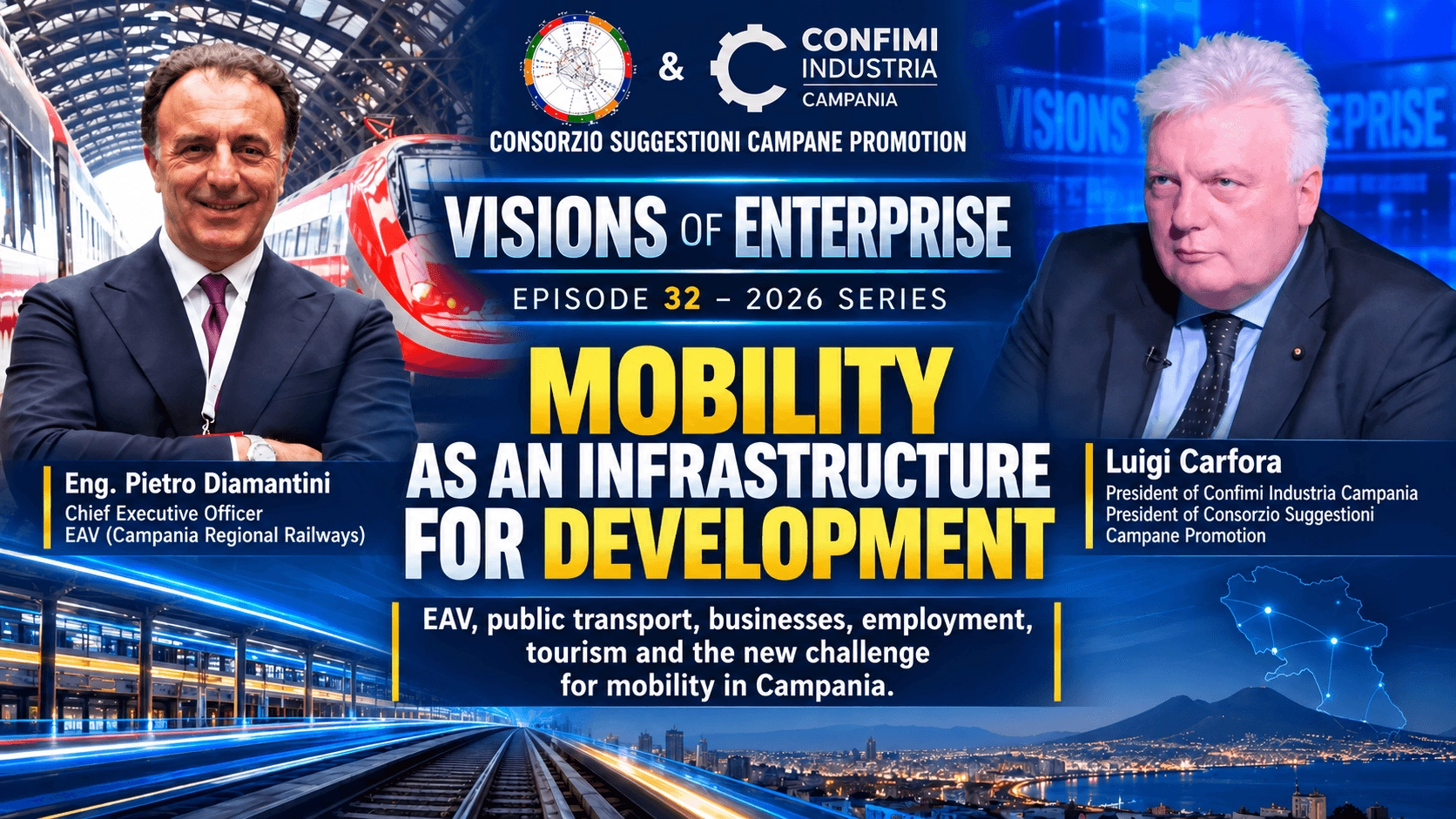
MOBILITY AS INFRASTRUCTURE FOR DEVELOPMENT
Sole Director of EAV – Ente Autonomo Volturno S.r.l.
🎥VISIONI DI IMPRESA – Episode 33 | 2026 Cycle
THE REFORM OF THE ARTISAN SECTOR AND THE FUTURE OF BUSINESSES
Craftsmanship, industry, SMEs, growth, competition and new rules: what balance is needed to foster the development of the productive system?
Topic:
Reform of the artisan sector, business evolution, competitiveness, access to credit, administrative simplification and development policies.
✦ Guiding thought
The future of craftsmanship cannot be separated from the future of business. The challenge is to recognise the value of work, expertise and the entrepreneur's creativity without allowing company size to become an obstacle to growth, innovation and competitiveness.
Introduction
The reform of the artisan sector represents one of the most significant steps in the process of updating policies aimed at small and medium-sized enterprises. In an economy where technology, work organisation and markets are redefining the traditional boundaries between productive activities, it is also necessary to rethink the rules that identify and support artisan businesses, recognising their skills and identity without limiting their opportunities for development.
Law No. 34 of 11 March 2026 has opened a new phase by delegating to the Government the task of reorganising the relevant regulatory framework. This process raises practical questions: the relationship between artisan status and business growth, the entrepreneur's role in the production process, the evolution of corporate structures, access to credit, administrative simplification and businesses' ability to compete in an increasingly complex environment.
Episode 33 of Visioni di Impresa, hosted and curated by Luigi Carfora, brings together business association representation, institutions and political perspectives, with particular attention to the impact of the reform on the productive system of Campania and Italy as a whole. The discussion aims to explore the conditions needed to reconcile the protection of the distinctive features of craftsmanship with business growth, innovation and competitiveness.
The objective is to move beyond the opposition between craftsmanship and industry and examine what kind of regulatory framework can recognise the specific characteristics of businesses while fostering innovation, investment, employment and growth. This reflection concerns not only one economic sector, but also the evolution of the business system and the conditions required to strengthen its competitiveness.
👤 Guests
Fabrizio Luongo
Secretary of Casartigiani Napoli and Vice President of the Naples Chamber of Commerce, Fabrizio Luongo has longstanding roots in the world of craftsmanship, including through a family and association tradition. His professional path provides a direct link to business needs, sector representation and the tools that support development.
Andrea Striano
Member of the National Department for Business and Productive Sectors of Fratelli d'Italia, Andrea Striano brings to the discussion the perspective of the national political debate on business policies, with particular attention to the reform of the artisan sector and measures aimed at growth and competitiveness across the productive system.
Francesco Iovino
Member of the Regional Council of Campania, Group Leader of "Riformisti e Moderati – Lista Cirielli – ECR" and President of the Special Transparency Commission. His institutional and council role offers a perspective on the functioning of regional administration, transparency, oversight of regional activities and the implementation of public policies.
Gaetano "Nino" Simeone
Member of the Regional Council of Campania, Group Leader of "Roberto Fico Presidente" and Vice President of the Special Transparency Commission, Gaetano "Nino" Simeone brings his institutional experience in infrastructure, mobility and territorial development—areas that affect the conditions for growth of the regional productive system.
Craftsmanship in the face of a new economic era
Italy's productive system is undergoing profound change. Technological innovation, process digitalisation, artificial intelligence, the energy transition, the reorganisation of supply chains and evolving markets are changing the way businesses produce, compete and build relationships with their local communities. In this context, reform of the artisan sector means more than updating a regulatory framework: it provides an opportunity to consider what business model the country intends to support and how to recognise the different ways in which work, economic initiative and entrepreneurial capability are expressed.
Craftsmanship is a longstanding component of Italy's economic fabric. It embodies technical expertise, knowledge passed down through generations, an understanding of materials, product customisation and the ability to respond to market needs. However, today's artisan business is not necessarily the traditional small workshop. It may use advanced technologies, organise complex processes, operate within international supply chains and invest in research, quality and sustainability. Its identity, therefore, cannot be understood solely in terms of employment size or organisational structure: the entrepreneur's actual contribution to the production process, specialisation, accumulated expertise and capacity to innovate must also be considered.
The central issue is to update the rules in a way that recognises the distinctive nature of craftsmanship while allowing businesses to evolve in response to market changes.
A reform that concerns business identity and growth
Law No. 34 of 11 March 2026, which establishes the annual law on small and medium-sized enterprises, delegates to the Government the task of reforming the regulatory framework for craftsmanship, whose principal reference is Law No. 443 of 8 August 1985. Article 15 provides for the adoption, within nine months of the law's entry into force, of one or more legislative decrees to rationalise, reorganise and update the legislation. The guiding principles include adapting the rules to changing market needs and technological developments, recognising the role of the artisan entrepreneur, supporting business growth, reviewing outdated corporate constraints and promoting the transfer of skills between generations.
The delegation, which entered into force on 7 April 2026, therefore sets 7 January 2027 as the deadline for the adoption of the implementing legislative decrees.
For decades, the 1985 legislation provided an essential framework for identifying artisan businesses, placing particular emphasis on the entrepreneur's personal work and direct involvement in the production process. Over time, however, the economic system has changed. Businesses have introduced machinery, automation, software, new organisational structures and collaborative models across increasingly complex supply chains. In this context, the distinction between craftsmanship and industry does not always immediately reflect the complexity of the activities performed or the expertise present within companies.
The challenge of the reform will therefore be to preserve a clear and recognisable definition of craftsmanship without freezing it into a production model that no longer reflects all contemporary business realities. An updated framework should provide criteria that are understandable, workable and consistent with the different development paths businesses may follow.
Company size must not become an obstacle to growth
One of the most significant issues concerns the relationship between artisan status and business growth. Under the current legislation, the requirements for recognition as an artisan business also include limits and conditions linked to the type of activity and the company's organisation. Expanding production, introducing new technologies, hiring employees or changing the organisational structure may therefore make it necessary to verify whether the prescribed requirements continue to be met.
Growth, however, is not a uniform process. Some businesses remain small because they operate in niche markets, focus on customisation or choose a lean organisational structure. Others, while originating from an artisan tradition, develop production capacity, expand their markets, invest in innovation and become suppliers within larger supply chains. In both cases, size alone is not enough to describe the quality, nature or competitiveness of the activity.
The review of qualification criteria will need to clarify which elements define the distinctive nature of craftsmanship and which constraints may be updated, taking into account different organisational structures and business development paths.
The issue also involves corporate structure. The choice of legal form and the allocation of management responsibilities should be able to respond to investment, continuity and organisational needs. The aim is to prevent outdated rules from creating disproportionate obstacles in relation to the actual nature of an activity, while preserving the requirements that justify recognition of its artisan character.
The entrepreneur's work and the value of expertise
The entrepreneur remains at the centre of this reflection. The artisan tradition is historically linked to direct knowledge of the production process, the ability to influence the product and personal responsibility for managing the business. This heritage does not necessarily mean carrying out every stage of production by hand. It may also be expressed through design, the choice of techniques, quality control, the organisation of skills and the ability to pass on professional knowledge.
Technological modernisation does not eliminate the value of the human contribution; it changes how that contribution is expressed. A workshop can integrate digital tools, automated systems and advanced technologies while retaining a strong foundation of expertise, creativity and entrepreneurial responsibility. The issue is not to oppose manual work to technology, but to understand how the entrepreneur's knowledge and capabilities continue to influence the production process even as tools and organisational structures change.
Another important element is the transfer of knowledge between generations. In many artisan businesses, the company's value consists not only of tangible assets, but also of expertise, customer relationships, market knowledge and operational capabilities developed over time. Generational continuity can offer an opportunity both to preserve and to renew this heritage when younger generations combine existing knowledge with new technologies, communication approaches and commercial strategies.
The reform is expected to take this dimension into account, so that recognition of craftsmanship does not remain limited to a snapshot of the business at a given moment, but also considers its capacity to evolve and transfer expertise.
Craftsmanship and industry: moving beyond opposition
The relationship between craftsmanship and industry is sometimes portrayed as a clear-cut distinction between small and large businesses, manual work and technological production, tradition and innovation. The reality is more complex. Contemporary supply chains are often based on collaboration between businesses of different sizes, specialisations and organisational structures. An artisan business may be an essential part of an industrial supply chain, just as an industrial company may retain within its operations skills, processes and production methods rooted in an artisan culture.
The distinction continues to serve a legal and administrative purpose, but it should not become a hierarchy of value. A business is not necessarily more competitive simply because it is larger, just as a small business is not automatically more authentic or more closely connected to its local community. Competitiveness depends on a range of factors: productivity, quality, innovation capacity, organisation, access to markets, human capital and the ability to invest.
For Italy, whose economy includes a significant presence of micro, small and medium-sized enterprises, the issue also concerns the ability to create pathways for growth. Size can affect access to credit, participation in tenders and contracts, the ability to finance investment and the capacity to enter international markets. However, a development policy cannot focus solely on encouraging businesses to increase in size. It must allow companies to choose organisational models suited to their markets and to collaborate through networks and supply chains.
Rules, employment and a proper understanding of costs
The reform also intersects with employment and the costs that affect business management. In this area, it is important to avoid oversimplification: employees' economic and regulatory conditions depend on the collective bargaining agreement actually applied, job classification, duties, supplementary agreements and the legislation in force. It is not correct to attribute a specific number of monthly salary payments, a uniform labour cost or an identical social security regime automatically to the entire artisan or industrial sector.
For businesses, the ability to plan recruitment requires transparency and predictability. The overall cost of labour includes remuneration, social security contributions, insurance and organisational components, which must be assessed in relation to the specific activity and the applicable collective agreement. Employees' personal taxation must also be distinguished from the costs borne by the employer: IRPEF is a personal income tax and does not vary simply according to whether the employer operates in the artisan or industrial sector.
An effective regulatory framework should encourage compliance, quality employment and productivity growth without fuelling opposition between business categories. The right balance cannot be achieved by treating the reduction of labour costs as an isolated objective, but by supporting investment, skills, organisational innovation and the conditions that enable companies to create value.
Credit, investment and business support
The ability to invest is one of the essential conditions for the continuity and development of artisan businesses. Purchasing machinery, modernising facilities, digitalising operations, improving energy efficiency, providing training and accessing new markets all require financial resources and planning capabilities that not every business can sustain independently.
It is important to distinguish between measures specifically dedicated to artisan businesses, instruments available to SMEs in general, and sector-specific or geographically targeted incentives. The SME Guarantee Fund, for example, is a public instrument that facilitates access to credit by providing a guarantee on financing; it is not a grant. The New Sabatini scheme supports SME investment in capital goods, subject to the requirements and conditions established by the applicable legislation. Other measures may concern specific supply chains, environmental objectives, innovation or geographical areas. Eligibility for each instrument therefore depends on the relevant legislation, the characteristics of the business and the project submitted.
In this context, the memorandum of understanding announced in June 2026 by SACE and Artigiancassa is intended to develop cooperation between insurance and financial solutions, export instruments and medium- to long-term financing, in support of growth, innovation and internationalisation.
The agreement points towards greater cooperation between financial instruments and business support services. Its practical effectiveness, however, will depend on operational arrangements, the ability to reach businesses and the extent to which it can respond to the specific needs of different territories.
Access to finance close to businesses remains a central issue. For many micro and small enterprises, access to credit depends not only on the availability of a financial measure, but also on the ability to understand its requirements, prepare a credible project and engage with financial intermediaries. An effective support system must therefore combine financial instruments with information, technical assistance and guidance, so that opportunities are not accessible only to companies that already have well-established administrative and project-management capabilities.
Administrative simplification and the relationship with local communities
Business competitiveness also depends on the quality of interactions with public administration. Clear procedures, predictable timelines, interoperable systems and up-to-date information can reduce organisational burdens and allow entrepreneurs to devote more resources to productive activities.
The updating of digital procedures for the Business Register forms part of the broader process of administrative modernisation. These are technical measures concerning how filings are prepared and submitted, and they should be distinguished from the substantive reform of the definition of an artisan business.
Administrative simplification and the review of legal requirements are separate areas, but both have an impact on businesses' day-to-day experience.
In Campania, Regional Law No. 11 of 14 October 2015 provided, with effect from 1 January 2016, for the abolition of the Artisan Business Register as a separate register. Businesses meeting the statutory requirements are instead recorded in the special section of the Business Register maintained by the competent Chamber of Commerce.
This framework makes it particularly important to ensure clear procedures, coordination between public bodies and accurate information for businesses starting up, modifying or expanding their activities.
Relations with local institutions therefore serve a practical purpose: identifying operational difficulties, encouraging dialogue between businesses and public administrations, and helping make development policies accessible to smaller enterprises as well. Proximity is not merely a geographical concept; it also means that institutions understand the conditions in which businesses operate and can translate regulatory objectives into procedures that work in practice.
The national dimension of the debate and the role of institutions
A reform that affects the definition and prospects of craftsmanship involves several levels of responsibility: the national legislature, the Government tasked with implementing the delegation, the Regions, the Chambers of Commerce and the organisations representing businesses. The debate must therefore connect companies' operational needs with the development of legislation and its implementation in local communities.
The participation of individuals with different institutional and political backgrounds makes it possible to examine the issue from complementary perspectives. National business policies, the role of business associations, regional responsibilities and local administrative experience all contribute to a framework in which the reform cannot be treated as an exclusively technical or sector-specific matter.
In this context, the participation of Andrea Striano, a member of the National Department for Business and Productive Sectors of Fratelli d'Italia, makes it possible to explore the perspective of the national political debate on policies for the productive system. His presence is also relevant in relation to the parliamentary process behind the Annual Law on Small and Medium-sized Enterprises, during which the delegation for the reform of the artisan sector was introduced. The involvement of representatives of Fratelli d'Italia in the legislative process, including the role played by the bill's rapporteur in the Chamber of Deputies, Fabio Pietrella, provides further context for understanding the political debate on the prospects for updating the regulatory framework.
The regional perspective is also represented by the experience of Francesco Iovino, Member of the Regional Council of Campania and President of the Special Transparency Commission, and that of Gaetano "Nino" Simeone, Regional Councillor and Group Leader of "Roberto Fico Presidente". Their experience and responsibilities relate to the functioning of institutions, administrative transparency, infrastructure and territorial policies. Their contribution makes it possible to place business issues within the broader relationship between economic development, the quality of public action and infrastructure conditions.
Casartigiani, representation and the continuity of expertise
Business associations are another essential element in understanding the evolution of craftsmanship. Representative organisations have historically served as a link between businesses, institutions and the processes through which economic policies are developed. Their experience is reflected in their ability to gather different needs, give a voice to productive enterprises and contribute to the creation of instruments that can support the sector's transformation.
The professional path of Fabrizio Luongo, Secretary of Casartigiani Napoli and Vice President of the Naples Chamber of Commerce, is rooted in the tradition of artisan representation and in the relationship between businesses and institutions. His connection with the association world, also grounded in family history, is a significant element in considering craftsmanship not merely as a regulatory category, but as a community of businesses, professional skills and relationships built over time.
Direct knowledge of business needs, relationships with local communities and experience in representation can help assess the practical consequences of regulatory decisions. From this perspective, access to finance close to businesses and the need for instruments that support companies at different stages of growth are also important. The discussion of Artigiancassa, guarantees and support measures is therefore linked to a broader question: how can investment and innovation opportunities be made genuinely accessible to artisan businesses?
Campania and the challenge of an integrated productive system
For Campania, the reform of the artisan sector is closely linked to the need to strengthen a productive system made up of businesses of different sizes, specialisations and organisational capabilities. Artisan activities contribute to the economic vitality of local communities, the preservation of expertise and the presence of specialised production. Industrial SMEs and service companies complement supply chains that can generate employment, investment and opportunities in domestic and international markets.
The issue is not to identify a single business model to favour, but to create the conditions for each enterprise to develop its potential, build partnerships and access appropriate support instruments. From this perspective, infrastructure, mobility, public services, training and administrative quality become components of industrial policy and territorial development.
For Campania, the dialogue between business representation, regional institutions and political perspectives makes it possible to connect national reform with the actual conditions in which companies operate. The quality of planning, administrative transparency, infrastructure, mobility and access to support instruments all contribute to shaping the region's development opportunities. The different experiences represented in the discussion therefore provide an opportunity to explore the relationship between national rules, business needs and territorial policies, without assuming that all perspectives necessarily coincide.
A reform to be assessed through its practical effects
The value of a reform cannot be measured solely by its stated objectives. Its impact on businesses will depend on the implementing criteria, the clarity of the provisions and how they are applied. For this reason, the updated framework for craftsmanship should also be assessed in terms of its ability to reduce uncertainty, make requirements easier to understand, support investment and ensure that growth does not lead to excessively complex administrative procedures.
A decisive factor will be coordination between national legislation and regional procedures, together with the availability of clear information for businesses, professionals and representative organisations. Another will be consistency between recognition of artisan status and access to support instruments. Measures should be understandable, accessible and tailored to projects, avoiding confusion between formal membership of a category and the actual capacity to carry out investment or generate development.
The reform therefore offers an opportunity to reconsider how the public system recognises and supports businesses. The expected outcome is not to eliminate the differences between craftsmanship and industry, but to establish a regulatory framework that recognises their distinctive characteristics without obstructing productive transformation.
✦Final reflection
Craftsmanship is a living part of the economy, not merely a reminder of Italy's productive traditions. Its ability to renew itself depends on the opportunity to integrate expertise, technology, organisation and access to markets while preserving the value of work and entrepreneurial responsibility.
The reform invites us to consider artisan businesses in the context of their evolution, recognising the value of expertise and entrepreneurial responsibility even as production processes and organisational structures change. The challenge will be to translate this vision into clear rules that support transformation without undermining the recognisability of artisan status.
For businesses, the fundamental issue remains the ability to operate in an environment where investing, innovating, hiring and developing do not become sources of regulatory uncertainty. For institutions and business associations, the responsibility is to contribute to a practical debate capable of translating productive needs into effective instruments and procedures.
Ultimately, the future of craftsmanship is connected to the future of Italian business as a whole: its ability to preserve expertise and identity, generate new opportunities and play a leading role in an economy undergoing continuous transformation.
🎙EPISODE 33 – 2026 CYCLE
🎙Hosted and curated by
Luigi Carfora
President of Confimi Industria Campania
President of Consorzio Suggestioni Campane Promotion.
👤Guests
Fabrizio Luongo, Secretary of Casartigiani Napoli and Vice President of the Naples Chamber of Commerce.
Andrea Striano, Member of the National Department for Business and Productive Sectors of Fratelli d'Italia.
Francesco Iovino, Member of the Regional Council of Campania, Group Leader of "Riformisti e Moderati – Lista Cirielli – ECR" and President of the Special Transparency Commission.
Gaetano "Nino" Simeone, Member of the Regional Council of Campania, Group Leader of "Roberto Fico Presidente" and Vice President of the Special Transparency Commission.
🎬 Direction
Pino Fontana
📍 Recorded at
Per Sempre News Studios
📺 Broadcast on
Per Sempre News
https://psntv.it/visionidimpresa
📱 Available on our social media channels
Facebook · LinkedIn · Instagram · TikTok · YouTube
🌐 All episodes of Visioni di Impresa are available on the official portal of Consorzio Suggestioni Campane Promotion and Confimi Industria Campania.
Visioni di Impresa – Official Portal:
https://www.suggestioni.eu/en/en-enterprise-visions/
✦Editorial responsibility notice
This article is an editorial feature produced as part of the Visioni di Impresa programme, with the aim of providing information and analysis on the economic, regulatory and institutional issues addressed in the episode.
The general assessments and considerations contained in the text represent an editorial analysis of the subject and should not be understood as statements attributed to the guests, unless expressly reported and verified. Any opinions expressed by participants during the programme remain attributable to their respective authors and do not necessarily represent the official position of the institutions, organisations or political parties with which they are affiliated.
Regulatory and informational references are provided for background and discussion purposes and do not constitute legal, tax or financial advice. For the application of specific provisions and the verification of requirements in individual business situations, readers should refer to the relevant institutional sources and, where appropriate, consult their appointed professional advisers.