


Enterprise Visions
Dialogues on real enterprise, between work, technology, territory and future
Enterprise Visions is a series of episodes and meetings dedicated to telling the story of enterprise without slogans and without simplifications.
The new 2026 cycle is born in ideal continuity with the path developed last year on workplace safety.
A thread that does not break, but expands.
Because if safety is the minimum condition to work,
sustainability is the necessary condition to endure.
And speaking about enterprise today means addressing all its dimensions, without reductions and without shortcuts.
In this new season, broadcast on Per Sempre News, we approach the world of enterprise with a broader, more concrete and necessary perspective, starting from a theme that is often invoked yet frequently misunderstood: business sustainability.
The Format
Enterprise Visions is a structured and continuous space for dialogue.
A place of analysis that starts from real enterprise — the one that produces, invests, hires and endures — in order to read ongoing transformations and understand their consequences.
If enterprise is the place where work is generated,
if work is the foundation of social cohesion,
then every change that affects enterprise directly affects society.
For this reason, the format rejects both ideology and uncritical enthusiasm, choosing a rational, critical and responsible approach.
The topics of the 2026 cycle
The new cycle of Enterprise Visions broadens its perspective and addresses, in an integrated way:
– economic, environmental and social sustainability
– sustainability of work and people
– business organization and competitiveness
– artificial intelligence and automation
– humanoids and advanced technologies applied to production processes
– social and employment impact of new technologies
– transformation of skills and of the labour market
– legal, regulatory and governance aspects of technological innovation
The objective is not to celebrate innovation, nor to oppose it by principle, but to understand its effects on enterprises, workers and society, and to identify the conditions under which innovation can become a shared and lasting driver of development.
Alongside manufacturing and advanced services, the cycle also focuses on a strategic sector for the territory:
– tourism and the hospitality supply chain
– hotel companies
– tourism enterprises
– travel agencies and related services
Because tourism is also enterprise.
And in tourism too, innovation, work and sustainability must remain in balance.
Episodes 2026
The 2026 cycle of Enterprise Visions develops as a progressive journey that moves across enterprise, technology, tourism, law and institutions, keeping responsibility at its core and continuing the dialogue already introduced in the opening sections of the format.
How to Browse the Episodes
The Visioni di Impresa archive is designed to be simple and intuitive to explore.
At the beginning of this page you will find the complete list of episodes from the 2026 series. Simply click on the cover image or the title of the episode you wish to watch to be taken directly to its dedicated page, where you can view the full video, read the editorial summary and discover the featured guests.
As the archive continues to grow, episodes will be distributed across multiple pages to ensure faster navigation and a better browsing experience. The main index will always remain up to date, allowing you to access every episode with a single click, regardless of the page on which it is published.
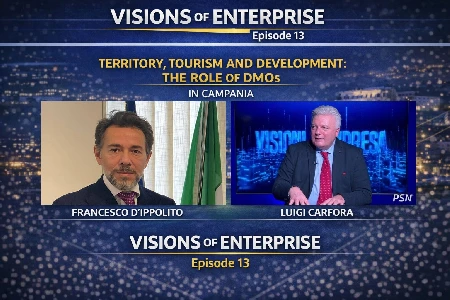
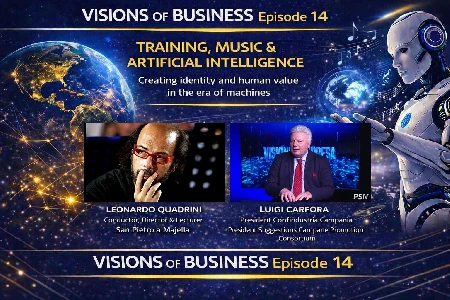
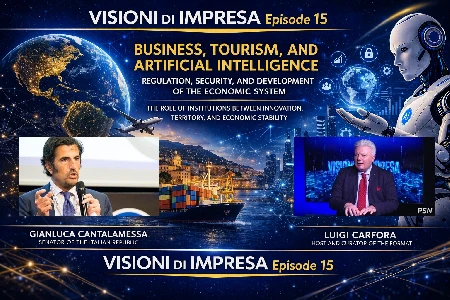
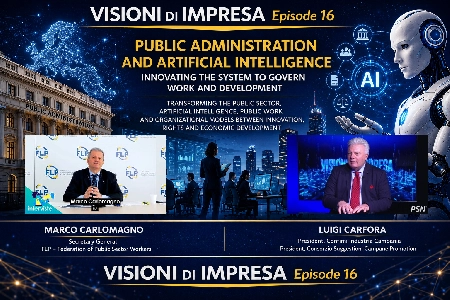
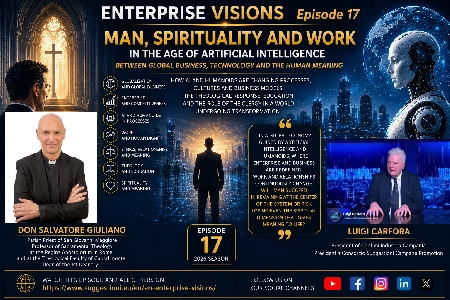
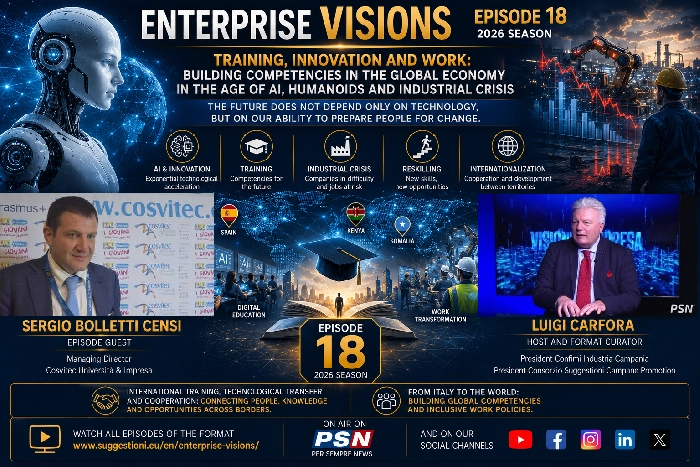
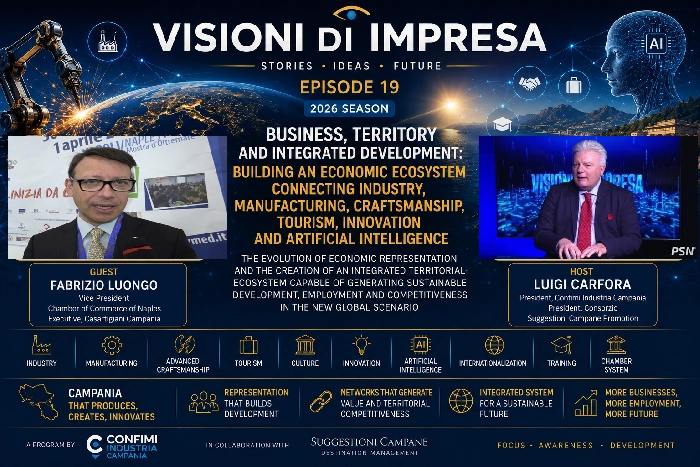
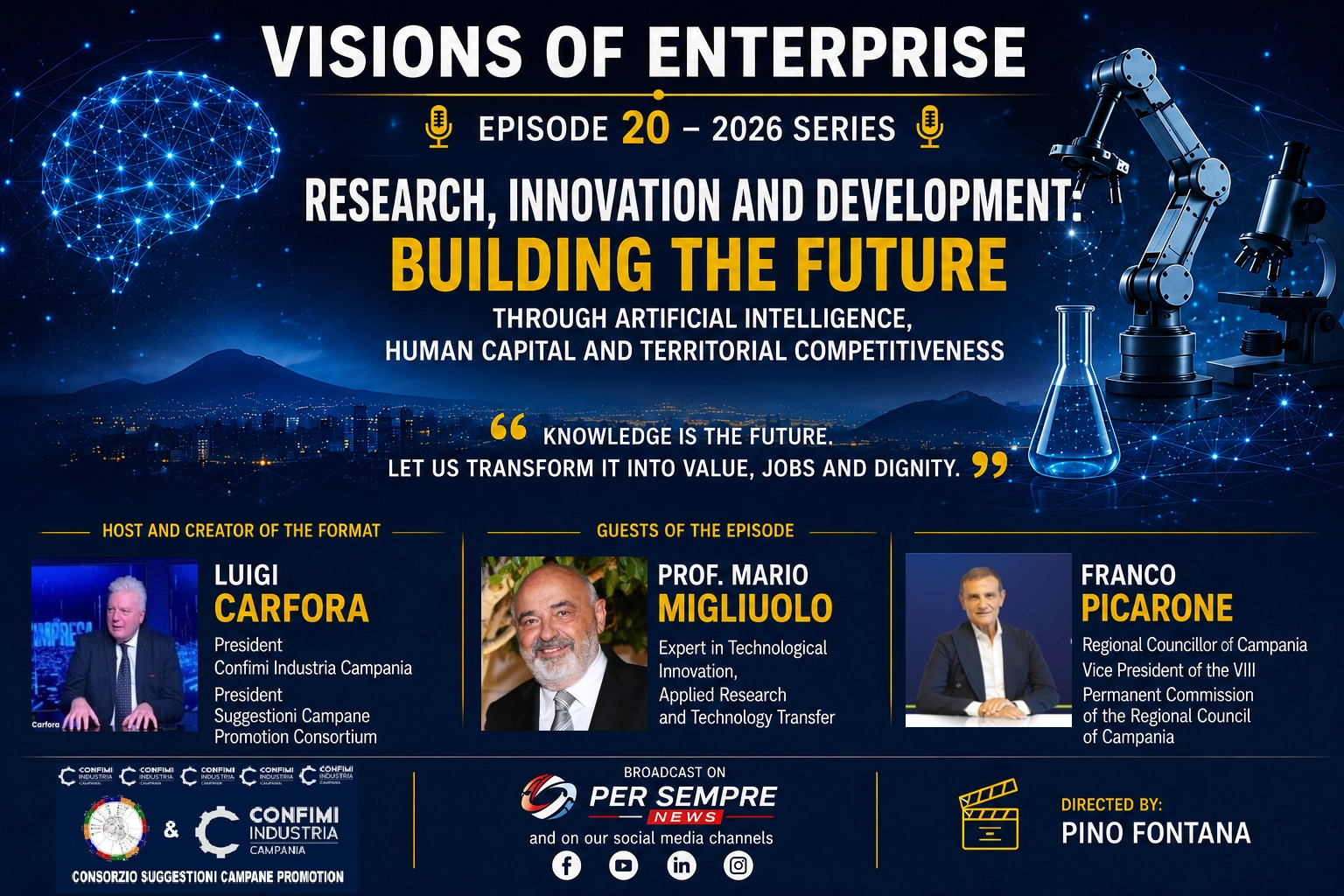
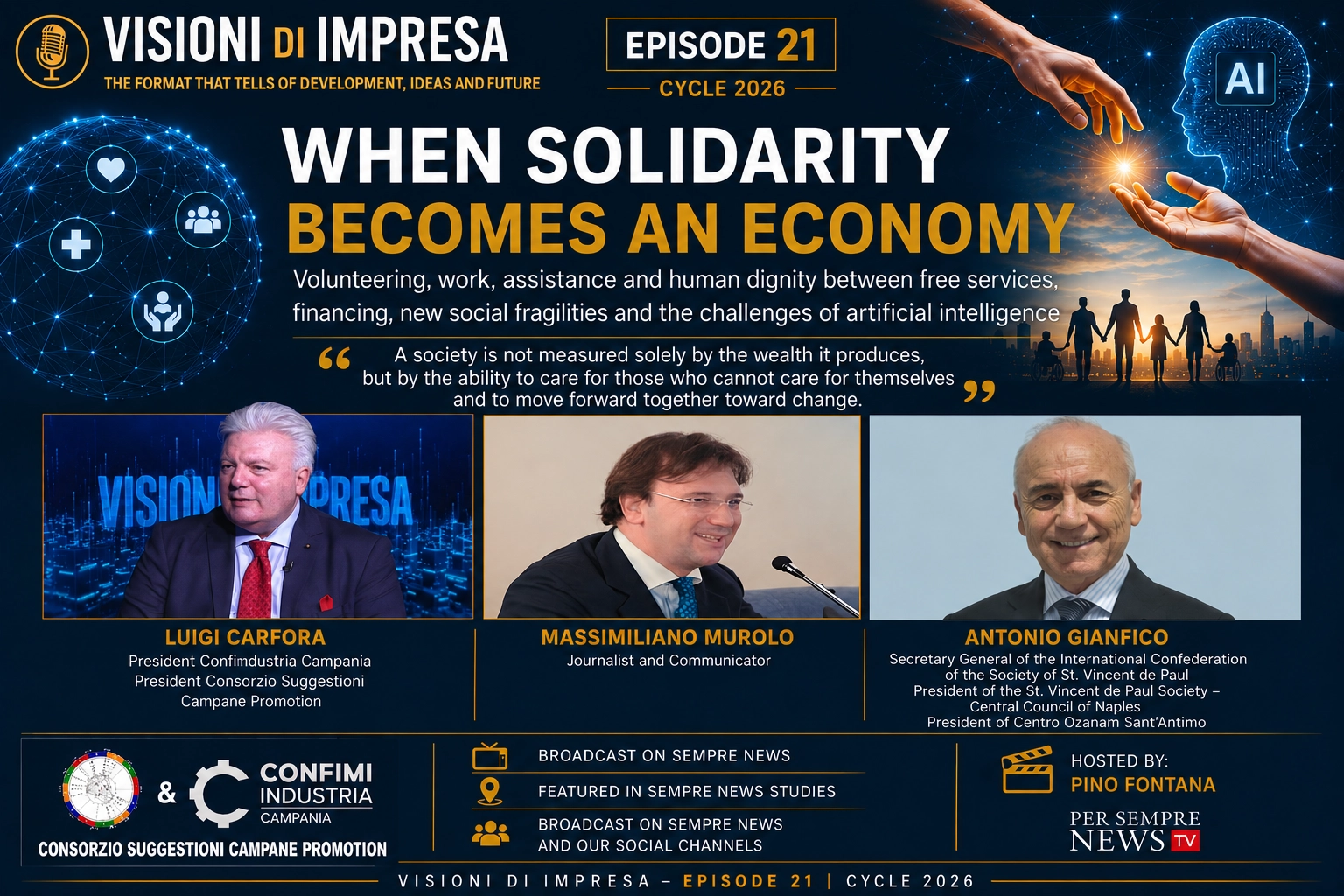
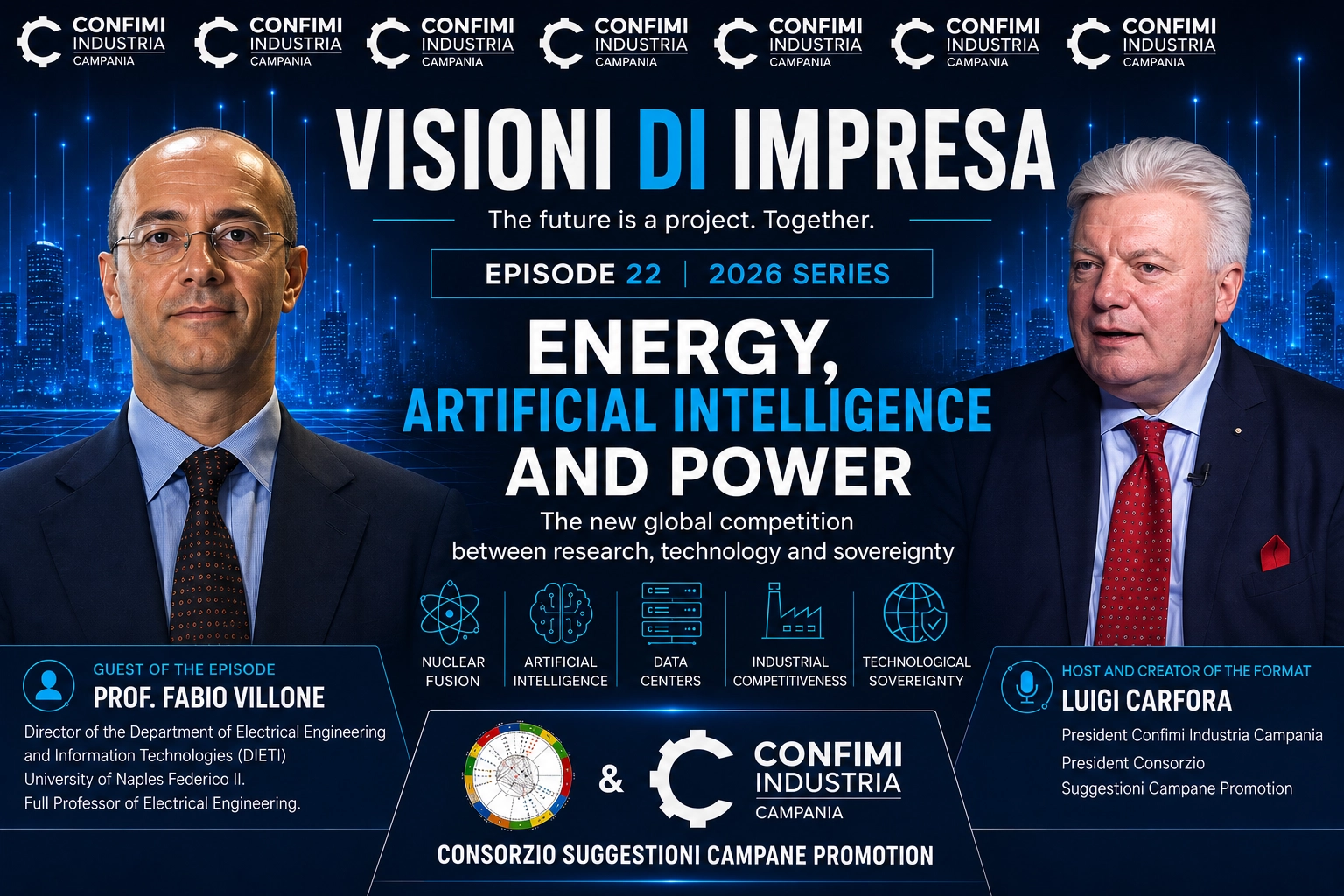
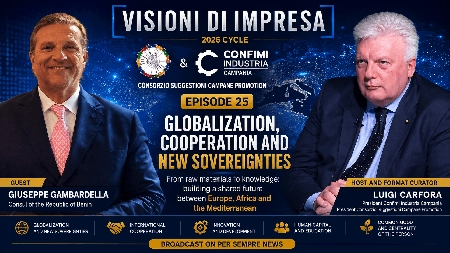
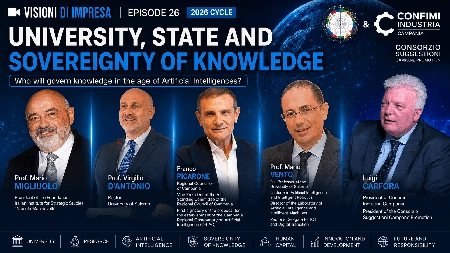
Mario Migliuolo • Franco Picarone
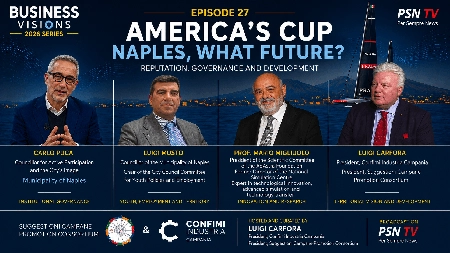
The Future of Cities
Mario Migliuolo
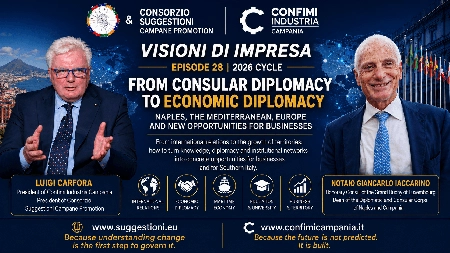
to Economic Diplomacy
Honorary Consul of Luxembourg
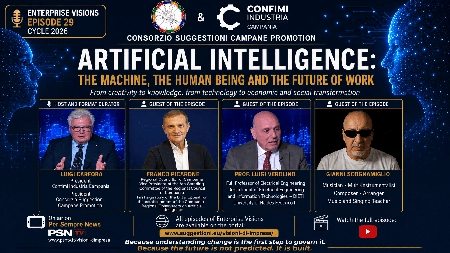
THE MACHINE, HUMANS AND THE FUTURE OF WORK
Gianni Scognamiglio
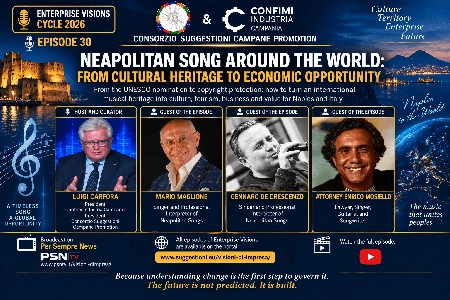
From Cultural Heritage to Economic Opportunity
Enrico Mosiello
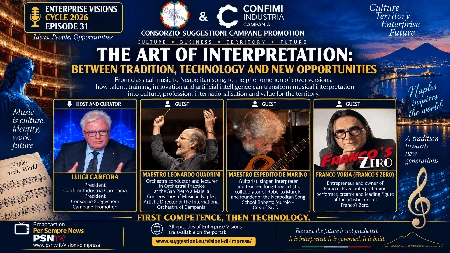
Between Tradition, Technology and New Opportunities
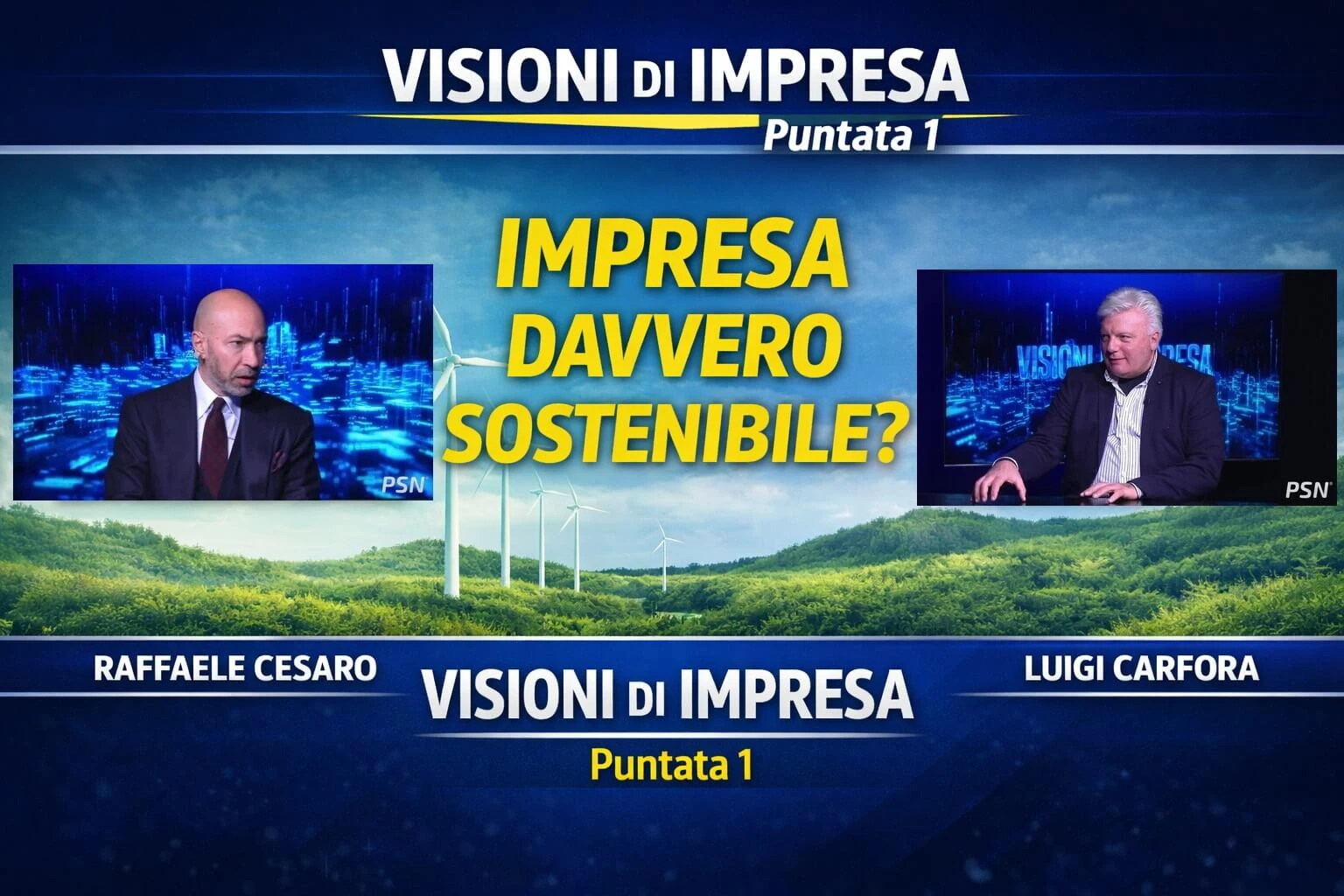
Enterprise Visions – Episode 1 | 2026
Theme: Business sustainability beyond slogans
✦ Guiding Thought of the Episode
"If safety is the starting point and sustainability the measure of long-term value, then the enterprise becomes the place where the future of work and of the territory is built."
The opening episode of the 2026 cycle explored the concept of corporate sustainability in its essential components, placing at the center the economic, social, and productive responsibility of today's enterprises. The conversation developed a concrete reflection on the real meaning of sustainability, moving beyond simplified narratives and bringing attention back to the real enterprise — the one that produces, invests, hires, and creates long-term value.
During the episode, the main pillars of sustainability were examined:
economic sustainability
environmental sustainability
social sustainability
sustainability of work and people
It emerged that a company can be considered truly sustainable only when it remains competitive in the market, respects the environment, values people, and builds long-term development prospects for the territory. Sustainability was therefore interpreted not as a statement of principle, but as a concrete responsibility shared by entrepreneurs, workers, and local communities.
The discussion also opened a direct reflection on some of the main challenges facing the production system and the labor market:
minimum wage
shortage of qualified professionals
difficulties companies face in retaining trained talent
risk of exclusion from the labor market for those without specific skills, especially in relation to the evolution of new technologies
The episode laid the foundations for the entire 2026 cycle, introducing a path that connects sustainability, innovation, and responsibility as inseparable elements of the future of enterprise.
✦ Reflection from the episode
"Sustainability cannot be a slogan: it exists only when an enterprise remains capable of creating work, value, and future over time."
🎙 EPISODE 1 – 2026 SERIES.
Hosted and led by:
Luigi Carfora, President of Confimi Industria Campania and President of Suggestioni Campane Promotion.
Episode guest:
Raffaele Cesaro, Engineer, Regional Head for Industrial Regeneration and Environmental Compliance at Confimi Industria Campania.
Broadcast on Per Sempre News
Recorded at the Per Sempre News studios
Enterprise Visions – Episode 2 | 2026
Theme: Humanoids and artificial intelligence: enterprise, work, responsibility
✦ Guiding Thought of the Episode
"If technology accelerates change and enterprise determines its direction, then it is human responsibility that decides which future we choose to build."
The second episode of Visioni di Impresa addresses one of the defining questions of our time: not whether artificial intelligence will change work, but how enterprises and human beings will choose to govern its evolution.
If sustainability defines the ability of a production system to endure over time, technological innovation determines its trajectory. From this premise emerges a discussion that does not seek science‑fiction scenarios, but examines transformations already underway, in which humanoids, advanced automation, and artificial intelligence are redefining roles, skills, and responsibilities.
Innovation is observed not as an abstract promise, but as a real process that affects corporate organization, professional competencies, and the future of work. In this context, responsibility and vision become essential to ensure that technological speed does not surpass humanity's ability to guide it.
Topics explored in the episode:
humanoids and advanced automation in production processes
transformation of skills and emergence of new professional roles
integration between human work and intelligent systems
ethical and social responsibility in the adoption of AI
balance between technological innovation and the sustainability of work
The episode also highlights the role of human education in the age of artificial intelligence. If AI accelerates data processing, it becomes even more necessary to strengthen critical thinking, emotional intelligence, and cultural autonomy in people. In this perspective, the humanities regain relevance as tools capable of supporting technological growth without excluding humans from decision‑making processes.
During the conversation, engineer Fabio Giovine also shared an exceptional preview: in the coming months, his company Ingenia Srl will introduce to the market humanoids equipped with operational functions and advanced artificial intelligence — systems developed and commercialized directly by the company. He announced his intention to bring one of these humanoids into the Visioni di Impresa studios, opening a public and direct dialogue on the technological, ethical, and social implications of coexistence between humans and intelligent systems.
If innovation is inevitable, the way it is guided becomes central. The goal is not to oppose humans and machines, but to build an equilibrium in which technology remains a tool serving development, work, and freedom.
The episode thus offers a concrete reflection on the future of enterprise, showing how the speed of innovation requires vision, awareness, and responsibility.
✦ Reflection from the episode
"Artificial intelligence can accelerate every process, but only a mind free in its thinking can prevent the future from being decided without humanity."
🎙 EPISODE 2 – 2026 CYCLE
Hosted and curated by:
Luigi Carfora, President of Confimi Industria Campania and President of the Consorzio Suggestioni Campane Promotion.
Episode guest:
Fabio Giovine, Engineer, Founder and CEO of Ingenia Srl.
Broadcast on Per Sempre News
Recorded at the Per Sempre News studios.

ENTERPRISE VISIONS – Episode 3 | 2026
Theme: Enterprise, ESG and Legal Responsibility – When Sustainability Becomes an Economic Condition
✦ Guiding Thought of the Episode
"If sustainability defines the longevity of an enterprise and technology accelerates its transformation, then law becomes the necessary tool to govern its economic and social consequences."
After the opening episode dedicated to corporate sustainability beyond slogans, and the subsequent discussion on humanoids, artificial intelligence, and responsibility in the evolution of work, the cycle now addresses the most concrete knot of change: the shift from sustainability as a declared value to sustainability as an economic and financial condition.
If the first episode examined sustainability as a productive and social responsibility of the enterprise, and the second highlighted the speed with which technological innovation is redefining processes and skills, the third episode introduces an inevitable question: what happens when sustainability and innovation become operational parameters of the banking system and of European financial instruments?
The dialogue with lawyer Nicola Todisco explores ESG not only as a cultural evolution of enterprise, but as a new economic architecture destined to influence access to credit, risk assessment, and business competitiveness.
Topics addressed:
ESG as a financial parameter within the European regulatory framework
access to credit and sustainability ratings: the risk of market exclusion
economic and legal challenges for SMEs in the adaptation process
corporate responsibility toward workers, territories, and communities
balancing sustainability, technological innovation, and entrepreneurial freedom
If the second episode showed how humanoids and artificial intelligence are transforming work and production organization, this discussion shifts to the economic consequences of that transformation: when sustainability enters financial logic, it is no longer merely a strategic choice, but a condition that can determine whether an enterprise remains within or is excluded from the system.
A central concern clearly emerges: many companies, especially small and medium‑sized enterprises, risk facing a double constraint — rapidly adapting to new European parameters or encountering difficulties in accessing financing and investment. In this scenario, law takes on an operational role, tasked with ensuring balance between social responsibility and economic sustainability.
The episode thus offers a concrete reflection on the relationship between enterprise, regulation, and economic freedom, showing how sustainability, technology, and legal responsibility have become inseparable dimensions of a single process of transformation.
✦ Regulatory update following the recording
The episode was recorded before the recent decisions of the European Union regarding ESG regulation.
After the recording, the Council of the European Union approved a significant revision of the regulatory framework on corporate sustainability, introducing a series of simplification measures and greater proportionality in the application of the obligations set out in the Corporate Sustainability Reporting Directive (CSRD) and the Corporate Sustainability Due Diligence Directive (CSDDD).
The new European approach has reduced the automatic extension of reporting obligations to smaller companies, limiting the number of businesses directly involved and mitigating the risk of administrative burdens being transferred along the entire production chain.
This intervention aims to rebalance the relationship between sustainability and economic competitiveness, especially in production systems with a strong presence of small and medium-sized enterprises, such as those in Italy and the Campania region.
However, this regulatory update does not alter the overall framework analyzed in the episode.
ESG standards remain increasingly relevant:
in the relationship between companies and the banking system
in European funding programs
in public tenders and access criteria for funds
in the industrial policies of large companies and international supply chains.
In other words, the regulatory revision introduces greater proportional balance, but it does not change the strategic direction taken by the European Union, in which sustainability, corporate responsibility, and transparency will continue to be key factors in the economic and financial assessment of companies.
For this reason, the discussion developed in the episode with attorney Nicola Todisco remains fully relevant: understanding how companies can integrate these parameters without compromising competitiveness and economic freedom continues to be one of the central challenges for the European production system.
✦ Reflection from the episode
"Sustainability is no longer just an ethical value: it is becoming an economic condition without which many enterprises risk being pushed out of the system."
🎙 EPISODE 3 – 2026 CYCLE
Hosted and curated by:
Luigi Carfora, President of Confimi Industria Campania and President of the Consorzio Suggestioni Campane Promotion.
Episode guest:
Avv. Nicola Todisco
Broadcast on Per Sempre News
Recorded at the Per Sempre News studios.
VISIONI DI IMPRESA – Episode 4 | 2026
Southern Italy, Work and Infrastructure – from Wage Gaps to Political Responsibility
✦ Guiding Thought of the Episode
"Income influences a choice. Structural conditions determine a decision."
In the fourth episode of the Visioni di Impresa series, we addressed a topic that can no longer be examined superficially: economic migration from Southern Italy, a phenomenon closely linked to regional competitiveness, infrastructure gaps, and labour market disparities.
Guest of the episode was Prof. Severino Nappi, former Regional Councillor for Labour and Training, university professor and labour lawyer, with direct experience in regional and national institutional dynamics.
The discussion began with a clear point: people migrate also because of salary differences. The wage gap between Northern and Southern Italy is a real and undeniable fact.
But if the issue were exclusively about wages, increasing income would be enough to stop departures. Data clearly show this is not the case.
Migration is not merely an economic choice. It is a systemic choice.
A family evaluates simultaneously:
– quality and stability of employment – efficiency of public transport – travel times to economic hubs – quality of healthcare services – schools and universities – digital infrastructure – administrative certainty – local services
Salary is a variable. But it is a variable within an ecosystem.
If income rises but the system remains fragile, migration continues.
And here lies the central logical point that emerged during the episode:
People seek stability and perspective.
Stability depends on income and on structural conditions.
If structural conditions are inadequate, income alone is not enough.
The problem of Southern Italy, therefore, is not only about wages. It is structural.
✦ What Is Needed to Make a Territory Competitive
To make an area of the South comparable to a city in Northern Italy or Northern Europe, wage adjustments are not enough. Equivalent structural conditions are required.
In particular:
🚆 Public Transport and Integrated Mobility – direct rail connections between towns and regional capitals – continuous public transport throughout the day – integration between local, regional and national networks – fast connections to industrial hubs – efficient access to ports, airports and logistics nodes
Without reliable mobility, there is no dynamic labour market.
🏥 Local Healthcare – adequate hospital facilities – community-based healthcare – guaranteed access times to medical services – services for the elderly and families
Healthcare quality is a decisive factor in family choices.
🌐 Digital Infrastructure – widespread ultra‑broadband – stable coverage in inland areas – effective digitalisation of public administration
Today, competitiveness also means connectivity.
🏫 Integrated Education System – universities connected to the production system – operational ITS (Higher Technical Institutes) – continuous training – structured school‑to‑work pathways
University mobility must not turn into permanent migration.
🏗 Industrial Infrastructure – equipped production areas – intermodality – connection to European corridors – administrative simplification with guaranteed timelines
A business invests where conditions are predictable.
✦ From Diagnosis to Commitment
At this point, the discussion could not stop at analysis.
If migration is driven by structural deficiencies, the response cannot be episodic.
We therefore asked Prof. Nappi a clear political question:
"If we acknowledge that Southern Italy loses economic strength because it lacks structural conditions for competitiveness, which concrete initiatives are you willing to promote and support, at regional and national level, to address these deficiencies?"
Not a generic statement, but a commitment on:
– strengthening local public transport – integrated infrastructure planning – coordination between Region and National Government – targeted use of national and European resources – industrial policies linked to infrastructure – real administrative simplification
During the episode, the willingness emerged to bring these issues to the competent decision‑making levels, not as a territorial claim, but as a matter of national competitiveness.
Because Southern Italy is not a local issue. It is a structural factor of the Italian economy.
✦ The Economic Mechanism
When a family leaves:
– income moves – consumption moves – pensions move – internal demand moves
Less population means less market. Less market means fewer investments. Fewer investments mean less work.
The "brain drain" is the visible part. Underneath lies the drain of the economy.
✦ Reflection from the episode
"You cannot retain a generation with a bonus. You retain it by building a system where income and infrastructure coexist. Income is the immediate lever. Infrastructure is the structural foundation. Without a foundation, no lever is sufficient."
🎙 EPISODE 4 – 2026 SERIES
Hosted and curated by:
Luigi Carfora, President of Confimi Industria Campania and President of Consorzio Suggestioni Campane Promotion.
Guest of the episode:
Prof. Severino Nappi, former Regional Councillor for Labour and Training, university professor and labour lawyer.
Broadcast on Per Sempre News
Recorded in the studios of Per Sempre News.
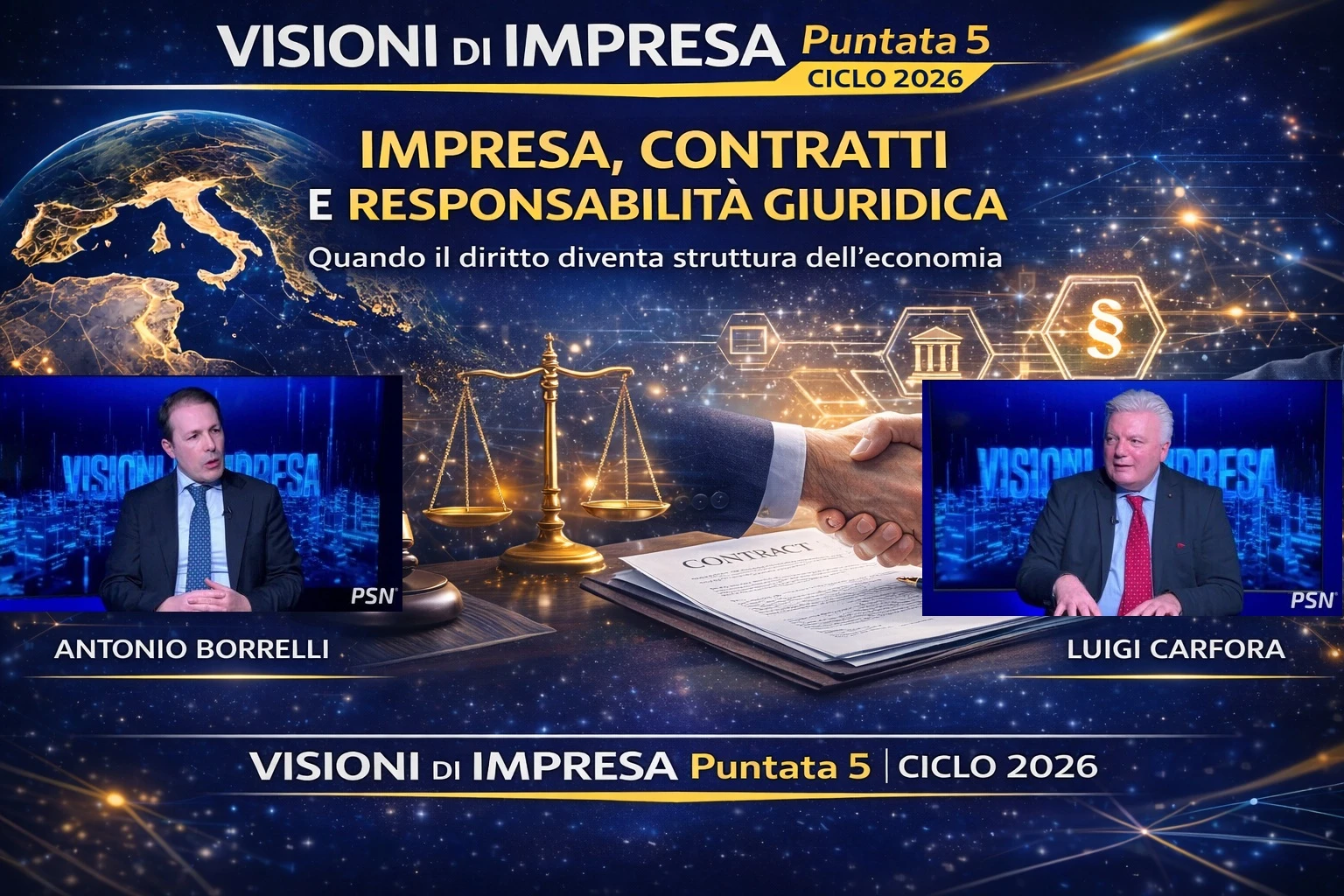
ENTERPRISE VISIONS – Episode 5 | 2026
Topic: Enterprise, contracts and legal responsibility – when law becomes the structure of the economy
✦ Guiding thought of the episode
"If an enterprise lives through economic relationships and every economic relationship is governed by a contract, then law is not only an instrument of protection: it becomes the architecture that sustains the entire productive system."
After addressing in the previous episodes the themes of corporate sustainability, the impact of technological transformation and the growing role of European economic and financial parameters, the cycle Enterprise Visions moves into the field where these transformations become operational: the legal dimension of business activity.
Every economic activity develops through a complex network of contractual relationships.
Commercial agreements, relations with suppliers and clients, supply chain arrangements, banking and financial contracts, and the management of employment relationships all represent the legal framework within which companies operate.
Episode five therefore explores the theme of business contracting as the legal infrastructure of the economy, analysing how the quality of rules and contracts directly affects the stability of companies, the prevention of conflicts and the competitiveness of the productive system.
The dialogue with Attorney Antonio Borrelli, member of the Bar Association of Torre Annunziata (Naples), focuses precisely on this issue: understanding how law can accompany the evolution of enterprises within an increasingly complex economic environment.
Among the different areas of contractual relationships, one dimension appears particularly significant: the management of employment relations.
According to analyses of the Italian civil justice system, labour disputes represent a significant share of the overall litigation before Italian courts, with a considerable number of cases concerning dismissals, wage differences, professional classifications and the application of collective labour agreements.
This highlights how employment contracts are not merely an administrative matter for companies, but one of the principal areas in which legal conflicts between enterprises and workers emerge.
Among the topics addressed in the episode:
– business contracting and the legal structure of economic activity
– commercial contracts, supply chain relations and contractual liability
– relations between enterprises, the banking system and financial instruments
– employment contracts and the main causes of judicial disputes
– balance between workers' protection and the economic sustainability of companies
– prevention of litigation and stability of productive relationships
During the dialogue a broader reflection emerges.
In an economic environment characterised by technological transformation, new European regulations and growing market complexity, law is not only the instrument that intervenes when conflicts have already arisen.
Rather, it becomes a tool of prevention and balance, capable of accompanying business activity and reducing the risks generated by increasingly complex economic relationships.
The quality of contractual structures therefore concerns not only the legal dimension of enterprises, but directly affects their economic stability, the management of employment relations and the overall competitiveness of the productive system.
From this perspective another important consideration emerges: in the modern business economy law does not merely represent the place where disputes are resolved, but becomes one of the instruments through which economic and organisational risk is managed.
Every contract defines rights, obligations and responsibilities between the parties and contributes to determining the level of stability or uncertainty within economic relationships.
When contractual structures are weak or imprecise, the risk is not only legal: it becomes economic, financial and organisational risk.
A legal dispute may affect company costs, the continuity of commercial relationships, corporate reputation and, in more complex cases, even access to credit and investment capacity.
For this reason, in modern business management, law is no longer only a defensive instrument but becomes an integral part of corporate strategy, capable of supporting economic development while reducing uncertainty in productive relationships.
In this context an increasingly important role is also played by the Organisation, Management and Control Model introduced by Italian Legislative Decree No. 231 of 2001, one of the most advanced instruments through which law directly enters the organisational structure of companies.
Legislative Decree 231/2001 introduced into the Italian legal system the administrative liability of companies for certain crimes committed by directors, managers or employees in the interest or for the benefit of the organisation.
To prevent these risks, companies may adopt an Organisational Model 231, a structured system of rules, protocols and internal controls aimed at identifying and preventing so-called predicate offences.
The model develops according to a structured logic that can be interpreted as a pyramidal architecture of risk management.
At the base lies the analysis of business processes and the mapping of sensitive activities through risk assessment.
At the intermediate level operational protocols, internal procedures and control systems are defined.
At the top of the system operates the Supervisory Body (Organismo di Vigilanza), an independent entity responsible for monitoring the effectiveness and updating of the model.
From this perspective law does not intervene only when conflict has already arisen, but becomes part of the organisational structure of the company as a tool for preventing legal and economic risk.
Business contracts, commercial relationships, supplier management and employment contracts therefore become elements of a single system of responsibility and control aimed at ensuring legality, economic stability and sustainability of business activities.
Another important aspect concerns the increasingly close relationship between corporate governance models, European sustainability parameters and legal risk-prevention instruments.
ESG criteria, which are increasingly present in financial systems, European investment programmes and supply-chain relationships, require companies to strengthen their ability to identify, assess and manage risks connected to their economic, organisational and social activities.
At the same time, the Italian legal system already provides instruments that partly anticipate this logic of organisational responsibility. Among these, particular relevance is given to the Organisation, Management and Control Model established by Legislative Decree 231/2001.
The 231 model introduces a preventive structure based on risk mapping, the identification of sensitive activities and the definition of organisational and control protocols aimed at preventing unlawful conduct within the company.
It represents a substantially pyramidal structure for the identification and management of risks, enabling companies to monitor their decision-making, organisational and operational processes.
In this sense, sustainability, governance and risk prevention should not be considered separate areas, but rather parts of a single framework in which enterprise, law and economics converge in the responsible management of development and competitiveness.
✦ Reflection from the episode
"When law intervenes only after conflict arises, the cost is always higher.
The real function of law in the modern economy is to prevent conflict before it turns into litigation."
The real function of law in the modern economy is to prevent conflict before it turns into litigation."
🎙 EPISODE 5 – 2026 CYCLE
Hosted and curated by:
Luigi Carfora, President of Confimi Industria Campania and President of the Consorzio Suggestioni Campane Promotion.
Guest of the episode:
Avv. Antonio Borrelli, Torre Annunziata Law Court, Naples.
Broadcast on Per Sempre News
Recorded at the Per Sempre News studios.
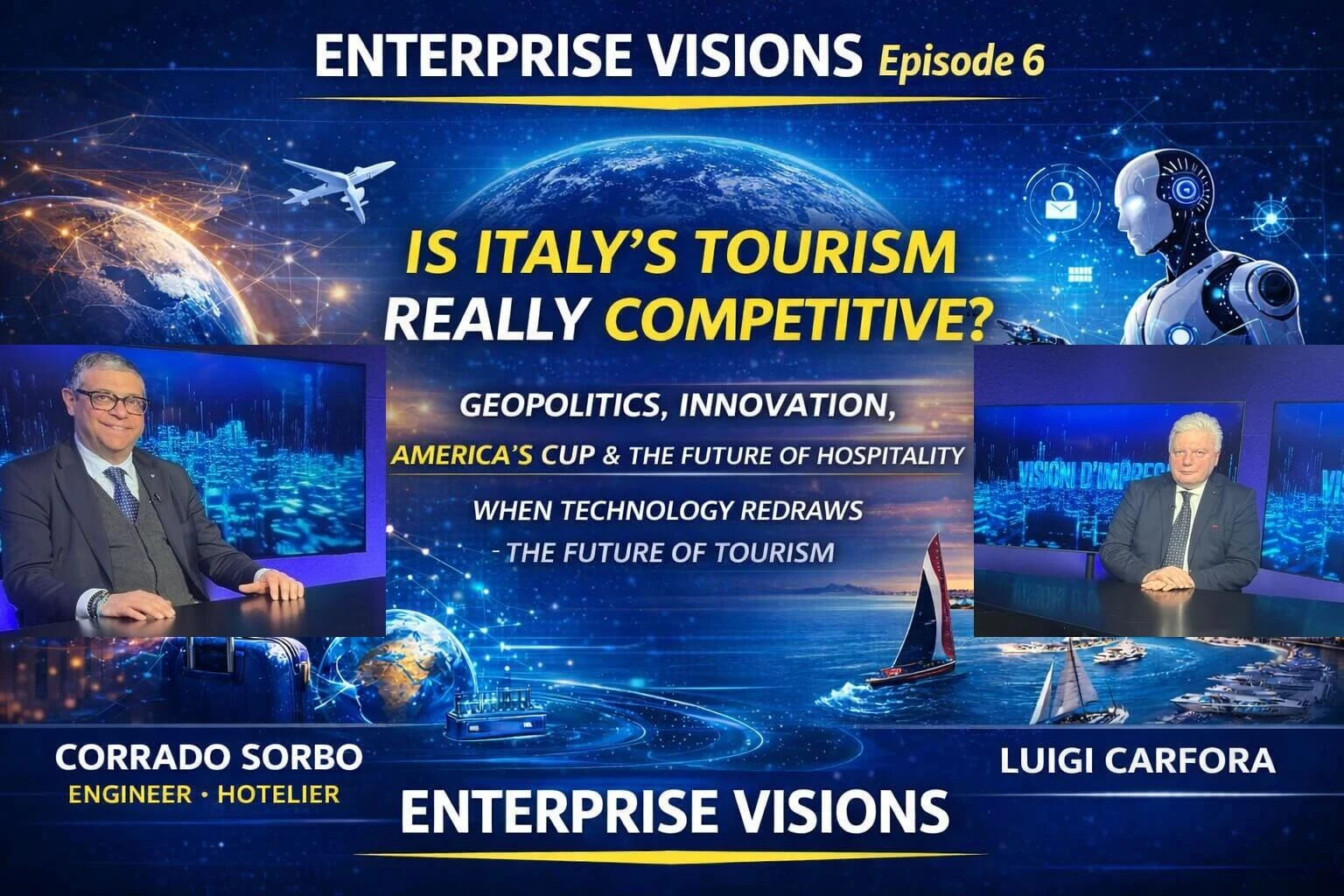
ENTERPRISE VISIONS – Episode 6 | 2026
Theme: Tourism, innovation and territorial responsibility – when geopolitics and technology redefine the economy of territories
✦ Guiding thought of the episode
"If innovation and sustainability are transforming industrial enterprise, then tourism must also evolve in order to remain competitive.
But in today's world it is no longer only the market that determines tourism flows: geopolitics, international security and the technological revolution are redesigning the geography of the tourism economy."
After addressing in previous episodes corporate sustainability, technological transformation, new European economic rules, territorial infrastructures and business contractual frameworks, the Enterprise Visions series brings the discussion into one of the most representative sectors of the Italian economy: tourism.
Tourism is not only hospitality or territorial promotion.
It is enterprise, employment, infrastructural investment and the economic organization of territories.
The economic weight of tourism in the Italian economy
Before even being a cultural or territorial sector, tourism today represents one of the structural pillars of the Italian economy.
According to the most recent estimates elaborated by ENIT and economic analysis organizations in the sector, the tourism industry as a whole generates approximately €237.4 billion in economic value, representing a very significant share of the national Gross Domestic Product.
Tourism is therefore not simply another economic sector: it is one of the main economic infrastructures of the country, capable of supporting entire production chains that go far beyond hospitality.
Among these:
– transport and mobility
– restaurants
– commerce and local craftsmanship
– cultural services
– territorial economy
– agri-food supply chains and typical products.
Economic projections also indicate significant growth of the sector in the medium term, with a possible expansion up to €280 billion by 2035, confirming tourism as one of the most solid drivers of the Italian economy.
Employment and social impact of tourism
Tourism also has a direct impact on employment.
Today the sector supports approximately 13.2% of national employment, including both direct work in tourism structures and the economic spillover generated in related activities.
According to sector development estimates, within the next decade tourism could support nearly 16% of total employment, further strengthening its role as an economic and social infrastructure of the country.
This data demonstrates how tourism is not only a matter of territorial attractiveness, but also a strategic lever for employment and for the economic stability of entire local communities.
The decisive role of international tourism
Another central element is represented by the spending of foreign visitors, which constitutes one of the main sources of wealth entering the national economic system.
In 2025, international tourists' spending in Italy exceeded €60 billion, contributing significantly to the country's economic balance.
Development strategies for the sector now aim to further strengthen this international dimension, with the objective of reaching approximately €80 billion in foreign tourist expenditure within the next ten years.
This data highlights how tourism also represents a form of indirect export of value, capable of bringing wealth into the territory without relocating production and employment.
Recent dynamics and new development trajectories
The most recent data show a constant growth in international arrivals, with an increase in airport arrivals of about +7% in the first quarter of 2026.
Italy thus continues to consolidate its position among the leading global tourist destinations, thanks to a combination of factors that uniquely characterize the national tourism system:
– widespread cultural and artistic heritage
– territorial and landscape diversity
– quality of the food and wine offering
– growth in average tourist spending
– progressive investments in sustainability and digital innovation.
In this context, tourism confirms itself as a complex and strategic economic sector, in which technological innovation, business organization and territorial enhancement must evolve together in order to maintain the international competitiveness of the Italian tourism system.
Connection with the theme of the episode
In light of these data, the discussion with Eng. Corrado Sorbo fits into a broader reflection on the future of tourism.
If tourism represents such a relevant component of the national economy, its evolution does not concern only the hospitality sector, but affects the entire economic and employment balance of the country.
For this reason, the episode also explores the relationship between tourism and technological transformation, questioning how digital innovation, artificial intelligence and new organizational models may redefine the way business is conducted in the hospitality sector.
Today, however, global tourism is increasingly influenced not only by market dynamics, but also by geopolitical and strategic factors.
The tensions and conflict involving Iran and the Middle Eastern area are already producing significant effects on international tourism.
According to analyses by Tourism Economics, in 2026 tourist arrivals to the Middle East could decrease between 11% and 27%, with an estimated loss between $34 and $56 billion in tourism spending.
The conflict is also generating flight cancellations, reduced bookings and a general shift in demand toward destinations perceived as more stable and secure, with cascading effects on the entire global tourism market.
In this scenario, a new variable emerges that is becoming increasingly decisive:
tourism is becoming progressively sensitive to international geopolitical balances, which influence flows, strategies and development prospects.
The paradox of Italian tourism
At the same time, Italian domestic tourism in recent years has shown growing competitive difficulties.
In many cases, for Italian families traveling abroad has become economically more convenient than taking holidays in Italy, with a strong preference for destinations in the eastern Mediterranean, North Africa and the Middle East.
Destinations such as:
• Egypt
• Turkey
• United Arab Emirates
• Red Sea resorts
• some islands of the eastern Mediterranean
have for years been chosen precisely because of their more competitive price-quality ratio compared to domestic Italian tourism.
The current geopolitical scenario, however, profoundly changes this dynamic.
If the areas involved in the conflict become less attractive or perceived as less secure, part of those international tourist flows could redistribute toward the western Mediterranean and southern Europe, with possible positive effects also for Italy.
But this advantage is not automatic.
To transform a phase of international instability into an economic opportunity, the territory must be organized as a competitive tourism production system.
And this is where the role of enterprises comes into play.
Tourism as a territorial industry
The dialogue with Eng. Corrado Sorbo, a hotel entrepreneur, addresses tourism not as a simple economic sector, but as a complex territorial industry, in which several elements converge:
• hospitality enterprises
• tourism services
• mobility infrastructures
• technological innovation
• management of cultural and environmental heritage.
For those operating in the hospitality sector, the central issue is not only the outbound tourism of Italians, but above all the ability to attract inbound international tourism, which represents the real economic lever for territorial development.
In this context several key questions become central:
– competitiveness of Italian tourism enterprises
– quality and innovation of hospitality services
– infrastructure and accessibility of territories
– integration between tourism, culture, mobility and services.
The strategic opportunity: the America's Cup
Within this scenario one of the most important international events for Naples and the Campania region is emerging: the America's Cup 2027.
The most prestigious sailing competition in the world represents much more than a sporting event.
It is a major international territorial positioning event, capable of generating significant economic effects in terms of:
• tourism flows
• international visibility
• infrastructural investments
• development of tourism and hospitality services.
For territories with a strong tourism vocation, events of this level represent rare opportunities to strengthen their positioning in the global tourism market.
The technological revolution in tourism: AI and humanoids
However, the transformation of tourism does not depend only on geopolitics and major events.
A new technological revolution is also emerging, directly affecting the hospitality sector.
Academic research shows that artificial intelligence and robotics are increasingly entering the tourism and hotel industry, assuming operational roles in various service functions.
Today there are already concrete examples of robots used as:
• receptionists and digital concierges
• assistants for automatic check-in
• robots for luggage delivery and room services
• informational assistants for guests
• support in restaurant activities and table service.
Studies on the future of hospitality indicate that these technologies may also perform advanced functions such as:
• multilingual digital tourist guides
• personalized visitor assistance systems
• automated management of hotel services
• predictive analysis of tourist flows and customer preferences.
This is therefore not a simple technological evolution, but a structural transformation of the service model in tourism.
The challenge for the sector will be to find the right balance between:
• technological innovation
• quality of the human experience
• cultural identity of hospitality.
A new balance between technology and territory
The episode therefore highlights a fundamental transition:
the tourism of the future will not be determined only by the beauty of places, but by the ability of territories to integrate:
• technological innovation
• quality of hospitality
• entrepreneurial organization
• efficient infrastructures
• cultural and territorial identity.
In this balance between tradition and innovation lies the competitiveness of Italian tourism in the world.
✦ Episode Reflection
"Tourism is not only hospitality.
It is enterprise, employment, economic organization and territorial development.
In a world where geopolitics, technology and security influence tourism flows, the territories that will succeed will be those capable of innovating without losing their identity and transforming their beauty into real economy."
🎙 EPISODE 6 – 2026 CYCLE
Hosted and curated by:
Luigi Carfora, President of Confimi Industria Campania and President of the Consorzio Suggestioni Campane Promotion.
Episode guest:
Corrado Sorbo, Engineer.
Broadcast on Per Sempre News
Recorded at the Per Sempre News studios.
ENTERPRISE VISIONS – Episode 7 | 2026
Topic: Artificial Intelligence and Law – Legal Responsibility in the Age of Intelligent Machines
✦ Guiding Thought of the Episode
"If artificial intelligence changes the way we work, produce and make decisions, then the law must change the way we protect freedom, responsibility and democracy.
When technology moves faster than regulation, the risk is not only economic: it is institutional."
After addressing the sustainability of real enterprises in the opening episode, analyzing the impact of humanoids and artificial intelligence on the organization of work, examining the economic and financial implications of ESG standards, and reflecting on the relationship between territorial development, infrastructure and economic competitiveness, the Visioni di Impresa cycle enters one of the most decisive questions of contemporary transformation: the relationship between technological innovation and law.
Artificial intelligence is no longer merely a technological frontier. It has become a regulated matter capable of directly affecting businesses, employment, public services and fundamental rights.
For this reason, the discussion in the seventh episode moves from the technical and productive dimension to the legal and institutional one, addressing an increasingly central question: who actually governs artificial intelligence?
In recent years the European Union has launched one of the most ambitious attempts at global technology regulation through the European Artificial Intelligence Regulation – the AI Act, which introduces a regulatory framework based on the risk classification of AI systems.
The regulation distinguishes between:
– prohibited practices
– high-risk artificial intelligence systems
– limited-risk systems
– minimal-risk systems
– general-purpose artificial intelligence models.
The AI Act entered into force on 1 August 2024 and provides for a progressive implementation of its provisions between 2025 and 2027, with most operational obligations applying from 2 August 2026, while some specific provisions concerning high-risk systems will extend until 2027.
The European approach aims to guarantee transparency, security and protection of fundamental rights, preventing technological development from escaping the control of democratic institutions.
The implementation of the regulation is progressive and will unfold through several operational phases leading to the full application of the rules by 2027.
At the same time, Italy has also launched its own regulatory path with the approval of a national law on artificial intelligence, establishing general principles for the protection of fundamental rights and defining a national governance framework for the implementation of European rules.
In this context, the law is not only called upon to regulate a technology.
It is called upon to define the relationship between technological power, economic freedom and social responsibility.
The dialogue with Professor Salvatore Aceto di Capriglia, Full Professor of Comparative Private Law at the University of Naples "Parthenope", Attorney admitted to practice before the Court of Cassation, and recipient of the Honorary Robe awarded by the Naples Bar Association, a distinction granted for having ranked first in the national bar examination, addresses precisely this crucial issue.
After listening in previous episodes to the perspectives of businesses, technical experts and economic operators, the discussion now focuses on the role of law in governing technologies that are increasingly autonomous and often developed and controlled by large global private platforms capable of influencing economic, social and democratic balances.
Among the central topics of the discussion:
– the growing gap between the speed of technological innovation and the pace of legislation
– legal responsibility of intelligent systems and automated decisions
– the relationship between private ownership of technological platforms and the sovereignty of states
– the impact of artificial intelligence on labour and industrial relations
– the need to guarantee transparency and protection of rights in automated decision-making systems
– the role of institutions in governing technological transformation.
The episode also addresses a particularly relevant issue for the productive system: the governance and responsibility obligations that companies will progressively have to assume when using artificial intelligence systems.
Companies will be required, among other things, to:
– map artificial intelligence systems used in business processes
– integrate AI into risk management and compliance systems
– prepare technical documentation and transparency procedures
– update contracts and relationships with technology suppliers
– ensure information and protection for workers in automated decision-making processes.
In this scenario, law assumes a strategic function: not only limiting the risks of innovation, but defining the conditions under which technology can develop without compromising economic freedom, individual rights and democratic principles.
The seventh episode therefore further broadens the perspective of the cycle, showing how business, technology and law can no longer be considered separate fields, but rather parts of a single transformation process affecting the entire organization of contemporary society.
What Actually Changes for Businesses
The European regulatory framework on artificial intelligence is not merely a declaration of principles. With the progressive entry into force of the European Artificial Intelligence Regulation (AI Act) and the adoption of national coordination legislation, the use of artificial intelligence definitively enters the sphere of legal responsibility for companies.
This means that artificial intelligence can no longer be considered a simple experimental technological tool, but must be managed as an organizational, operational and risk factor within the company.
For businesses, this implies a series of concrete actions that will become increasingly relevant in the coming years.
Among the most important:
1. Mapping AI systems used within the company
Companies will need to identify and classify artificial intelligence systems used in their production, organizational or decision-making processes, distinguishing between minimal-risk, limited-risk and high-risk tools.
2. Internal governance of artificial intelligence
AI will need to be integrated into corporate management systems by identifying internal responsibilities and linking AI usage with risk management, privacy and security frameworks.
3. Impact assessment of AI systems
For certain applications, a preventive assessment will be required to evaluate the effects that AI systems may have on fundamental rights, employment, safety and access to services.
4. Transparency and traceability of automated decisions
Companies must ensure that decision-making processes supported by algorithms are understandable, verifiable and properly documented, avoiding opaque automated systems that affect workers, clients or citizens.
5. Updating contracts with technology providers
The use of AI platforms and solutions will require revising contractual relationships with providers and developers, introducing clauses on responsibility, security, audit mechanisms and data governance.
6. Training and information
Companies will be required to train executives, technical managers and employees on the use of artificial intelligence within organizational processes, particularly when it affects the organization of work.
In this scenario, regulatory compliance does not represent only an obligation: it can also become a factor of competitiveness.
Companies that begin today to organize themselves structurally around artificial intelligence will not only reduce future legal risks but will also gain a stronger ability to integrate technological innovation with organizational responsibility.
✦ Reflection of the Episode
"When innovation surpasses the ability of institutions to understand it, the risk is not only technological but democratic: rules must return to guiding change without stopping it."
🎙 EPISODE 7 – 2026 SERIES
Hosted and curated by:
Luigi Carfora, President of Confimi Industria Campania and President of the Consorzio Suggestioni Campane Promotion.
Guest of the episode:
Salvatore Aceto di Capriglia, Full Professor of Comparative Private Law at the University of Naples "Parthenope", Attorney admitted to practice before the Court of Cassation, and recipient of the Honorary Robe awarded by the Naples Bar Association, a distinction granted for having ranked first in the national bar examination.
Broadcast on Per Sempre News
Recorded in the studios of Per Sempre News.
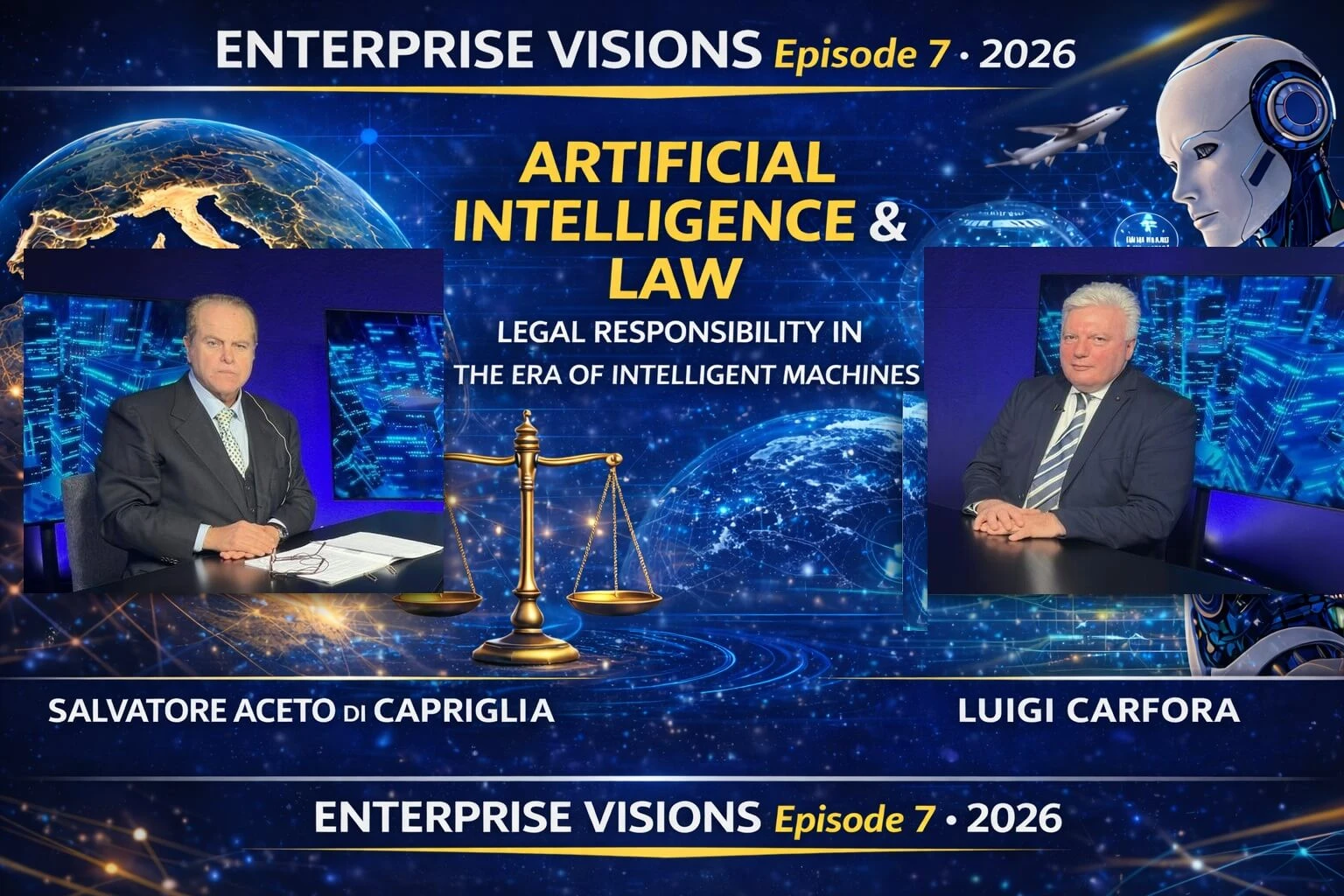
ENTERPRISE VISIONS – Episode 8 | 2026
Theme: Global business, economic dumping and technological transformation – the challenge between advanced economies and emerging countries
✦ Guiding Thought of the Episode
"If globalization connects markets but not living conditions, then competition risks becoming imbalance.
And if technology is redefining production worldwide, the real challenge will be building development without creating new forms of economic exclusion."
After exploring the sustainability of modern enterprises, the impact of artificial intelligence on the organization of work, the economic implications of ESG criteria and the relationship between infrastructure, territorial development and competitiveness, the Enterprise Visions series now broadens its perspective to a truly global dimension.
The eighth episode addresses one of the most complex issues of contemporary economic transformation:
the relationship between advanced economies and emerging countries within an increasingly interconnected global market.
Globalization has progressively integrated production chains, financial systems and international trade. Yet, despite this growing interconnection, major structural imbalances persist between different regions of the world, particularly in terms of:
– cost of living
– purchasing power of currencies
– wage levels and labour costs
– access to technology and innovation
– production standards and regulatory systems.
These differences generate a phenomenon that is frequently debated within international economic policy: economic dumping.
In a globalized market, countries with significantly lower labour costs and different regulatory frameworks can produce goods at prices that are extremely difficult for companies operating in advanced economies to match.
For countries such as Italy — characterized by a highly specialized manufacturing system and by small and medium-sized enterprises — this imbalance can create significant competitive pressure on domestic industries.
At the same time, however, emerging economies are experiencing their own profound transformations.
Many of these countries still rely heavily on agricultural production, primary sectors and labour-intensive supply chains, while gradually entering global markets and attempting to build their own industrial development paths.
The dialogue of this episode explores precisely this complex relationship:
how globalization reshapes the balance between industrial economies and developing regions.
A global economy marked by structural differences
One of the key elements addressed in the episode concerns the structural disparity between different economic systems.
In many emerging countries:
– the cost of living is significantly lower
– labour markets operate under different regulatory frameworks
– production costs are drastically reduced
– access to technological innovation remains uneven.
This combination can create situations in which companies located in advanced economies struggle to compete under equal conditions.
At the same time, however, the issue cannot be reduced simply to competition between countries.
It also raises broader questions about:
– fairness in global trade
– the social sustainability of economic models
– the responsibility of advanced economies toward emerging regions
– the long-term balance of international economic systems.
Technology as a new global turning point
Another central topic of the episode concerns the technological transformation currently reshaping production systems worldwide.
Artificial intelligence, advanced automation and humanoid robotics are rapidly transforming industrial organization.
These technologies have the potential to profoundly change the global economic balance.
On the one hand, automation may reduce the advantage of low-cost labour, potentially bringing part of industrial production back to technologically advanced countries.
On the other hand, if access to technology remains concentrated in a limited number of regions, the technological revolution could further widen the gap between advanced and developing economies.
In this scenario, innovation becomes not only a factor of competitiveness but also a geopolitical and social issue.
The debate therefore raises crucial questions:
– how will artificial intelligence transform global production chains?
– will automation reduce the relevance of low labour costs?
– could advanced technologies generate new forms of economic imbalance?
– what role can international cooperation play in reducing global inequalities?
Enterprise, development and global responsibility
The discussion also touches on a broader reflection about the role of enterprises in the global economy.
In an increasingly interconnected world, economic development cannot be considered solely from a national perspective.
The relationship between advanced economies and emerging countries also involves:
– international development policies
– fair trade systems
– technology transfer
– support for sustainable economic growth in developing regions.
The challenge, therefore, is not simply defending competitiveness within advanced economies.
It is also about building a global economic system capable of combining development, innovation and social balance.
A dialogue between law, economics and international cooperation
The conversation with Avv. Gerry Danesi, honorary consul of Nicaragua and a professional with international institutional experience, introduces a perspective that connects economic dynamics with diplomatic and geopolitical considerations.
The episode examines how different regions of the world approach economic development and how global governance structures — including international organizations and multilateral cooperation frameworks — attempt to address inequalities in trade and production systems.
Through this dialogue, the episode reflects on how global economic systems may evolve in the coming decades, especially in light of the technological transformation that is already reshaping industries worldwide.
✦ Episode Reflection
"Globalization has connected markets, but not yet balanced opportunities.
The real challenge for the future will be ensuring that innovation and development reduce global inequalities instead of amplifying them."
Guest Profile – Additional Information
In addition to his role as Honorary Consul of Nicaragua, Attorney Gerry Danesi holds several prominent positions in the academic, legal, and international institutional fields.
He serves as a lecturer at the Department of Social and Humanistic Studies (DiSSU) at the Catholic Popular University "Eustachio Montemurro – Teresa D'Ippolito" and is a lawyer admitted to practice before the Italian Supreme Court (Cassation Court).
He is also Head of Euro-Mediterranean Studies for Cooperation and Peace, with responsibility for the Third Sector and International Cooperation.
At the institutional level, he serves as National Head for Justice and Social Policies at FE.N.CO., President of the Commission on Justice and Legal Affairs of the Diplomatic Consular Corps of Naples – Campania, and Vice Coordinator of the Commission on Consular Law and Diplomatic Relations at the Naples Bar Association.
A profile that combines legal expertise, international vision, and a strong commitment to cooperation between economic and institutional systems.
🎙 EPISODE 8 – 2026 SERIES
Hosted and curated by:
Luigi Carfora
President of Confimi Industria Campania
President of the Consorzio Suggestioni Campane Promotion
Guest of the episode:
Avv. Gerry Danesi
Honorary Consul of the Republic of Nicaragua
Broadcast on Per Sempre News
Recorded in the studios of Per Sempre News
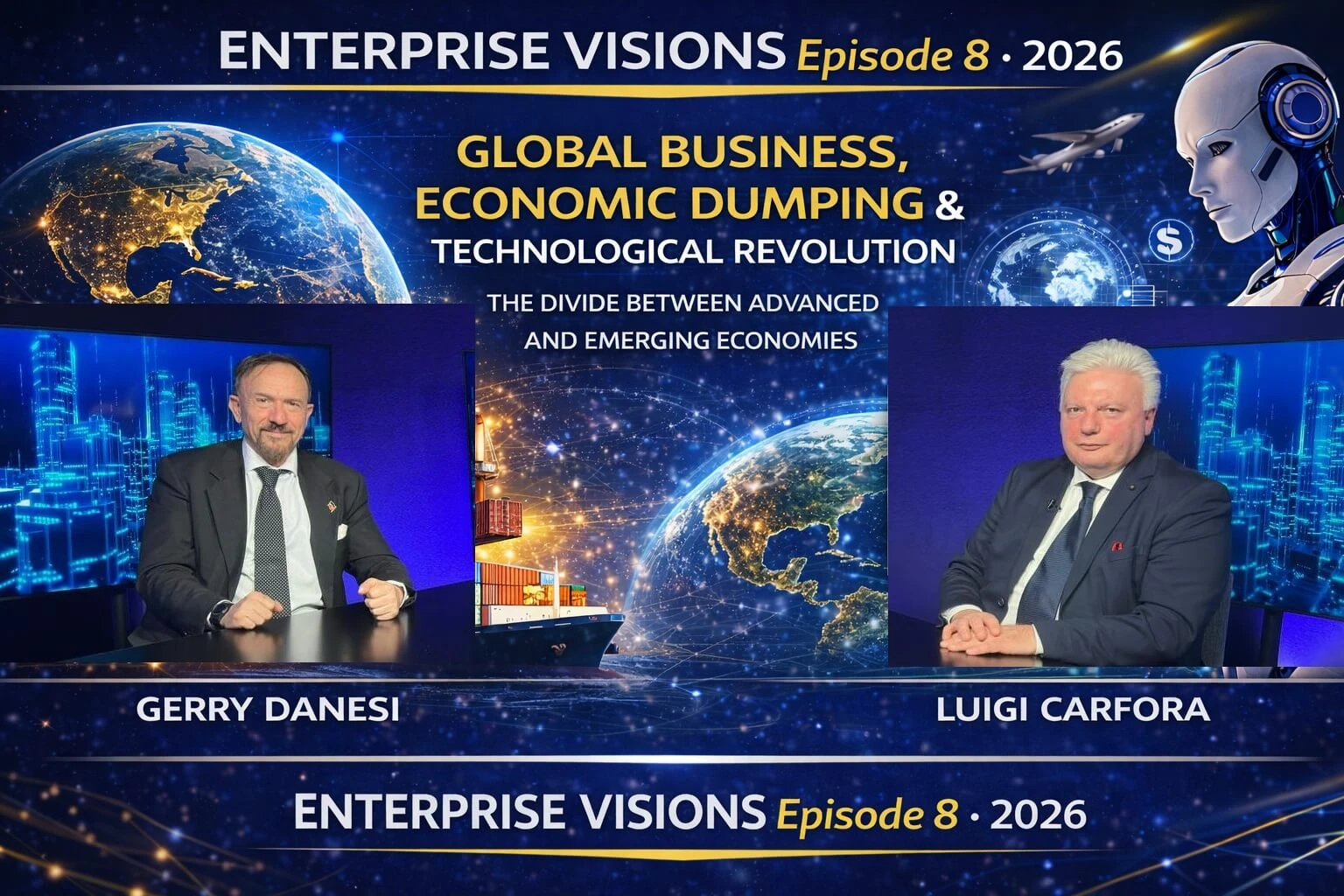
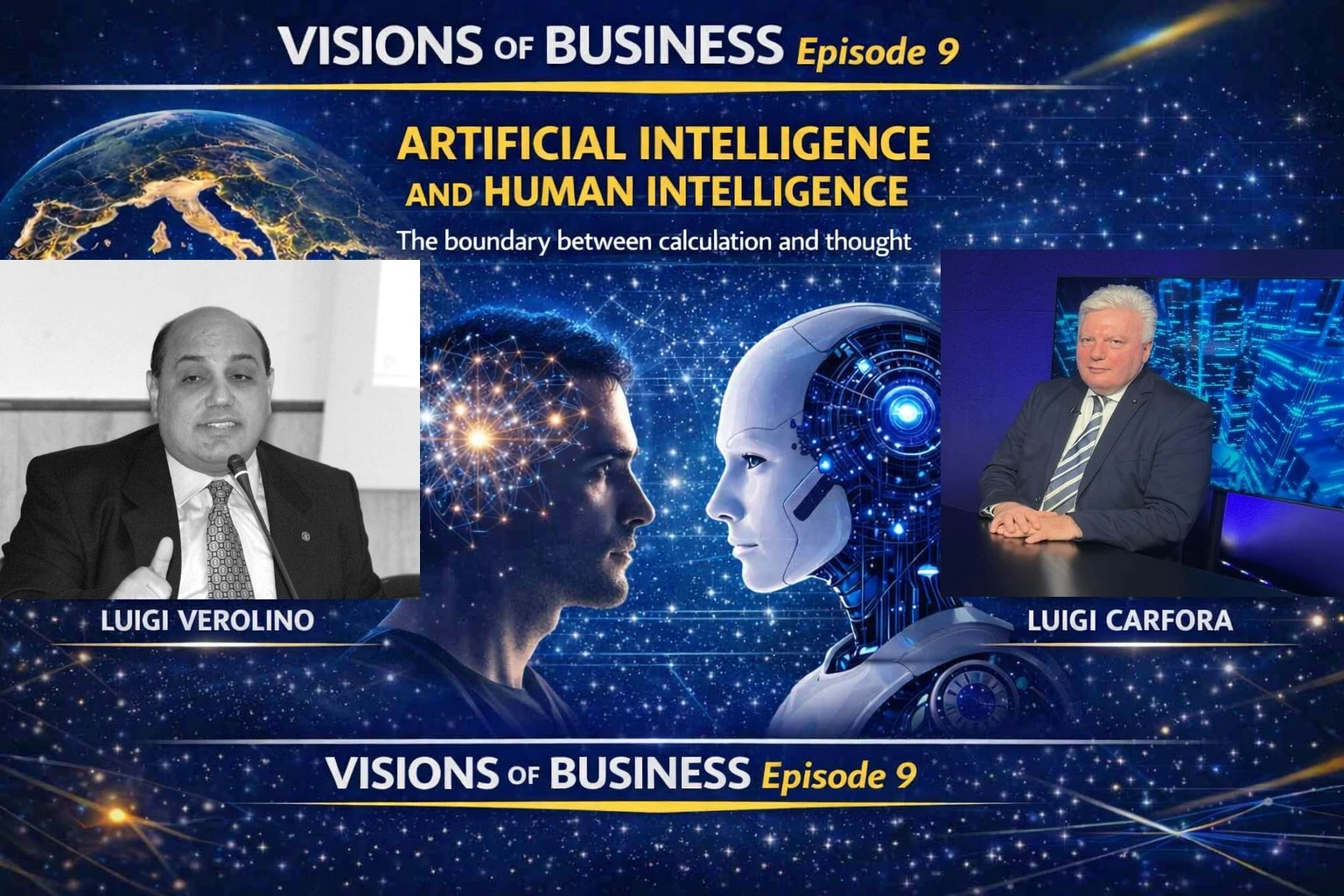
VISIONI DI IMPRESA – Episode 9 | 2026
Theme: Artificial Intelligence and Human Intelligence – The Boundary Between Calculation and Thought
"Artificial intelligence can process data and build increasingly sophisticated models, but thinking remains a uniquely human prerogative: machines calculate the world, while human beings understand its meaning."
✦ Guiding Reflection of the Episode
"The revolution of artificial intelligence is not only about technology. It concerns the understanding of what distinguishes calculation from thought, and the role that human intelligence will continue to play in guiding the future."
Artificial Intelligence and Human Intelligence: A Defining Question of Our Time
After addressing in previous episodes the themes of corporate sustainability, technological transformations, and the legal dynamics governing economic activity, the Visioni di Impresa series enters one of the most profound issues of our time: the relationship between artificial intelligence and human intelligence.
Artificial intelligence today represents one of the greatest scientific and technological revolutions of recent history. Increasingly sophisticated algorithmic systems are capable of analyzing enormous quantities of data, identifying correlations, generating predictive models, and supporting decision-making processes in fields ranging from medicine to finance, from industry to scientific research.
However, the growing diffusion of these technologies raises a fundamental question: what truly distinguishes machine intelligence from human intelligence?
The Scientific Perspective: Professor Luigi Verolino
This episode explores this question together with Professor Luigi Verolino, Full Professor of Electrical Engineering at the Department of Electrical Engineering and Information Technologies (DIETI) of the University of Naples Federico II.
An electronic engineer and university professor with a long academic and scientific career, Professor Verolino has also conducted research activities at CERN in Geneva and at the INFN National Laboratories of Frascati, contributing to the development of studies in the fields of applied electromagnetism and electrical systems.
Throughout his academic career he has published numerous scientific papers and university textbooks used in the education of engineering students. He has also distinguished himself through his commitment to the dissemination of scientific culture and to university orientation activities. In addition, he has held institutional roles within the University of Naples Federico II, including the directorship of SOFTel – the University Center for Orientation, Training and Distance Learning.
His contribution to this episode therefore allows the topic of artificial intelligence to be examined not only from a technological perspective, but also through the perspective of a scientist reflecting on the relationship between knowledge, technology, and society.
Calculation and Thought: The Fundamental Difference
During the dialogue, a fundamental distinction emerges.
Machines are extraordinarily efficient at calculation and data processing. Algorithms are designed to recognize patterns, compute probabilities, build mathematical models, and simulate complex languages.
This makes artificial intelligence an extremely powerful tool for analyzing economic phenomena, optimizing industrial processes, and supporting decisions based on vast amounts of information.
However, this computational capability does not coincide with thought.
Human thinking is not limited to processing data.
Human beings are capable of asking questions, attributing meaning to information, and imagining scenarios that do not yet exist.
In this sense, the difference between artificial intelligence and human intelligence is not merely quantitative, linked to computational speed or the capacity to process information. It is a qualitative difference, one that concerns the very nature of thought itself.
Artificial intelligence can analyze the world through mathematical and statistical models.
Human intelligence, on the other hand, interprets the world, constructs its meaning, and guides the choices that shape the future of societies and economies.
Artificial Intelligence and Its Impact on Business and Industry
This distinction becomes particularly relevant for the world of business as well.
Artificial intelligence technologies are increasingly entering production processes, corporate management systems, and market analysis models.
Predictive algorithms, advanced automation systems, data analysis tools, and digital platforms are profoundly transforming the way companies organize production, manage information, and make strategic decisions.
In this scenario, technology becomes an extraordinary tool supporting economic activity.
But precisely for this reason, the role of human intelligence becomes even more crucial.
Entrepreneurs, managers, researchers, and economic decision-makers cannot limit themselves to using increasingly sophisticated technological tools. They must be able to interpret data, understand contexts, and guide strategic choices.
If calculation can be delegated to machines, thought cannot.
The Cultural and Human Challenge of Artificial Intelligence
The risk emerging in contemporary debate is not so much the power of artificial intelligence technologies, but rather the possibility that human beings may gradually renounce their own critical capacity, entrusting algorithms with decisions that instead require responsibility, vision, and a deep understanding of reality.
The issue therefore becomes not only technological, but also anthropological and cultural.
In a world where machines are becoming increasingly intelligent, the real challenge is to preserve and develop what makes human intelligence unique: the ability to interpret complexity, to imagine the future, and to make responsible decisions.
Technology as a Tool Guided by Human Intelligence
From this perspective, artificial intelligence should not be considered a substitute for human intelligence, but rather a tool capable of expanding the possibilities of knowledge and development—provided that it remains guided by human thought.
Technological progress becomes an extraordinary resource only when it is accompanied by cultural and scientific awareness capable of guiding its use.
Because, as emerges in the dialogue of the episode, the true difference lies not in the power of machines, but in the human capacity to think about the world that machines help to build.
✦ Reflection of the Episode
"Artificial intelligence can calculate the world with ever-greater precision. But only human intelligence can understand its meaning and decide the direction of the future."
🎙 EPISODE 9 – 2026 SERIES
Host and creator of the format:
Luigi Carfora
President of Confimi Industria Campania
President of the Consorzio Suggestioni Campane Promotion
Guest of the episode:
Prof. Luigi Verolino
Full Professor of Electrical Engineering
Department of Electrical Engineering and Information Technologies (DIETI)
University of Naples Federico II
Broadcast on: Per Sempre News
Recorded at the studios of Per Sempre News.
Visioni di Impresa – Episode 9
Humanism and Artificial Intelligence: Conflict or Integration?
A contribution by Luigi Carfora, guest at CPC, on the central themes of the episode
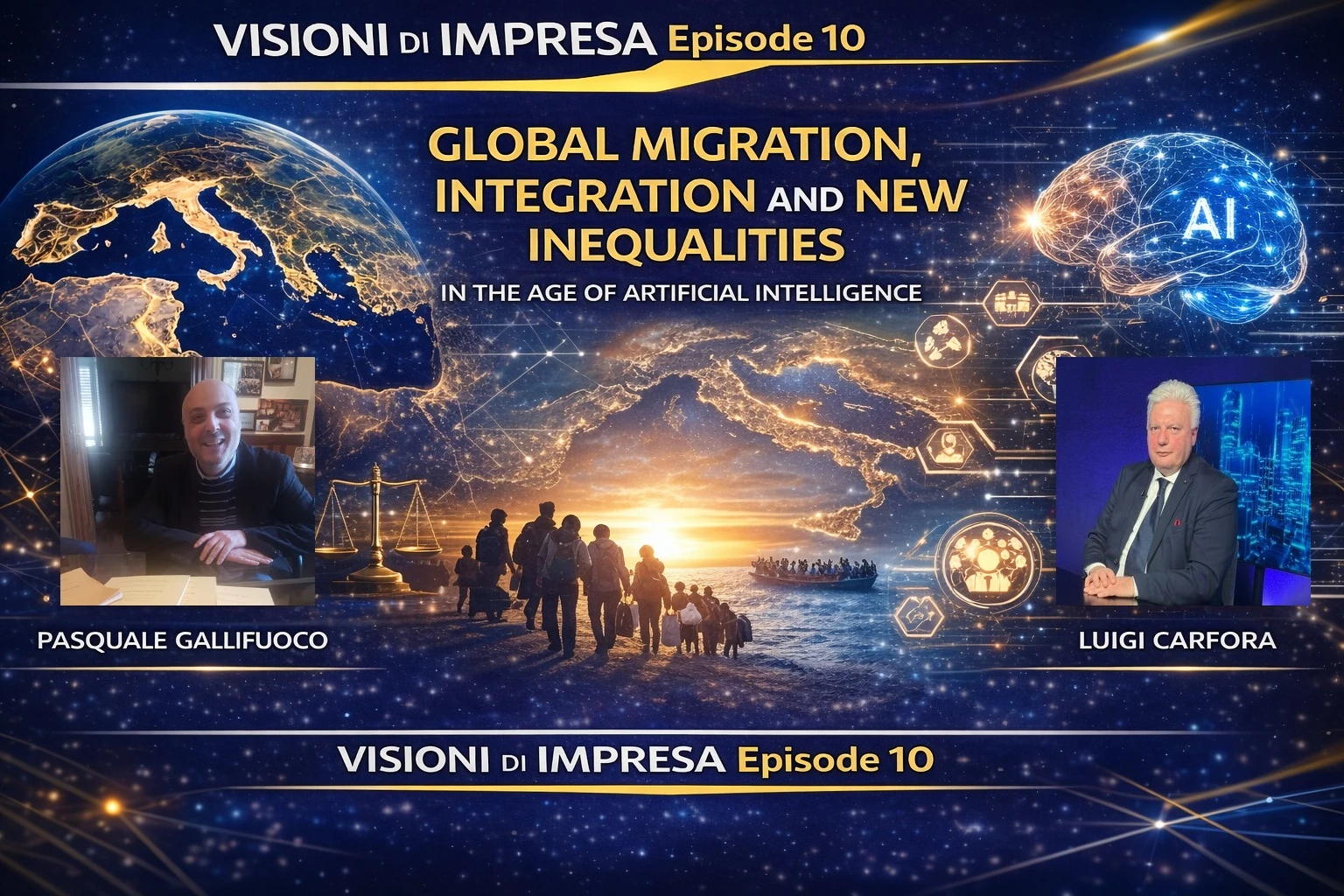
VISIONI DI IMPRESA – Episode 10 | 2026
Global Migration, Integration and New Inequalities in the Age of Artificial Intelligence
✦ Guiding Thought of the Episode
"If globalization has made the world interconnected, migration represents its most human and most dramatic consequence.
The real question is not how to stop it, but how to govern it without turning it into new forms of exploitation."
Introduction
After exploring in previous episodes the transformation of the global economy, the dynamics of international competition, and the impact of new technologies on production systems, Visioni di Impresa now addresses one of the most complex and decisive issues of our time: migration.
Human mobility is not a new phenomenon.
However, today it takes on different characteristics.
It is the result of a combination of factors:
-
global economic imbalances
-
climate crises
-
wars and geopolitical instability
-
transformations in the labor market
-
expectations of social advancement
In this context, migration becomes the intersection point between economics, law, ethics, and international politics.
The Mediterranean as a Geopolitical Space
The Mediterranean is not just a geographical boundary.
It is a historical space of encounter between civilizations, cultures, and economies.
Today, it is also one of the world's main migration frontiers.
In this scenario, Italy occupies a strategic yet complex position:
-
point of arrival
-
transit space
-
place of integration or marginalization
Understanding migration therefore means interpreting the Mediterranean as a cultural and geopolitical system, not merely as an area of crisis.
Integration or Marginalization?
One of the key issues concerns the model of integration.
It is not only about reception.
It is about building real conditions for:
-
access to employment
-
protection of rights
-
social participation
-
cultural recognition
When these elements are missing, the risk is the creation of marginalized areas that generate social tension and economic fragility.
The Risk of New Forms of Exploitation
Alongside migration, an even more sensitive issue emerges:
👉 new forms of modern slavery
In many contexts, migrants become part of production systems characterized by:
-
underpaid labor
-
lack of protections
-
illegal intermediation
-
systemic exploitation
These are not isolated cases, but dynamics embedded in the distortions of globalization already analyzed in previous episodes.
Migration and the Productive System
For businesses, migration is not only a social issue.
It is also an economic one.
Companies are confronted with:
-
labor shortages in certain sectors
-
the need for new skills
-
integration within production environments
-
balancing legality and competitiveness
The challenge is to build a model that does not turn migrant labor into a tool for social dumping, but into a driver of sustainable development.
Italian Emigration and Brain Drain
Alongside incoming migration flows, Italy has long experienced the opposite phenomenon: the emigration of its own citizens, particularly highly educated young people.
This dynamic, often less visible in public debate, has deep economic and social consequences.
Many graduates and professionals — especially from Southern Italy — move abroad in search of:
-
better career opportunities
-
more competitive wages
-
more efficient public services
-
stable institutional environments
-
stronger merit-based systems
This creates a dual effect:
-
destination countries benefit from already-trained human capital
-
regions of origin experience demographic, economic, and productive decline
In Southern Italy, this translates into:
-
depopulation
-
shrinking entrepreneurial base
-
loss of skilled competencies
-
contraction of domestic demand
This becomes a form of invisible wealth transfer, where the value generated by education is absorbed by other economies.
Migration as a Systemic Phenomenon
From this perspective, migration is not only about those who arrive, but also about those who leave.
It is not just a social issue, but a structural component of global economic balances.
Migration flows — both incoming and outgoing — are part of broader dynamics explored throughout the Visioni di Impresa cycle:
-
globalization
-
economic inequalities
-
competitiveness of productive systems
-
transformation of labor
The real challenge is to build a model capable of:
-
retaining human capital
-
attracting new skills
-
avoiding social dumping
-
ensuring balanced development
Without this balance, the risk is increasing polarization between regions — and even within the same country.
The New Variable: AI, Automation and Humanoids
This topic directly connects with previous episodes.
If technology reduces the need for human labor in advanced economies, what happens to migration flows?
A new scenario emerges:
-
reduced demand for manual labor
-
increasing technological unemployment
-
transformation of required skills
This could create a new tension:
👉 fewer opportunities in destination countries
👉 greater migration pressure from origin countries
The Future of Developing Countries
Many countries of origin remain trapped in conditions of:
-
structural poverty
-
political instability
-
economic dependency
-
limited access to technology
If technological transformation is not accompanied by global development policies, the risk is an even wider gap between economies.
Migration, Culture and Identity
Migration is not only economic or legal.
It is also cultural.
The interaction between different identities can become:
-
a driver of growth
or -
a source of conflict
The difference lies in the ability of societies to build advanced models of coexistence.
The Role of International Relations
Migration cannot be addressed at a purely national level.
It requires:
-
cooperation between states
-
coordinated European policies
-
agreements with countries of origin
-
investment in local development
Without an international vision, migration policies remain incomplete.
Key Topics of the Episode
-
global migration and economic imbalances
-
the Mediterranean's role
-
social and economic integration
-
exploitation and modern slavery
-
impact of migration on businesses
-
migration and social dumping
-
AI, automation, and the future of work
-
scenarios for emerging economies
-
international cooperation and migration policies
✦ Final Reflection
"There is no economic development without social balance.
And there is no sustainable globalization without a fair and conscious management of migration.
The future will not depend only on technology, but on humanity's ability to remain human."
🎙 Episode 10 – 2026
Host and Creator
Luigi Carfora
President, Confimi Industria Campania
President, Consorzio Suggestioni Campane Promotion
Guest
Prof. Pasquale Gallifuoco
Professor of Human Geography and Geography of Languages at University of Naples "L'Orientale", professional journalist, expert in Mediterranean cultural and geopolitical dynamics, and President of ACLI Cultural Heritage – Naples
🎬 Directed by: Pino Fontana
📺 Broadcast on Per Sempre News
🎙 Recorded at Per Sempre News studios
VISIONI DI IMPRESA – Episode 11 | 2026
Energy Crisis and Geopolitics – Industry Between Survival and Sovereignty
"There is no industrial policy without an energy policy. And there is no enterprise without sustainable energy."
✦ Guiding Reflection of the Episode
"The energy crisis is not an emergency. It is a structural condition. And today more than ever, it separates economies that can produce from those that are destined to fall behind."
After exploring in previous episodes the transformations driven by technology, the role of artificial intelligence, and the dynamics shaping economic decisions, Visioni di Impresa now addresses one of the most crucial issues of our time:
👉 the relationship between energy, industry, and economic sovereignty.
2026 is not the beginning of the crisis.
It is the moment when the crisis becomes visible.
The conflict in Iran and the tensions in the Strait of Hormuz have triggered a global energy shock. However, this shock has merely exposed an underlying fragility.
Because the Italian industrial system—and more broadly the European one—has been operating for years under a structural competitive disadvantage.
✦ The Surge in Energy Costs: A "Perfect Storm"
Within just a few weeks, the global energy system experienced simultaneous increases across all major components:
- oil up to +50%
- fuel prices in Europe up to +30%
- natural gas peaks exceeding +60%
- electricity prices rising between +30% and +40%, with immediate impact on industrial costs
This is not a sector-specific crisis.
👉 It is a perfect storm, simultaneously affecting:
- production
- logistics
- supply chains
- distribution
When the entire value chain is hit at once, companies can no longer absorb the impact.
✦ A Foreseen Crisis: The Position of Confimi Industria
The real issue, however, lies elsewhere.
👉 this crisis had already been clearly identified
For years, the President of Confimi Industria, Paolo Agnelli, has consistently highlighted a structural anomaly:
- energy costs up to 3–4 times higher than in other European countries
- lack of a coherent industrial energy strategy
- fragmented and non-structural public interventions
Even before the 2026 geopolitical crisis, Confimi had clearly outlined the problem:
👉 Italian companies operate with a permanent competitive disadvantage
This is not about market fluctuations.
It is about a system that makes production structurally more expensive in Italy.
And when production costs rise:
- competitiveness declines
- margins shrink
- the industrial system weakens
Over the years, this analysis has been accompanied by a concrete initiative led directly by Paolo Agnelli.
Under his leadership, the Energy Manifesto was launched—signed by hundreds of Italian companies—as a structured platform for institutional advocacy.
The Manifesto identifies key strategic priorities:
- alignment of Italian energy costs with European levels
- reduction of non-core charges burdening enterprises
- greater transparency in price formation mechanisms
- development of a stable, long-term industrial energy policy
Within this framework, Agnelli's action takes on a clear meaning:
👉 it is not a contingent demand
👉 it is a structural position aimed at protecting industrial competitiveness
Because without comparable energy conditions, markets are not truly competitive, and Italian companies are forced to operate at a systemic disadvantage.
This already critical framework, even before 2026, provides the basis for understanding the impact of the current geopolitical crisis.
✦ War Does Not Create the Problem: It Amplifies It
With the conflict in Iran, this imbalance has become unsustainable.
Current price increases add to pre-existing structural costs, generating a cumulative effect:
👉 a competitive gap that becomes unbridgeable
- Italy: approx. €85/MWh
- France: approx. €25/MWh
- Germany: approx. €44/MWh
This means producing with energy costs up to three times higher than direct competitors.
The consequences are inevitable:
- reduced production
- halted investments
- risk of delocalization
And above all:
👉 a gradual exit from the industrial system
✦ Energy Shock 2026: The Campania Case
In this context, the Campania region represents one of the clearest indicators of the ongoing crisis.
As highlighted in the March 17 statement published on the Suggestioni Campane platform – "Carfora Confimi: Energy Shock 2026, 100,000 Campanian Companies at Risk":
- up to 100,000 companies are exposed to energy risk
- tens of thousands are already operating under severe financial pressure
- the potential impact on employment is significant
This is not a projection.
👉 It is a snapshot of reality.
✦ Production Structure and Energy Imbalance
For companies in Campania, the energy issue goes beyond price levels.
The critical factor lies in the structure of the regional production system, largely composed of micro and small enterprises that rely on energy as a core production input but lack sufficient bargaining power in the liberalized market.
In a context where energy supply is concentrated and industrial demand is fragmented, formal freedom of supplier choice does not always translate into real negotiating power.
For many SMEs:
- energy is a non-compressible cost
- it cannot be easily passed along the value chain
- it directly impacts margins
As a result, even limited price increases immediately affect:
- investment capacity
- liquidity
- industrial sustainability
In a region dominated by small enterprises, this imbalance risks amplifying an already structural fragility.
✦ Policy Priorities: From Territory to National Level
In this context, the need for strong and coherent representation becomes evident.
Confimi Industria Campania calls for the following priorities to be addressed at the national level:
- Ensure truly competitive and transparent conditions in the liberalized energy market, with specific protection for industrial SMEs
- Introduce structural instruments to guarantee stability and predictability of energy costs, moving beyond emergency-based measures
- Take into account territorial specificities, preventing the widening of internal competitive disparities
✦ A Consistent Position
Confimi Industria Campania fully supports the national objective of strengthening the competitiveness of the Italian production system.
However, in a context of widespread structural fragility, protecting industrial energy users is an essential condition for economic balance and productive stability.
Campania today represents an advanced indicator of the crisis, anticipating dynamics that may extend nationwide.
✦ The Real Issue: Companies Operating at a Loss
The most critical point is not immediate business closures.
It is a more complex and dangerous phenomenon:
👉 companies continuing to operate while generating losses
The causes are cumulative:
Energy
- gas +60%
- electricity +40%
- up to 30% of production costs
Transport
- fuel +30%
- logistics up to 35% of costs
Margins
- typically 3–6%
Liquidity
- immediate costs
- delayed revenues
Pricing
- inability to adjust prices
👉 result:
margins collapse and turn into losses
✦ The Silent Crisis: Industrial Desertification
The risk is not immediate.
It is gradual.
- production continues
- liquidity declines
- losses accumulate
👉 until a breaking point is reached
This is the real emergency:
👉 a slow but steady process of industrial desertification
✦ Energy and Sovereignty: The Political Dimension
The energy issue is no longer technical.
It is political.
👉 without competitive energy, there is no industry
And without industry:
- there is no employment
- there is no growth
- there is no economic sovereignty
✦ Technical Contribution: Managing, Not Enduring
In this scenario, the contribution of Engineer Eugenio Feleppa, Deputy Director of Confimi Industria Campania and Energy Manager, becomes crucial.
His perspective introduces a clear principle:
👉 the crisis must be addressed with expertise, not emergency measures
Through:
- Energy Managers and EGE certification
- White Certificates (TEE)
- ISO 50001 systems
- energy welfare initiatives
A new approach emerges:
👉 energy becomes a strategic function of the enterprise
✦ The Core Message: Companies Do Not Ask for Aid
A key position emerges throughout the episode:
👉 companies do not ask for assistance
👉 they ask for conditions to compete
👉 they ask for fair rules within the European market
👉 because competition takes place at the global level
This is not about artificially supporting the system.
It is about removing a structural disadvantage.
✦ The Final Risk: Exiting Global Competition
If the energy gap persists:
- companies will not invest
- they will relocate
- they will shut down
👉 this is not a cyclical crisis
👉 it is an irreversible transformation
✦ Final Reflection
"War has brought the issue into focus. But the problem was already there. An industrial system does not collapse in a day—it slowly loses competitiveness. And when production costs exceed the value created, companies do not enter crisis: they exit the system."
🎙 EPISODE 11 – 2026 SERIES
Host and creator:
Luigi Carfora
President, Confimi Industria Campania
President, Consorzio Suggestioni Campane Promotion
Guests:
Paolo Agnelli
President, Confimi Industria
Eugenio Feleppa
Deputy Director, Confimi Industria Campania
Energy Manager
🎬 Direction: Pino Fontana
📍 Broadcast on Per Sempre News
📍 Recorded at Per Sempre News Studios
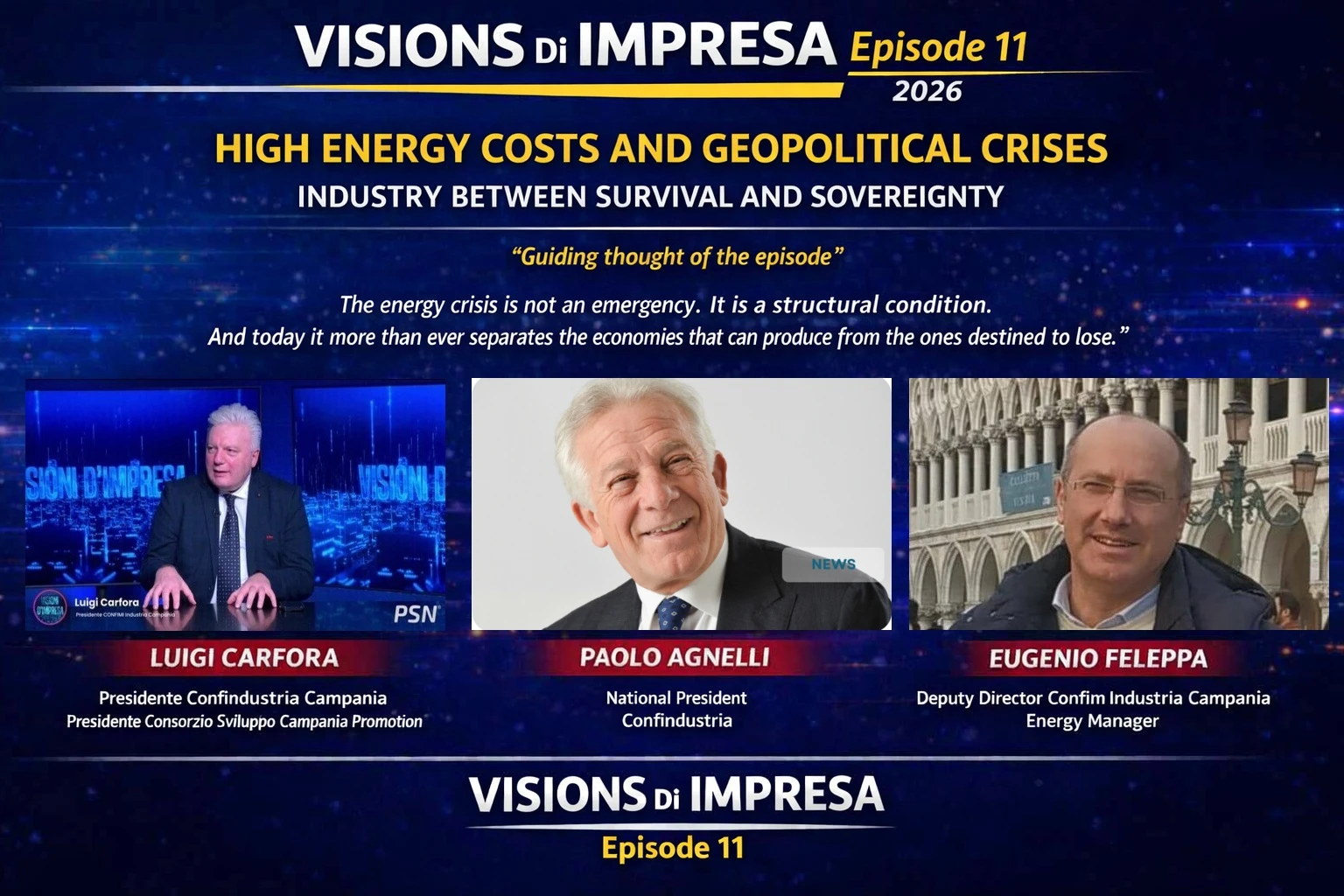
🎥 VISIONI DI IMPRESA – Episode 12 | 2026
Business and Sport in Southern Italy: Real Economy, Identity and Value Creation
Theme: Sport and businesses in Southern Italy between entrepreneurial capacity, economic impact and territorial development
✦ Guiding Thought of the Episode
"In Southern Italy, business is never just business.
It is the ability to endure, to build, and to give shape to a context that often does not support growth."
Introduction
After exploring in previous episodes the major forces reshaping the global economy — technology, law, migration, and energy — Visioni di Impresa now returns to a fundamental point:
👉 the real capacity to do business in Southern Italy.
Not as an abstract concept, but as a concrete experience.
Within this context, sport emerges not as a separate field, but as a possible extension of economic activity — capable of generating tangible effects on territories, employment, and social identity.
Doing Business in Southern Italy: A Matter of Context
Operating in Southern Italy means working within a system where conditions are not neutral.
The structural limits are well known:
– infrastructural gaps
– more complex access to credit
– administrative uncertainty
– lack of integrated production systems
And yet, within this environment, there are entrepreneurial experiences that demonstrate a key point:
👉 the issue is not only where business is done, but how value is built within that context
An Entrepreneurial Path
Andrea Langella's experience fits fully within this framework.
An entrepreneur with a long-standing industrial background, he represents a model of continuity and adaptability over time.
His path highlights a key element:
👉 doing business in Southern Italy requires vision, solidity, and risk management
The Experience in Football: An Extension of Enterprise
His involvement in professional football, particularly with Juve Stabia, should not be seen as a deviation, but as an extension of the same entrepreneurial approach.
When he took over the club, it was facing serious economic difficulties and lacked a clear sporting direction.
What followed was not merely a sporting recovery, but a structured entrepreneurial process:
– financial stabilization
– organizational restructuring
– long-term sustainability
– progressive competitive growth
The club eventually returned to a strong position, achieving promotion to Serie B and coming close to even more ambitious results.
Sport as Real Economy
This experience highlights an often overlooked point:
👉 sport is not outside the economy
👉 it is part of the economy
A football club generates:
– direct and indirect employment
– local economic spillovers
– visibility and attractiveness
– development of related services
In Southern Italy, these effects are even more significant, as they operate in territories where development opportunities are more limited.
Building Value and Transition
A particularly relevant aspect of this experience is its final phase.
After restoring stability and value, Langella exited the club through an operation that brought in an international investment group, transferring ownership after having created the necessary economic and organizational conditions.
This is not a secondary detail.
👉 it represents a typical entrepreneurial cycle:
– building a viable asset
– making it attractive to investors
– enabling a transition to a new development phase
It is not simply an exit.
It is the completion of a value creation process.
The Structural Limit of Southern Italy: Lack of System
A recurring theme throughout the Visioni di Impresa cycle clearly emerges:
👉 Southern Italy does not lack entrepreneurial capacity
👉 it lacks system integration
This is also evident in sport:
– isolated projects
– limited continuity
– weak integration with the broader economic fabric
The risk is that successful experiences remain isolated, without generating structural impact.
From Individual Experience to Model
The real question is not to celebrate a successful case.
It is to understand whether experiences like this can become:
– replicable models
– drivers of development
– building blocks of integrated economic systems
Sport can play a role in this process, but only if embedded within a broader strategic vision.
Business, Territory and Responsibility
In Southern Italy, business always extends beyond pure economics.
It directly affects:
– social cohesion
– local opportunities
– territorial balance
This applies equally to industrial enterprises and to sports organizations.
Key Topics of the Episode
– doing business in Southern Italy
– operating in structurally complex environments
– sport as an extension of economic activity
– economic impact of sports ecosystems
– sustainability and continuity
– long-term value creation
– transition from individual enterprise to system
✦ Final Reflection
"Southern Italy does not need narratives.
It needs models.
And every entrepreneurial experience capable of creating, consolidating, and transferring value proves that the real limit is not the territory, but the ability to build systems."
🎙 Episode 12 – 2026
Host and Creator
Luigi Carfora
President, Confimi Industria Campania
President, Consorzio Suggestioni Campane Promotion
Guest
Andrea Langella
Entrepreneur
🎬 Directed by: Pino Fontana
📺 Broadcast on Per Sempre News
🎙 Recorded at Per Sempre News studios
🎥 VISIONI DI IMPRESA – Episode 13 | 2026
Territory, Tourism and Development: Organizing Value through DMOs
Theme: The role of Destination Management Organizations in Campania between governance, economic development and system-building
✦ Guiding Thought of the Episode
"A territory does not become competitive because of what it has,
but because of how it is organized.
Without organization, even the greatest value remains only potential."
Introduction
After exploring in previous episodes the major forces shaping the contemporary economy — technology, law, migration, energy, and the role of business in Southern Italy — Visioni di Impresa now takes a further step:
👉 from enterprise
👉 to the territory as an organized economic system
Because today, the real challenge is no longer just to create value,
but to structure it, connect it, and make it competitive.
Within this framework emerges the role of Destination Management Organizations (DMOs), increasingly relevant tools in territorial development strategies, particularly in regions such as Campania.
The Contribution of Prof. Francesco Eriberto d'Ippolito
The dialogue in this episode develops from the contribution of Prof. Francesco Eriberto d'Ippolito, Director of the Department of Political Sciences and Full Professor at the University of Campania "Luigi Vanvitelli", a jurist and an authoritative institutional figure.
Recently appointed President of the DMO "Destination Caserta", he is now engaged in a particularly delicate phase:
👉 shaping a governance model capable of connecting institutions, businesses, cultural assets, and local operators.
This is not merely a formal role.
It represents a strategic step in which a territory attempts to evolve from a collection of resources into a coherent and organized system.
What DMOs Really Are
DMOs are often described as tourism promotion bodies.
But this definition is reductive.
👉 DMOs do not simply promote a destination
👉 they organize it as an economic product
This involves:
– creating a unified strategic direction
– coordinating attractions, services, and stakeholders
– integrating public and private actors
– transforming identity and heritage into economic value
The goal is not visibility alone.
👉 it is structured economic development
The "Destination Caserta" Project
The "Destination Caserta" initiative reflects this approach.
It is not a local marketing project, but an attempt to build a territorial system that connects:
– the Royal Palace of Caserta
– the Bourbon heritage system
– the Appian Way
– the wider Caserta area
👉 a broad and integrated territory with strong potential
The objective is clear:
– overcoming fragmentation
– building a coordinated offering
– transforming episodic flows into stable presence
– increasing the quality of tourism-related spending
Campania: A Transformational Phase
Campania is currently undergoing a significant transition.
On one side:
– strong international attractiveness
– unique cultural and natural heritage
– increasing tourist flows
On the other:
👉 the simultaneous emergence of multiple DMOs across the region
This is a positive signal, but it raises a fundamental question:
👉 how can these initiatives avoid remaining isolated?
Critical Issues: A Matter of Structure
The critical points do not concern individual DMOs or those leading them.
They concern the system as a whole.
This is a transitional phase, where key challenges emerge:
– coordination between territories
– integration between public and private actors
– definition of operational models
– measurement of economic impact
👉 these are structural issues
👉 not issues of competence
In this context, the role of institutional and academic leadership becomes essential in guiding the process toward effectiveness.
The Risk of Fragmentation
The multiplication of DMOs can produce unintended effects if not properly coordinated:
– overlapping functions
– competition between neighboring territories
– dispersion of resources
– fragmentation of strategies
👉 the issue is not the number of DMOs
👉 but their ability to operate as a system
The Potential: A Paradigm Shift
If properly structured, DMOs can represent a turning point for Southern Italy.
They can become:
– platforms for territorial coordination
– drivers of economic development
– connectors between tourism, culture, and industry
– tools for attracting investment
👉 not just tourism promotion
👉 but territorial economic policy
The Link with the Business System
This closes the circle with the entire Visioni di Impresa cycle.
Businesses do not operate in isolation.
They operate within a context.
And when that context is not organized:
– risk increases
– competitiveness declines
– growth potential is reduced
DMOs can become:
👉 the bridge between territory and productive system
The Real Challenge
The central issue remains clear:
👉 not creating new structures
👉 but making them work together
Because Southern Italy does not suffer from a lack of initiatives.
It suffers from a lack of integration among initiatives
Key Topics of the Episode
– what DMOs are
– the "Destination Caserta" project
– territorial governance
– emergence of DMOs in Campania
– risks of fragmentation
– economic potential
– relationship between territory and business
✦ Final Reflection
"Value already exists within territories.
The real question is whether we are able to organize it.
Because only when it becomes a system can it generate development."
🎙 Episode 13 – 2026
Host and Creator
Luigi Carfora
President, Confimi Industria Campania
President, Consorzio Suggestioni Campane Promotion
Guest
Prof. Francesco Eriberto d'Ippolito
Director of the Department of Political Sciences
University of Campania "Luigi Vanvitelli"
President of the DMO "Destination Caserta"
🎬 Directed by: Pino Fontana
📺 Broadcast on Per Sempre News
🎙 Recorded at Per Sempre News studios
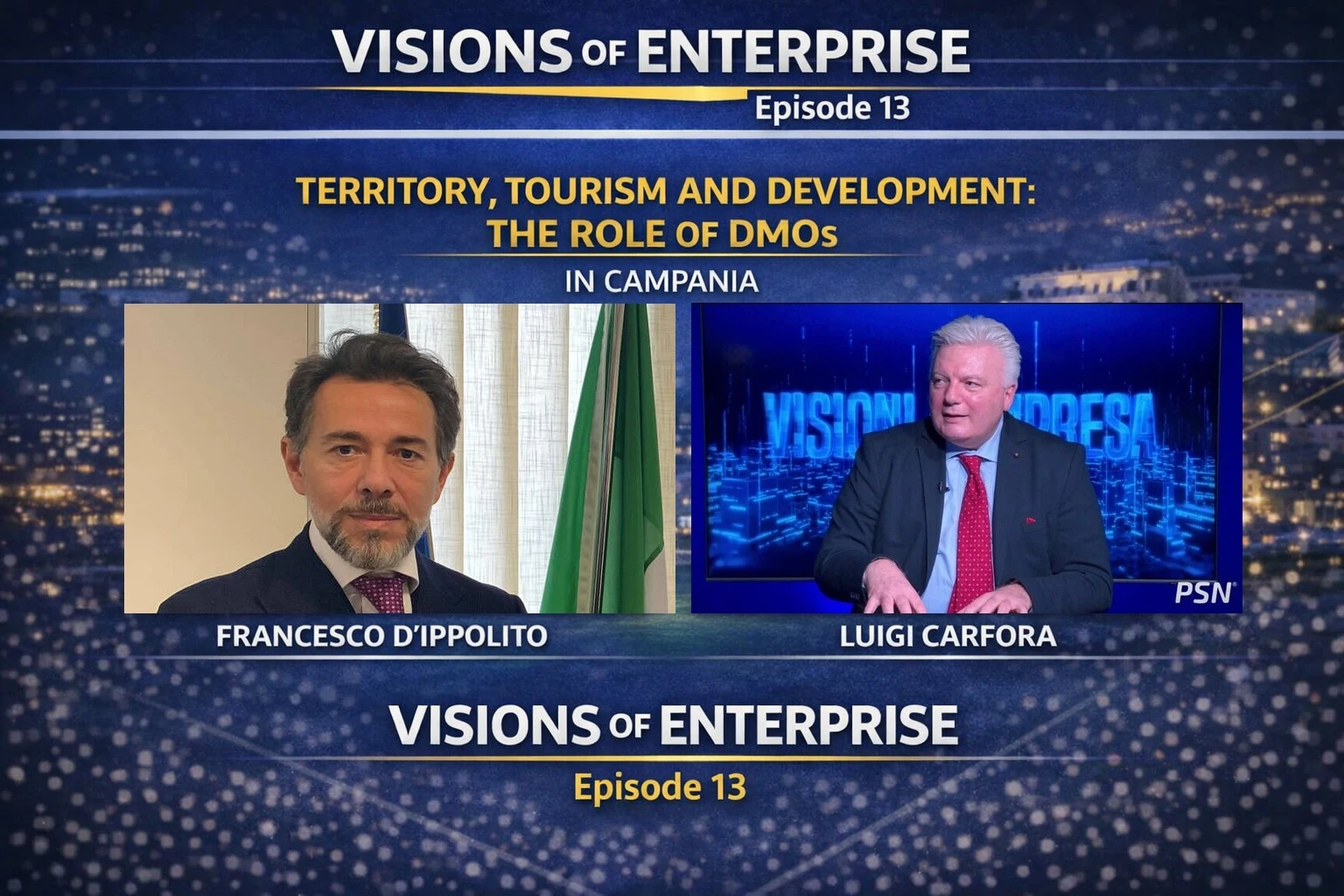
🎥 VISIONI DI IMPRESA – Episode 14 | 2026
Theme: Training, music and identity – creating human value in the age of artificial intelligence
✦ Key insight of the episode
"When technology makes everything accessible and replicable, true value no longer stems from production, but from training.
The real difference will not be made by those who know how to use tools, but by those who have built an identity that no machine can imitate."
After examining in previous episodes the evolution of technology, the role of artificial intelligence in production processes, the impact of economic transformations on territories, and the legal implications of digitalisation, the Visioni di Impresa series now addresses a deeper and often overlooked dimension: training as the origin of value.
Episode 14 introduces a significant shift in perspective.
It does not simply observe the enterprise as an economic system, but interprets it as the expression of a cultural and identity-driven construction.
In this context, the dialogue with Maestro Leonardo Quadrini — conductor, pianist, composer and professor at the San Pietro a Majella Conservatory in Naples — offers a privileged perspective on the theme of training: that of music, one of the most rigorous and structured domains of human knowledge.
Music, in fact, is not merely art.
It is discipline, method, coordination, listening and responsibility.
In other words, it is a true school of enterprise.
Training and identity: beyond the logic of skills
In contemporary debate, training is often interpreted as continuous updating or the acquisition of technical skills.
A functional but reductive view.
The musical experience demonstrates instead that authentic training is never purely technical.
It is a long, layered process that builds identity.
In the path of a conductor, the following elements converge:
– theoretical study and constant practice
– interpretative ability
– management of complex groups
– responsibility for collective outcomes
It is not about learning how to do something.
It is about becoming capable of guiding, interpreting and giving meaning.
Applied to the business world, this perspective highlights an increasingly widespread issue:
the presence of technically competent organisations lacking a recognisable identity.
Training, therefore, is neither a cost nor an ancillary activity.
It is the foundation of competitive differentiation.
Music as an economic system and generator of employment
The episode also addresses a frequently underestimated aspect:
music as a complex economic value chain.
The music sector activates an articulated network of activities:
– training (conservatories, academies, teachers)
– artistic production (musicians, conductors, composers)
– organisation and distribution (theatres, festivals, events)
– related services (technicians, communication, cultural tourism)
This is a system that generates employment, income and territorial value.
In this sense, music is not only a cultural expression, but a true economic infrastructure capable of generating indirect impact and development.
However, this value chain functions only in the presence of one essential element:
quality.
And quality, once again, is the direct result of training.
The transformation of the music market: simplification and loss of depth
In recent years, the music sector has undergone a significant transformation.
A production model has gradually emerged, characterised by:
– reduction of musical complexity
– centrality of image over content
– artists often lacking structured training
This model responds to precise industrial logics.
Simplification enables greater speed, replicability and control.
However, it also produces significant effects:
– loss of artistic depth
– standardisation of content
– reduction in the durability of value over time
Music thus becomes a fast-consumption product,
closer to industrial logic than to cultural expression.
The dialogue with Maestro Quadrini highlights a fundamental distinction:
between those who interpret music as the result of a path, and those who use it as a market tool.
Artificial intelligence and music production
Within this scenario, artificial intelligence introduces a new variable, enabling the generation of musical content through increasingly sophisticated algorithms.
Available technologies allow:
– automated composition of musical pieces
– imitation of musical styles
– production of bases and arrangements
This introduces a new competitive dynamic within the sector.
Music, traditionally rooted in human experience, enters a dimension of advanced technical reproducibility.
However, the central issue is not the ability of AI to produce music,
but its inability to generate experience, intention and identity.
Artificial intelligence can simulate.
It cannot live.
The risk of substitutability
The spread of AI makes an increasingly clear distinction evident.
Not between humans and machines, but between:
– superficial competence and deep competence
– standardised production and authentic identity
The real risk is not that technology will replace humans,
but that it will replace everything that is easily replicable.
In this sense, the lack of training becomes a factor of vulnerability.
Those who have not built a solid professional and cultural identity
are more exposed to technological substitution.
What changes concretely for the productive and creative world
The ongoing transformation produces concrete effects for both businesses and professionals.
Among the main ones:
- Centrality of structured training
- Updating alone will no longer be sufficient. Deep and integrated competencies will be required.
- Need to develop recognisable identities
- In a saturated market, differentiation will depend on the ability to be unique.
- Conscious integration of artificial intelligence
- Technologies must be used as support tools, not as substitutes for competence.
- Shift from quantity to quality
- Mass production loses value, while depth and time-intensive work gain importance.
- New working models in the creative industries
- Music and cultural professions will need to evolve by integrating artistic, technological and managerial skills.
The role of training in the future of music and enterprise
The episode highlights how training represents the true point of balance between technological innovation and human value.
In both music and enterprise,
the future will not be determined by technology itself,
but by how individuals will be able to use it without losing their identity.
Training thus becomes:
– a factor of competitiveness
– a tool for differentiation
– an element of long-term sustainability
✦ Episode reflection
"In an age of infinite production, what endures is not what is created faster, but what is built more deeply.
Training does not accelerate results: it makes them lasting."
🎙 EPISODE 14 – 2026 SERIES
Created and hosted by:
Luigi Carfora
President of Confimi Industria Campania
and President of Consorzio Suggestioni Campane Promotion
🎙 Guest:
Maestro Leonardo Quadrini
conductor, pianist, composer and professor at the San Pietro a Majella Conservatory in Naples
🎬 Directed by: Pino Fontana
📺 Broadcast on Per Sempre News
🌐 Watch the episode:
https://psntv.it/visioni-dimpresa
https://www.suggestioni.eu/visioni-di-impresa/
📍 Recorded at Per Sempre News studios
📺 Available on Per Sempre News and our social channels
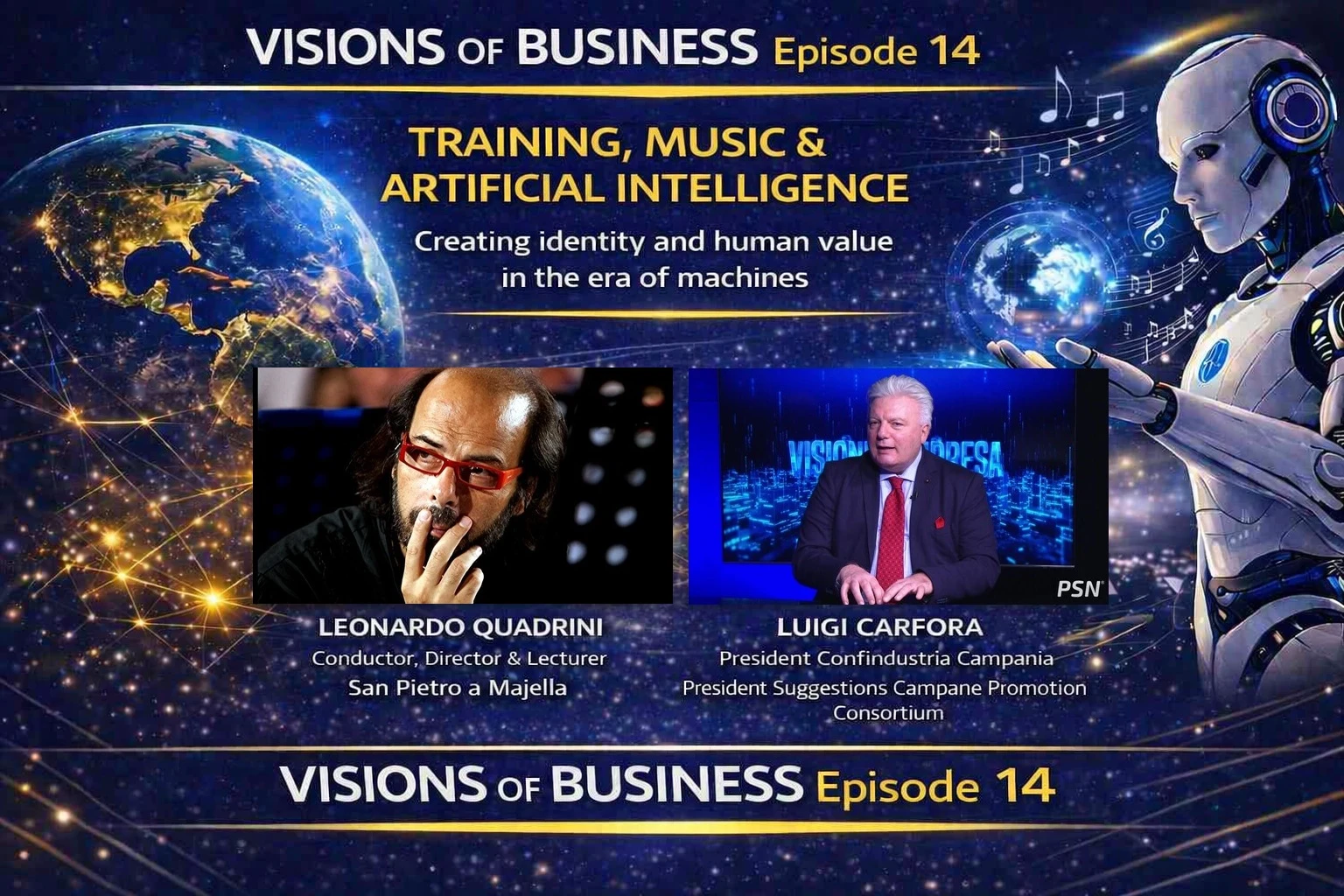
🎥 VISIONI DI IMPRESA – Episode 15 | 2026 Series
State, Enterprise and Economic Transformation: From Keynesian Economics to Technological Globalization
Episode Theme
Economy, enterprise and the transformation of the Italian productive system between the First Republic, economic liberalism, multinational dominance, the crisis of SMEs, artificial intelligence, humanoid robotics, taxation, Special Economic Zones and the growing need for renewed public economic regulation.
✦ Guiding Thought of the Episode
"Every economic system that concentrates wealth and power without redistributing stability and social dignity inevitably generates imbalances that later evolve into economic, social and democratic crises."
Introduction to the Episode
After addressing in previous episodes the major themes of energy, law, security, productive transformation and social dynamics, Visioni di Impresa enters an even deeper reflection:
👉 understanding how the Italian economic model has changed
👉 understanding why local productive systems have progressively weakened
👉 understanding what role the State should play in the contemporary economy.
This episode examines the historical transition:
👉 from the Keynesian economic philosophy of Italy's First Republic
👉 to the liberal economic model of the Second Republic
👉 and finally to today's phase dominated by financial globalization, multinational corporations and artificial intelligence.
This transformation has not only changed markets.
It has transformed:
– the relationship between State and market
– the relationship between enterprise and territory
– the balance between labor and technology
– the relationship between wealth creation and social redistribution.
The First Republic and the Keynesian Economic Balance
During the First Republic, the State was not considered an obstacle to economic development.
It was considered:
👉 a necessary regulator of the economy.
Keynesian economic philosophy was based on a precise principle:
👉 when left entirely unregulated, markets naturally tend to generate social and economic imbalances.
For this reason, the State intervened in:
– industrial policy
– infrastructure development
– employment protection
– strategic investments
– income redistribution.
The objective was not to eliminate the market.
The objective was:
👉 preventing the market from destroying social equilibrium.
The State therefore maintained:
– a regulatory role
– a redistributive role
– a strategic role.
The real economy remained central.
Enterprises were still deeply connected to:
– local territories
– productive communities
– labor
– national industrial supply chains.
Economic activity had not yet become fully subordinated to global financial logic.
The Second Republic and the Rise of Economic Liberalism
During the 1990s, Italy experienced a profound political and economic transformation.
A new philosophy progressively emerged:
👉 the belief that markets could regulate themselves efficiently.
The State gradually reduced its direct economic intervention.
Globalization became the dominant paradigm.
According to this approach:
– competition would increase efficiency
– global markets would generate widespread growth
– liberalization would create opportunities for everyone.
However, this theory relied on one essential assumption:
👉 economic actors had to compete under relatively balanced conditions.
And this is precisely where the structural contradiction of the contemporary system emerges.
When overwhelmingly powerful economic actors dominate the market:
👉 markets no longer generate balance
👉 they generate concentration.
Multinational Dominance and the Weakening of Local Economies
Globalization has undoubtedly expanded markets and accelerated innovation.
But it has also produced:
👉 an unprecedented concentration of economic power.
Today's multinational corporations do not simply control production and trade.
They control:
– data
– logistics
– digital platforms
– global distribution systems
– finance
– communication
– technology.
This radically transforms economic balance.
Italian SMEs, despite representing the productive backbone of the national economy, now compete against entities possessing:
– enormous financial capacity
– international tax advantages
– privileged access to capital markets
– technological capabilities unreachable for many local businesses.
The consequences are progressive:
– weakening of local economies
– commercial desertification
– loss of territorial industrial supply chains
– reduction of local economic sovereignty.
The Limits of Antitrust in Global Capitalism
Antitrust systems were created to prevent excessive concentrations of economic power.
However, contemporary capitalism has reached dimensions that often make traditional regulatory tools insufficient.
Even in the United States, where antitrust culture has deep historical roots:
👉 major technological platforms continue concentrating enormous economic and informational power.
If regulation struggles even in the United States:
👉 controlling global concentration becomes even more difficult in economically fragile systems such as Italy.
Meanwhile, while public debate focuses on large corporations:
👉 SMEs often remain without concrete protection.
Antitrust mechanisms rarely reach:
– territorial market imbalances
– distortions affecting local enterprises
– asymmetries within commercial distribution
– indirect forms of economic compression against local economies.
The Return of the Regulatory State
At this point, the reflection of the episode becomes central.
After decades of liberal economic predominance, a fundamental question emerges:
👉 can markets truly regulate themselves when economic power becomes so concentrated?
Contemporary reality increasingly suggests the opposite.
When:
– wealth becomes concentrated
– debt increases
– real income declines
– families become economically weaker
– SMEs suffocate under fiscal pressure
– labor loses stability
the return of a regulatory role for the State becomes inevitable.
Not in the sense of replacing the market.
But in the sense of a State capable of:
– rebalancing the system
– redistributing opportunities and income
– protecting the real economy
– defending local productive structures
– preventing destructive concentrations of economic power.
The philosophical issue therefore becomes clear:
👉 economic freedom without social balance tends to evolve into economic domination.
Income Redistribution and Social Sustainability
The issue of income redistribution has become central again.
Millions of citizens:
– families
– professionals
– small entrepreneurs
– self-employed workers
are experiencing increasing economic pressure.
Not only because of taxation.
But also because of:
– stagnant wages
– rising living costs
– growing private debt
– shrinking economic margins
– unstable labor conditions.
When the economic system fails to distribute sufficient income:
👉 domestic demand weakens
👉 businesses sell less
👉 debt increases
👉 taxation becomes unsustainable.
This is precisely why Keynesian thought regains relevance today:
👉 without redistribution capacity, the economic system loses social balance and long-term stability.
Tax Debt and the Crisis of Economic Sustainability
Millions of tax collection notices now weigh on:
– businesses
– families
– professionals.
The issue cannot be interpreted solely as tax evasion.
In many cases:
👉 the productive system no longer generates enough profitability to sustain the overall fiscal and contribution burden.
Recent Italian government measures:
– debt settlement programs
– tax amnesties
– facilitated repayment mechanisms
– installment systems
attempt to reduce the accumulated fiscal pressure.
However, the structural problem remains:
👉 without real growth in productive income and purchasing power, every fiscal solution risks remaining temporary.
Special Economic Zones and Bureaucratic Simplification
The Southern Italy Special Economic Zone (SEZ) system was designed to:
– attract investment
– accelerate authorizations
– reduce bureaucracy
– improve competitiveness in Southern Italy.
The direction is strategically correct.
Yet important critical issues remain:
– administrative delays
– overlapping regulations
– insufficient infrastructure
– operational complexity.
Bureaucratic simplification cannot remain merely theoretical.
It must become:
👉 a concrete transformation of the administrative system.
Counterfeiting, Italian Sounding and Hybrid Products
At the same time, another major phenomenon increasingly damages the Italian economy:
👉 economic and cultural counterfeiting of Made in Italy products.
Italian Sounding and hybrid products generate enormous losses:
– loss of market share
– devaluation of authentic Made in Italy
– unfair competition
– weakening of Italian industrial supply chains.
Many products present themselves as Italian:
– through names
– colors
– branding
– communication strategies
while having no real connection with Italian production systems.
Defending Made in Italy means:
👉 defending labor
👉 enterprises
👉 productive identity
👉 local territories
👉 the real economy itself.
Artificial Intelligence, Humanoid Robotics and Future Challenges
The episode also addresses one of the deepest transformations of our time:
👉 artificial intelligence and humanoid robotics.
AI is not simply another technological innovation.
It represents:
👉 a new phase of global economic transformation.
Artificial intelligence is already reshaping:
– labor organization
– productivity
– decision-making systems
– industrial processes
– information management.
But the most delicate issue concerns advanced robotics and humanoid systems.
For the first time in modern history:
👉 not only mechanical functions are being automated
👉 but also cognitive and decision-making activities.
This opens enormous questions regarding:
– labor redistribution
– social sustainability
– professional retraining
– technological concentration
– data control
– the balance between humans and machines.
The central question is not whether artificial intelligence will replace certain human activities.
The real question is:
👉 who will economically control this transformation.
If the AI revolution is controlled exclusively by a few global corporations:
👉 the risk will be an even more radical concentration of economic power.
And this is precisely where public governance becomes necessary again.
The State will increasingly need to address:
– AI regulation
– protection of human labor
– redistribution of technological productivity gains
– protection of local economies
– social equilibrium in the age of automation.
Because without redistribution:
👉 technological productivity may grow while social fragility simultaneously increases.
Security and Economic Stability
Economic development also requires:
– security
– territorial stability
– social trust.
When criminality, degradation and instability increase:
👉 investment attractiveness decreases
👉 competitiveness weakens
👉 economic confidence collapses.
Security is not merely a public order issue.
It represents:
👉 an invisible infrastructure of economic development.
The Structural Challenge: Building a New Balance
The final reflection of the episode leads to a central conclusion.
Italy does not lack:
– enterprises
– creativity
– productive capability
– innovation
– territorial quality.
What it lacks is:
👉 a new systemic balance.
A balance capable of harmonizing:
– market and State
– innovation and social protection
– technology and human dignity
– globalization and territorial protection
– economic freedom and income redistribution.
✦ Final Reflection of the Episode
"When markets stop distributing social balance, the State cannot remain a passive observer. It must return to governing economic processes in order to prevent wealth concentration from destroying the productive and social fabric of society."
🎙 EPISODE 15 – 2026 SERIES
Hosted and directed by
Luigi Carfora
President of Confimi Industria Campania
President of Consorzio Suggestioni Campane Promotion
Guest of the episode
Gianluca Cantalamessa
Member of the Italian Senate – XIX Legislature
Member of the 9th Senate Commission for Industry, Commerce, Tourism, Agriculture and Agri-food Production, member of the Italian Delegation to the OSCE Parliamentary Assembly and member of the Parliamentary Anti-Mafia Commission.
🎬 Directed by: Pino Fontana
📍 Recorded at Per Sempre News Studios
📺 Broadcast on Per Sempre News and our official social channels
🌐 Watch the episode:
https://psntv.it/visioni-dimpresa
https://www.suggestioni.eu/visioni-di-impresa/
📍 Recorded at Per Sempre News studios
📺 Available on Per Sempre News and our social channels
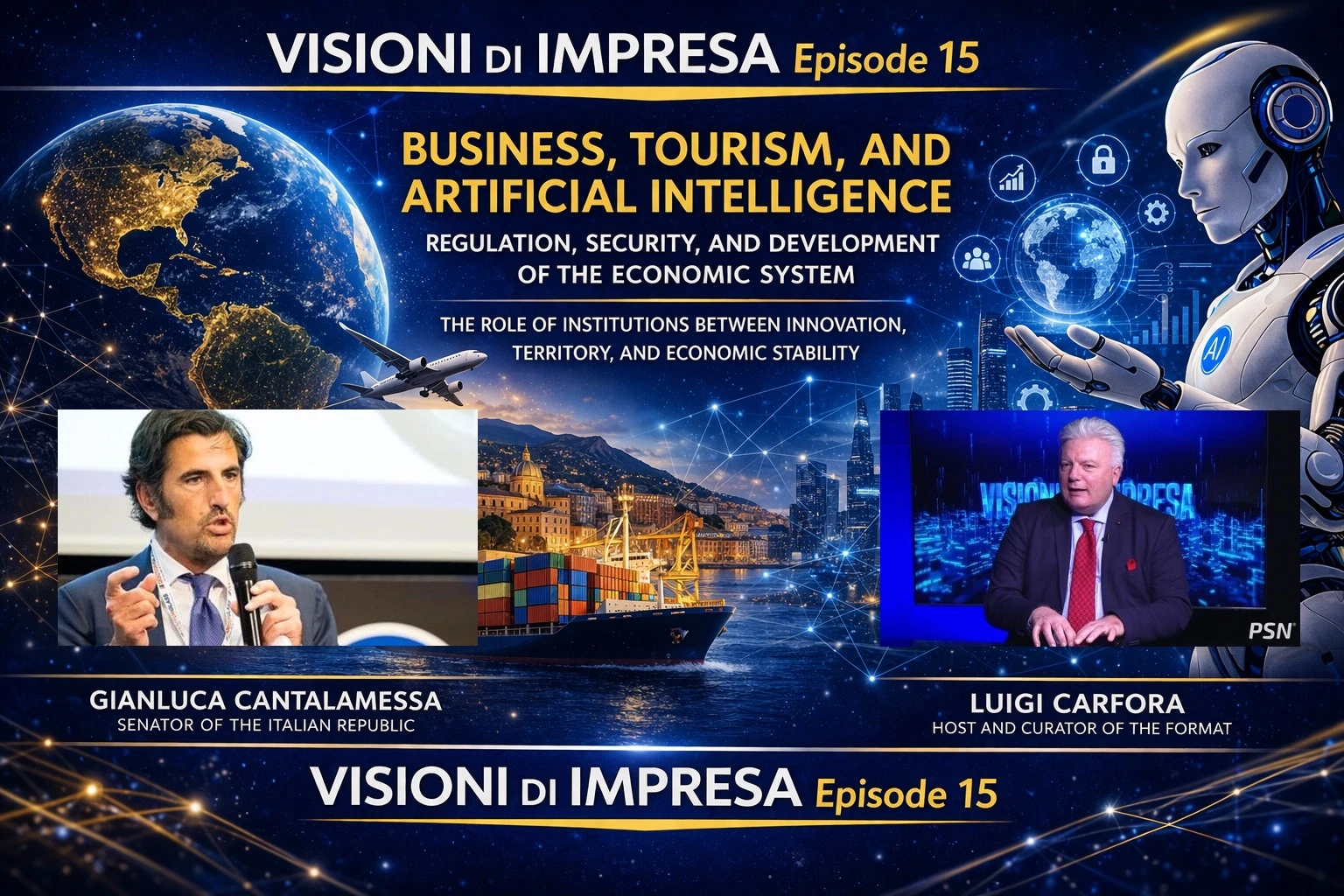
🎥 VISIONI DI IMPRESA – Episode 16 | 2026 Cycle
Public Administration, Artificial Intelligence and Work: The Italian State Facing the Test of Change
Theme: Transformation of Public Administration in Italy between artificial intelligence, work organization and the State's ability to support economic development
✦ Guiding Thought of the Episode
"The State does not slow down development due to a lack of resources, but because of its inability to transform itself."
Episode Introduction
After exploring in previous episodes the relationship between business, innovation, territory and institutions, Visioni di Impresa addresses a decisive issue:
👉 the real functioning of the Italian State.
Not in its theoretical dimension, but in its concrete ability to impact the economy, labor and the country's competitiveness.
Because there is a truth that is rarely addressed directly:
👉 the main constraint on development is not external
👉 it lies within the public system
Within this context, the contribution of Marco Carlomagno, Secretary General of FLP – Federation of Public Sector Workers, becomes central, as he has long analyzed and represented the transformation of public work in Italy.
👤 Guest Profile
Marco Carlomagno is the Secretary General of FLP – Federation of Public Sector Workers, one of the leading representative trade union organizations within the Italian Public Administration.
Throughout his career, he has developed a cross-functional expertise combining:
– direct knowledge of public sector work dynamics
– analysis of organizational models within the Italian Public Administration
– continuous engagement with institutions on reform processes
– in-depth focus on transformations driven by technological innovation
He is among the most active voices in the national debate on:
– modernization of Public Administration in Italy
– impact of artificial intelligence on work
– evolution of skills in the public sector
– new organizational models and smart working
In recent years, he has placed particular emphasis on the relationship between:
👉 technological innovation and quality of work
👉 efficiency of Public Administration and economic development
👉 workers' rights and transformation of production systems
His approach moves beyond the traditional opposition between innovation and protection, promoting a vision of:
👉 Public Administration as a strategic driver of development
👉 public work as a key element of the national system
👉 Guiding Question of the Episode
"Is Public Administration today capable of supporting Italy's development, or does it risk becoming the main factor slowing it down?"
Public Administration: Infrastructure or Obstacle?
Public Administration should be the main infrastructure of development.
However, in practice, it often becomes:
– a system that slows down processes
– a multiplier of complexity
– a source of uncertainty for businesses and citizens
👉 This is not an ideological issue
👉 it is a functional one
An inefficient Public Administration is not only an internal problem:
it is a direct cost for the Italian economic system.
Artificial Intelligence: Solution or Alibi?
The introduction of artificial intelligence in Public Administration is often presented as an inevitable turning point.
But the real question is different:
👉 is AI transforming Public Administration
👉 or is it masking its inefficiencies?
Without a deep review of processes, the risk is clear:
– digitizing existing inefficiencies
– accelerating structural errors
– replacing without redesigning
Carlomagno highlights a crucial point:
👉 technology does not reform systems
👉 it amplifies them
Ve.R.A. and the New Face of the Tax Administration
The introduction of artificial intelligence into Public Administration is no longer merely a theoretical scenario.
On May 23, 2026, the Ve.R.A. (Verification of Financial Relationships) system of the Italian Revenue Agency officially entered into operation, becoming one of the most advanced fiscal risk analysis tools currently implemented within the Italian public system.
The platform uses:
– algorithmic analysis
– interconnected databases
– automated processing of financial flows
– banking data
– electronic invoicing
– tax and asset information
with the objective of identifying anomalies and positions considered at risk of tax evasion.
Compared to the past, the transformation is evident.
The tax administration no longer operates only through traditional audits and manual inspections.
👉 it is entering a predictive and automated dimension.
This introduces several elements of efficiency:
– faster controls
– stronger data-crossing capabilities
– reduction of random inspections
– targeted anomaly detection
– increased tax recovery capacity
But it also raises highly sensitive questions.
Because the speed of the fiscal machine risks becoming dramatically faster than:
– the taxpayer's ability to defend themselves
– the understanding of algorithmic mechanisms
– the real possibility of correcting errors or anomalies
A broader reflection therefore emerges regarding the relationship between State, technology and economic freedom.
👉 the risk is building a Public Administration increasingly efficient in control
👉 but not equally efficient in supporting economic development
The perception among many citizens and small businesses is that of a fiscal State becoming increasingly penetrating and automated.
A system capable of:
– monitoring
– cross-checking
– flagging
– intervening rapidly
while often continuing to show slowness in:
– payments
– authorizations
– administrative responses
– reduction of bureaucratic pressure
This is where the central issue of the State's digital transformation emerges.
👉 technology is making Public Administration faster
👉 but the question remains: who will truly benefit from this speed?
Because without a balance between:
– control
– protection
– development
– rights
– economic growth
the risk is creating a system increasingly perceived as moving toward a model of permanent fiscal surveillance.
And the most critical issue concerns the most fragile parts of the economic system:
– small businesses
– professionals
– self-employed workers
who often possess fewer:
– defensive tools
– organizational structures
– financial resources
compared to large economic groups and more structured international tax evasion systems.
👉 the real challenge is not only digitalizing control
👉 but building a State capable of being simultaneously efficient, fair and sustainable for the productive system.
The Core Issue: Public Work
The real issue is not technological.
It is work.
Public Administration in Italy today faces a choice:
– maintain outdated organizational models
– or radically rethink public work
This requires addressing:
– real skills
– career paths
– system attractiveness
– individual responsibility
👉 without this transition, innovation remains superficial
Skills: The Real Boundary
The debate on innovation in Public Administration often focuses on tools.
But the real boundary lies elsewhere:
👉 skills
Without serious and structured investment:
– technology remains unused
– processes do not change
– the system remains stagnant
The risk is building a formally modern but substantially unchanged Public Administration.
Organizational Models: The Real Ground of Reform
Real change lies in organizational models.
Not in software.
The issue is clear:
👉 Public Administration is designed to manage procedures
👉 but today it must manage results
This implies:
– widespread accountability
– performance evaluation
– integration between digital and in-person work
– decision-making capacity
Without this shift, any reform remains incomplete.
The Critical Point: The State and Trust
The functioning of Public Administration directly impacts a key factor:
👉 trust
Trust of businesses
Trust of investors
Trust of citizens
When processes are uncertain and opaque:
– investments slow down
– businesses hesitate
– the system loses credibility
👉 trust is not abstract
👉 it is an economic variable
Innovation and Rights: A Necessary Balance
Technological transformation also raises a social issue.
It cannot be ignored.
Artificial intelligence affects:
– roles
– functions
– employment prospects
The risk is twofold:
– loss of work value
– exclusion of outdated skills
👉 innovating without managing social impact creates instability
The Italian Limit: Reforms Without Implementation
A critical point emerges:
👉 Italy does not lack reforms
👉 it lacks implementation
Many innovations remain:
– formal
– incomplete
– not integrated
The result is a system that changes on paper, but not in operational reality.
From Public Administration to the Economic System
The link with the business world is direct:
👉 the quality of Public Administration determines the quality of the economy
Timeframes, skills, decisions and accountability impact:
– investment capacity
– competitiveness
– territorial development
There are no strong businesses within a weak public system.
Key Topics of the Discussion
– the State as an economic infrastructure
– artificial intelligence in Public Administration
– public work and organizational transformation
– skills and training
– relationship between Public Administration and businesses
– trust and the economic system
– innovation and rights
– reforms and implementation capacity
✦ Episode Reflection
"The future does not depend on how much we innovate, but on how capable we are of transforming the State that must support that innovation."
🎙 EPISODE 16 – 2026 CYCLE
Hosted and curated by
Luigi Carfora
President, Confimi Industria Campania
President, Consorzio Suggestioni Campane Promotion
Guest of the episode
Marco Carlomagno
Secretary General, FLP – Federation of Public Sector Workers
🎬 Directed by: Pino Fontana
📺 Broadcast on Per Sempre News
📍 Recorded at Per Sempre News studios
📺 Available on Per Sempre News and on our social channels
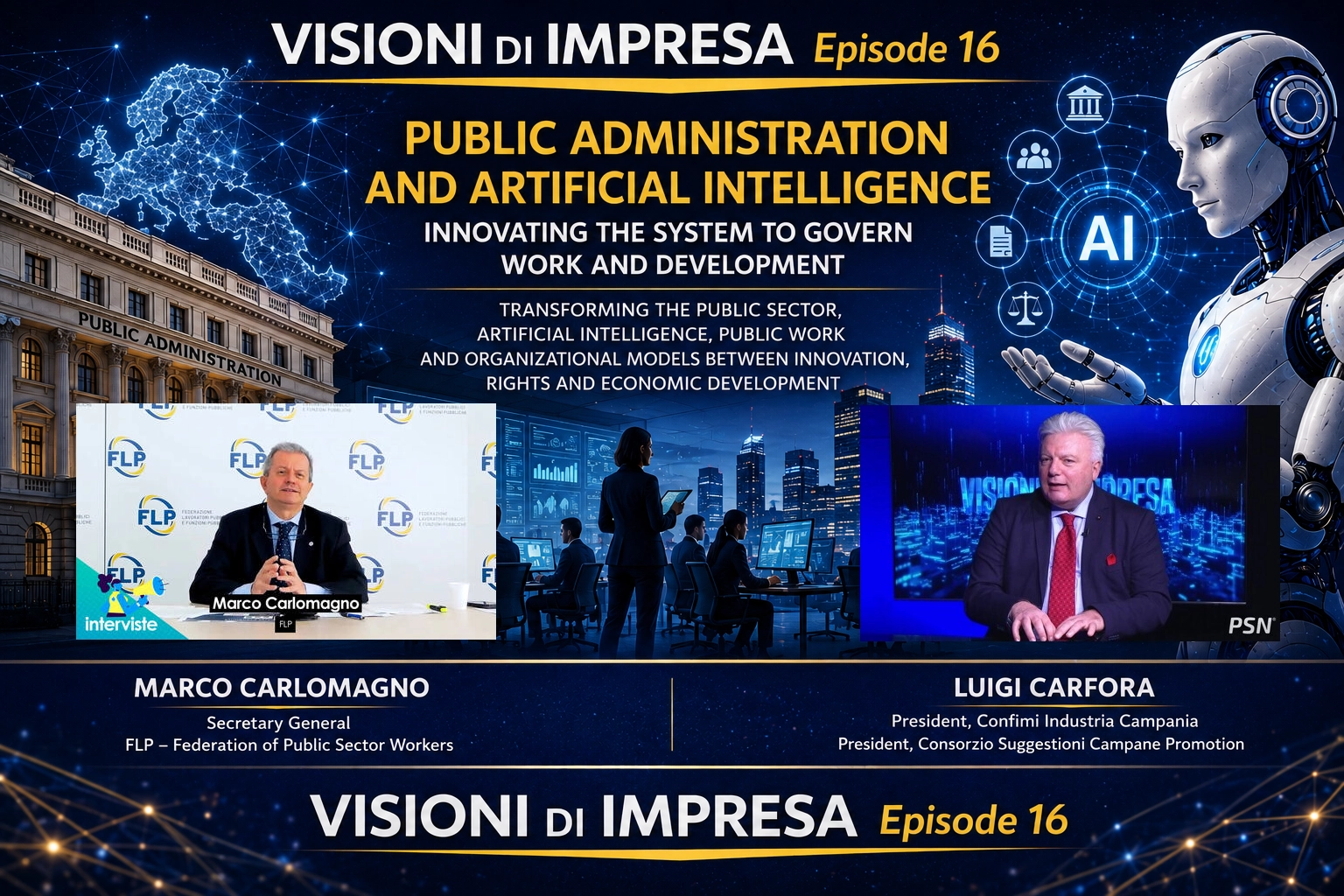
🎥 ENTERPRISE VISIONS – Episode 17 | 2026 Cycle
Man, Work and Spirituality in the Age of Artificial Intelligence: between global enterprise, technology and the meaning of being human
Theme: The impact of artificial intelligence and humanoids on economic processes, cultures and the spiritual dimension of human beings, between the transformation of work and the response of theology
✦ Guiding Thought of the Episode
"In a global economy increasingly driven by technology and algorithms, the real challenge is not what machines can do, but what human beings risk becoming."
Episode Introduction
After exploring in previous episodes the relationship between business, the State, innovation and work, Enterprise Visions moves into an even deeper—and in many ways decisive—dimension:
👉 the relationship between global economic development and human identity.
In an increasingly interconnected system, where enterprise and business operate on a global scale, artificial intelligence and humanoid systems are transforming not only production processes, but also the way human beings work, relate to one another and understand themselves.
This is no longer just about innovation.
👉 it is about understanding whether, within this transformation,
the human being will remain at the center of the system
👉 or will risk being progressively reduced to an economic function
And with it, whether the spiritual dimension—which has always represented the foundation of human meaning—will still find its place.
👤 Guest Profile
Don Salvatore Giuliano is a priest of the Archdiocese of Naples, parish priest of the Basilica of San Giovanni Maggiore in the historic center of the city and Dean of the First Deanery.
Alongside his pastoral activity, he holds an academic role as Professor of Sacramental Theology at the Pontifical Athenaeum Regina Apostolorum in Rome and at theological institutions in Naples, contributing to the formation of both clergy and laypeople.
His path combines:
– pastoral experience in complex urban contexts
– academic activity and theological reflection
– attention to contemporary cultural processes
Over the years, he has developed a particular sensitivity to the relationship between:
👉 faith and social transformations
👉 contemporary culture and spiritual dimension
👉 human beings and technological change
👉 a profile that places him in a privileged position to address one of the most delicate issues of our time
Global Economy and the Transformation of the Human Being
The current historical phase is marked by unprecedented acceleration.
Enterprise and business now operate within a global context where:
– decisions are driven by data
– processes are automated
– relationships are mediated by technology
Artificial intelligence introduces a dominant logic:
👉 efficiency
👉 speed
👉 optimization
But this logic is not neutral.
As it enters economic systems, it tends to redefine the role of the human being:
👉 from subject to function
👉 from person to process
The risk is that technological globalization produces a system in which human value is progressively subordinated to the logic of outcomes.
Work: Between Production and Meaning
In both human and Christian tradition, work has never been merely an economic activity.
It is:
– participation
– construction
– expression of the person
Yet in a context dominated by AI and humanoids, work tends to be redefined as:
– management of systems
– supervision of processes
– adaptation to technological logic
👉 the issue is not only what changes in work
👉 but what changes in the human being who works
If work loses its dimension of meaning, it becomes purely functional.
And when work becomes a function, the human being risks becoming one as well.
Humanoids and Relationships: A New Frontier
The introduction of humanoids into social and economic contexts opens an even more radical question.
Machines capable of:
– interacting
– learning
– simulating empathy
introduce a new form of relationship.
But is this relationship real?
👉 or is it a functional simulation?
As global business integrates these technologies to increase efficiency and productivity, a deeper question emerges:
👉 is the human being still able to distinguish between authentic relationships and artificial interaction?
Global Enterprise and the Centrality of the Human Being
This issue is not only about technology.
It concerns the economic model.
A global system driven by:
– algorithms
– platforms
– automation
can generate growth, but raises an inevitable question:
👉 who ensures that the human being remains an end and not a means?
If enterprise becomes only optimization, and business only efficiency, the risk is that:
– the person is reduced to data
– work to function
– relationships to interaction
Spirituality and Technology: The Point of Fracture
It is in this context that the spiritual question emerges.
For the first time, technology enters a space historically belonging to human interiority.
Scenarios are emerging where:
– digital tools support spiritual paths
– intelligent systems provide existential answers
– platforms mediate religious experiences
👉 but can spirituality be mediated by technology?
👉 or is there a dimension of the human being that remains irreducible?
The Response of Theology
Theology is not called to oppose technology.
It is called to interpret it.
To understand:
– what the human being is
– what consciousness is
– what relationship means
– what freedom means
👉 elements that cannot be reduced to algorithms
The point is not to limit innovation.
👉 but to define the boundaries within which it remains human
The relevance of this reflection becomes even more evident today.
In recent hours, it was officially announced that Pope Leo XIV will soon publish his first Encyclical, entitled Magnifica Humanitas, dedicated to "the protection of the human person in the age of artificial intelligence."
The document — scheduled for official presentation on May 25 — explicitly recalls the historical legacy of Rerum Novarum by Pope Leo XIII, the encyclical that addressed the social consequences of the Industrial Revolution at the end of the nineteenth century.
Today, the Church appears ready to confront another epochal transformation.
No longer only the industrial revolution.
👉 but the algorithmic revolution.
According to previews released by Vatican sources and authoritative Catholic observers, the Pontiff intends to place at the center of the debate:
– human dignity
– work
– conscience
– freedom
– the relationship between humanity and technology
within a context in which artificial intelligence risks profoundly redefining:
– the economy
– social relationships
– labor systems
– the very identity of the human person.
This development makes the topic explored in this episode of Enterprise Visions even more timely and significant.
👉 understanding not only what technology will be capable of doing
👉 but what vision of humanity will remain at the center of the system as change accelerates.
Formation: The Challenge for the Clergy
The ongoing transformation also imposes responsibility on the Church.
Not only pastoral.
But cultural.
A new form of formation is needed, capable of:
– understanding technology
– interpreting economic changes
– accompanying human beings in complex contexts
Because the risk is clear:
👉 a growing gap between technological evolution and spiritual understanding
Cultural Risk: A Society Without Depth
If technology becomes dominant without being understood, the risk is cultural.
A society that is:
– fast but without reflection
– connected but isolated
– efficient but without meaning
In such a scenario, the spiritual dimension risks being marginalized.
👉 not because it disappears
👉 but because it is no longer recognized
From Technology to Meaning
The real challenge is not to stop change.
It is to understand it.
👉 it is not about deciding what technology will do
👉 but about who the human being will be who uses it
And this requires dialogue between:
– enterprise
– economy
– culture
– theology
Key Topics of the Discussion
– global enterprise and transformation of the human being
– artificial intelligence and identity
– humanoids and relationships
– work between function and meaning
– spirituality in the technological age
– role of theology
– formation of the clergy
– balance between innovation and meaning
✦ Episode Reflection
"The future does not depend on the power of technology, but on the ability of human beings to remain human while using it."
🎙 EPISODE 17 – 2026 CYCLE
Hosted and curated by
Luigi Carfora
President, Confimi Industria Campania
President, Consorzio Suggestioni Campane Promotion
Guest of the episode
Don Salvatore Giuliano
Parish Priest, Basilica of San Giovanni Maggiore – Naples
Professor of Sacramental Theology
Dean of the First Deanery
🎬 Directed by: Pino Fontana
📺 Broadcast on Per Sempre News
📍 Recorded at Per Sempre News studios
📺 Available on Per Sempre News and on our social channels
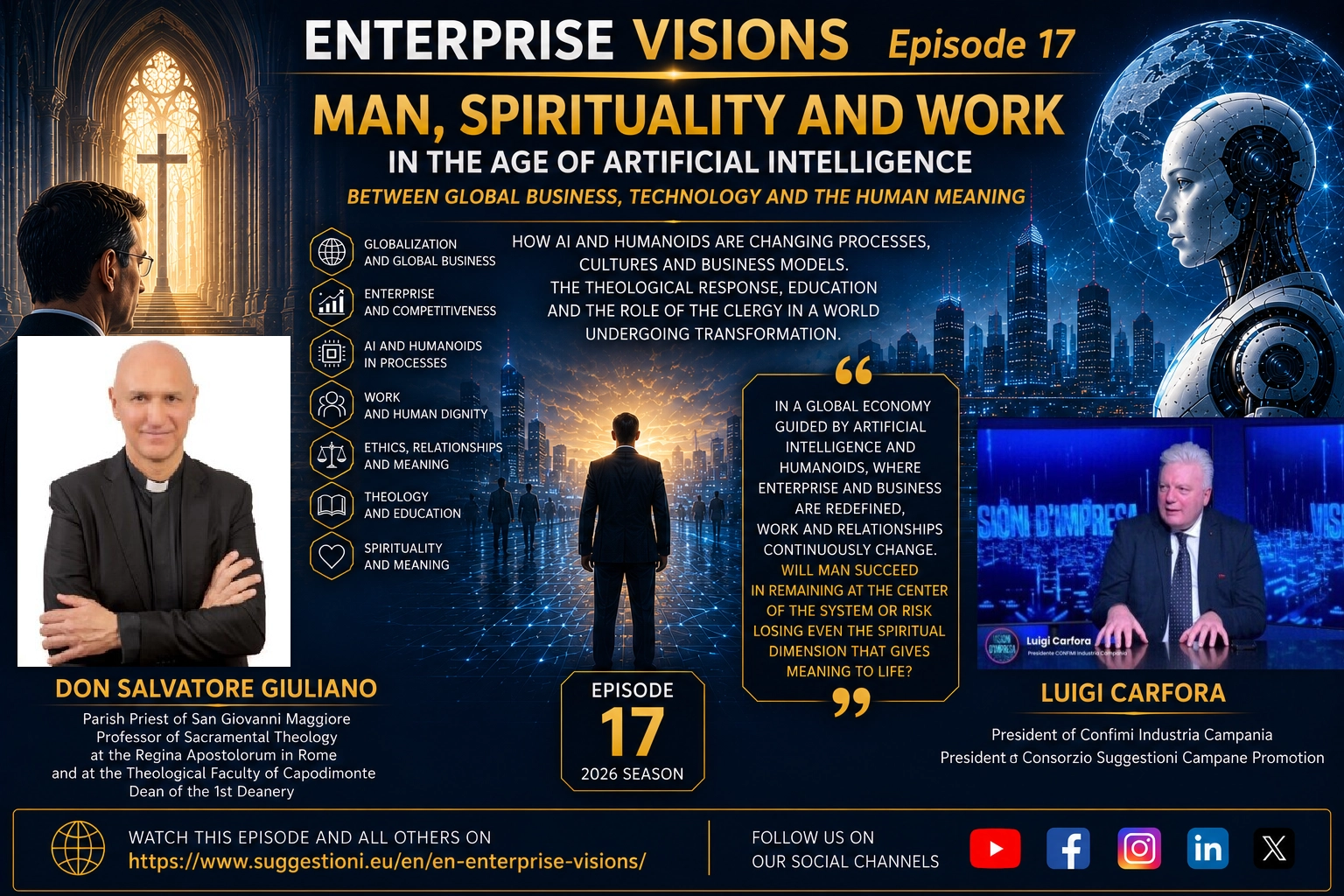
🎥 ENTERPRISE VISIONS – Episode 18 | 2026 Cycle
Training, Innovation and Work: Building Competencies in the Global Economy between AI, Industrial Crises and the Transformation of Productive Systems
Theme: Universities, advanced education, artificial intelligence, technological transfer and professional reskilling between innovation, industrial crises and new development models
✦ Guiding Thought of the Episode
"In an economy dominated by the speed of innovation, the real risk is not the arrival of technology, but leaving people without the competencies needed to face it."
Episode Introduction
After exploring in previous episodes the relationship between enterprise, innovation, artificial intelligence, work and social transformation, Enterprise Visions addresses one of the most strategic and concrete issues of our time:
👉 the relationship between education, technology and the economic survival of productive systems.
Artificial intelligence, advanced robotics and humanoid systems are transforming at unprecedented speed:
– production
– work organization
– industrial models
– market-required competencies
The issue is no longer whether change will arrive.
👉 change is already happening.
The real question is another:
👉 are enterprises, institutions and educational systems truly prepared to manage this acceleration?
Because while technology evolves rapidly, millions of workers risk suddenly finding themselves excluded from the market.
👤 Guest Profile
Sergio Bolletti Censi is founder and Managing Director of Cosvitec Università & Impresa, a consortium established with the objective of creating a stable connection between universities, research, education and productive systems.
Throughout his career, he has developed cross-sector expertise combining:
– innovation and technological transfer
– advanced university and professional training
– European project development
– internationalization of competencies
– international cooperation
– territorial development
An expert in food technologies, food safety and quality systems, he has contributed to innovation processes linked to food-tech and the evolution of productive supply chains.
According to professional and institutional sources, Sergio Bolletti Censi was among the promoters involved in enhancing the professional role of Food Technologists in Campania, contributing to the initial structuring of the regional professional order and participating in its first representative activities.
Over the years, he has consolidated collaborations with:
– University Federico II
– University Parthenope
– research institutions
– European innovation networks
– Erasmus+ and Horizon programs
developing projects related to:
– sustainability
– digital innovation
– startups
– AI and education
– technological transfer
– international mobility
Through Cosvitec, he has promoted programs and partnerships in Spain, Kenya, Somalia and numerous other international contexts, building models that integrate:
👉 education
👉 innovation
👉 local development
👉 economic cooperation
👉 Guiding Question of the Episode
"In a global economy increasingly dominated by AI, automation and humanoids, is the educational system still capable of protecting work and competencies, or are we facing a technological transformation that risks leaving millions of people without role, income and perspective?"
Technology and the Acceleration of Change
The current economic phase is characterized by unprecedented acceleration.
Artificial intelligence is not merely transforming specific sectors.
It is redefining:
– production timelines
– organizational models
– required competencies
– the value of human work
Enterprises face continuous pressure to:
👉 innovate rapidly
👉 reduce costs
👉 increase competitiveness
This produces an evident consequence:
👉 evolutionary processes are dramatically accelerating.
And when change accelerates, education can no longer remain slow.
The Critical Issue: Competencies Becoming Obsolete Within Years
One of the major emerging problems concerns the lifespan of competencies.
Professions considered central only a few years ago now risk becoming marginal.
Technology is replacing:
– repetitive activities
– administrative processes
– intermediate functions
– parts of industrial operations
👉 the issue is not only technological
👉 it is social and economic
Because without continuous updating, thousands of workers risk losing their place in the labor market.
The Electrolux Case: When Transformation Becomes a Social Crisis
The recent Electrolux case represents one of the clearest signals of this transformation.
The Swedish home appliance multinational announced around 1,700 job cuts in Italy — almost 40% of the group's Italian workforce — including the closure of the Cerreto d'Esi plant, located in the Province of Ancona (Marche), and major reductions across other Italian production sites.
The reasons highlighted include:
– crisis in European demand
– increased production costs
– Asian competition
– industrial reorganization needs
– automation and process optimization
But the most delicate issue is another:
👉 what happens to workers when productive systems change faster than their ability to adapt?
The Electrolux case is not isolated.
In recent years, many companies have:
– relocated production
– automated processes
– reduced personnel
– replaced human processes with technological systems
👉 and this phenomenon is expected to increase.
From Industrial Crisis to the Need for Reskilling
When a company enters crisis or changes its productive model, the issue does not concern only the enterprise itself.
It affects:
– families
– territories
– local economies
– social stability
For this reason, education can no longer be considered an accessory element.
👉 it must become a strategic infrastructure of the economic system.
Professional reskilling therefore becomes essential:
– to reintegrate workers expelled from traditional sectors
– to support industrial transformation
– to prevent social exclusion and income loss
Because a worker who loses competencies today risks losing:
👉 economic autonomy
👉 professional dignity
👉 the possibility of re-entering the market
Universities, Education and Enterprise: Building an Ecosystem
This is where the relationship between:
– universities
– training institutions
– enterprises
– research
becomes strategic.
Educational systems must evolve together with technology.
They cannot remain limited to theory.
They must anticipate:
– new professions
– new competencies
– new productive models
Experiences developed by Cosvitec demonstrate a different model:
👉 education integrated with innovation and enterprise.
International Training and New Global Balances
The international experience developed by Cosvitec represents a central element of the discussion.
Projects carried out in Spain, Kenya, Somalia and other international contexts demonstrate that education can no longer be interpreted exclusively at a local level.
Today, competencies move within a global market.
Enterprises increasingly seek:
– adaptable professionals
– technological capabilities
– international competencies
– knowledge of increasingly integrated processes
In this scenario, international cooperation is not only about educational development.
👉 it concerns the construction of new economic and employment balances.
Programs developed by Cosvitec highlight a model in which:
– universities
– territories
– enterprises
– institutions
– international productive systems
enter into direct connection.
Education therefore becomes:
👉 transfer of competencies
👉 economic cooperation
👉 professional integration
👉 creation of new employment opportunities
🌍 Globalization, Work and New Competencies
Globalization is profoundly transforming labor markets.
There are no longer completely isolated productive systems.
European industrial crises, relocations, automation and artificial intelligence are generating increasingly rapid international competition.
This produces an evident consequence:
👉 competencies are becoming the true global economic passport.
Today, workers no longer compete only within nearby territories.
They compete within an international system in which:
– technology
– innovation
– education
– adaptability
become decisive factors.
For this reason, education must evolve continuously.
👉 not only to create employment
👉 but to prevent economic exclusion and social marginalization.
AI and New Educational Models
Artificial intelligence is also transforming the way people learn.
New tools enable:
– advanced simulations
– immersive education
– personalized learning
– integration between enterprise and teaching
Yet a decisive question emerges:
👉 who will train the competencies required to govern these systems?
Because the risk is evident:
– technology without competencies
– innovation without application
– enterprises without qualified human capital
Systemic Risk: Development Without Social Balance
Innovation produces growth only if systems are capable of absorbing it.
If technology accelerates without educational adaptation, the risk is creating:
– excluded workers
– marginalized territories
– permanent industrial crises
– new forms of professional poverty
👉 the real issue is not technology
👉 but the speed at which it transforms markets compared to people's ability to adapt
Education as Economic Security
In this scenario, education takes on a new meaning.
It is no longer only instruction.
👉 it becomes economic security.
Because in the future:
– work will change multiple times
– competencies will require constant updating
– professional stability will depend on the ability to evolve
And this requires a system capable of integrating:
– enterprise
– innovation
– universities
– research
– continuous education
Key Topics of the Discussion
– AI and acceleration of productive processes
– industrial crises and transformation of work
– the Electrolux case and industrial layoffs
– education and professional reskilling
– universities and productive systems
– innovation and economic security
– competencies and new industrial models
– balance between technology and social sustainability
✦ Episode Reflection
"The future will not depend only on the ability of enterprises to innovate, but on the ability of economic systems not to leave people behind while change accelerates."
🎙 EPISODE 18 – 2026 CYCLE
Hosted and curated by
Luigi Carfora
President, Confimi Industria Campania
President, Consorzio Suggestioni Campane Promotion
Guest of the episode
Sergio Bolletti Censi
Managing Director
Cosvitec Università & Impresa
🎬 Directed by: Pino Fontana
📺 Broadcast on Per Sempre News
📍 Recorded at Per Sempre News studios
📺 Broadcast on Per Sempre News and on our social channels
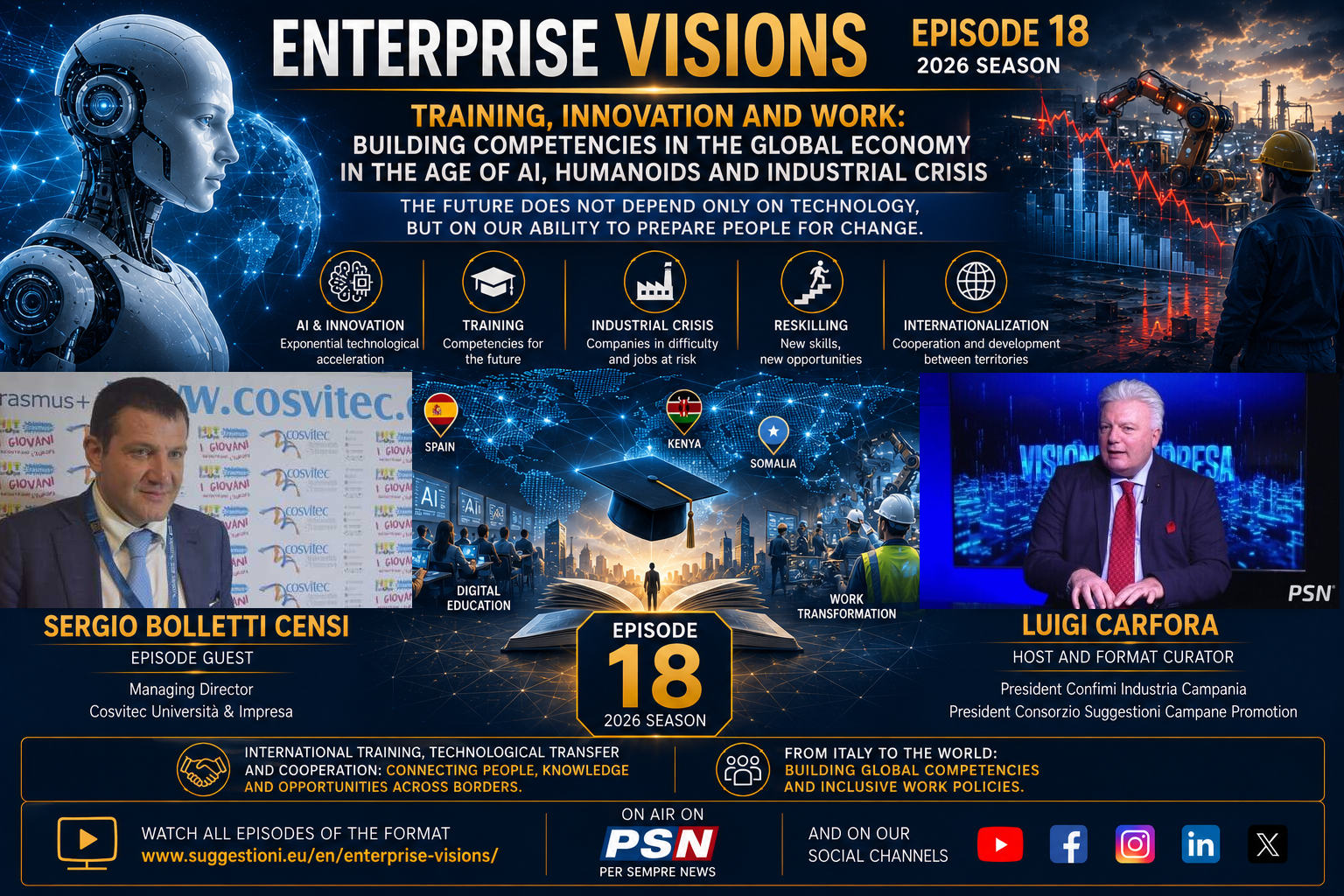
🎥 ENTERPRISE VISIONS – Episode 19 | 2026 Season
Business, Territory and Integrated Development: Building an Economic Ecosystem Connecting Industry, Manufacturing, Craftsmanship, Tourism, Innovation and Artificial Intelligence
Theme: The evolution of economic representation and the construction of an integrated territorial ecosystem capable of generating development, employment and competitiveness in the new global scenario
✦ Guiding Thought of the Episode
"In today's global scenario, having quality businesses is no longer enough.
What is needed is a territory capable of transforming its skills, productions and identity into an integrated, competitive and stable economic system."
Introduction to the Episode
After exploring in previous episodes the major transformations linked to artificial intelligence, labor, public administration, spirituality, education and the evolution of productive systems, Enterprise Visions addresses one of the most strategic issues for the future of Southern Italy:
👉 the construction of an integrated territorial economic network.
Today, the issue is no longer only about:
– the quality of individual companies
– the value of productions
– professional skills
– territorial excellence
👉 it is about the ability of a territory to transform these resources into an organized economic system.
Globalization, artificial intelligence, market digitalization and the speed of new economic platforms are profoundly reshaping traditional production models.
In this scenario:
– isolated businesses
– disconnected supply chains
– fragmented representative systems
– uncoordinated territorial structures
risk progressively losing competitiveness.
For this reason, it is becoming increasingly necessary to build:
👉 integration among production chains
👉 connections between territorial economic systems
👉 shared development strategies
👉 coordinated economic networks
👉 common platforms for competitiveness and representation
among:
– industry
– manufacturing
– advanced craftsmanship
– tourism
– culture
– innovation
– chamber systems
– training
– internationalization
– AI and digital transformation
👤 Guest Profile
Fabrizio Luongo is Deputy Vice President of the Naples Chamber of Commerce and a historic executive within the Casartigiani Campania system, one of the main representative organizations for craftsmanship and small and medium-sized enterprises in the region.
Throughout his career, he has developed extensive experience in the relationship between:
– economic representation
– territorial institutions
– chamber systems
– business development
– organization of productive supply chains
– territorial competitiveness
His professional experience belongs to a context in which economic representation can no longer be limited to the formal protection of productive categories.
👉 it must become a concrete capacity to build systemic development.
Over the years, he has participated in:
– institutional working groups
– territorial development processes
– economic coordination activities
– initiatives linked to SME competitiveness
– strengthening relations between businesses and institutions
with particular attention to:
– the craft sector
– micro and small enterprises
– territorial production networks
– the enhancement of Campanian Made in Italy
– the strategic role of the chamber system in economic development
👉 GUIDING QUESTION OF THE EPISODE
"In a global economy driven by AI, automation and new international networks, can the Campanian productive system still survive as a collection of isolated businesses, or is it necessary to build an integrated territorial ecosystem capable of connecting industry, manufacturing, craftsmanship, tourism, innovation, training and economic representation in order to generate stable development, employment and long-term competitiveness?"
From Representation to the Construction of Integrated Territorial Strategies
The reflections of this episode take place within an economic context in which even the role of economic representation is undergoing profound transformation.
Today, representative organizations can no longer limit themselves exclusively to:
– category protection
– management of immediate business needs
– traditional institutional mediation
Global economic transformation, artificial intelligence, international competition, market acceleration and the evolution of production systems require a higher level of territorial organization.
For this reason, it becomes necessary to:
👉 build shared strategic paths
👉 create structured relationships between different economic systems
👉 develop collaborative territorial platforms
👉 promote integration among production chains
👉 establish stable connections between businesses, institutions and territories
The central issue no longer concerns only individual companies.
👉 it concerns the ability of representative organizations to create the conditions for territories to evolve as integrated economic systems.
This means connecting:
– industry
– manufacturing
– advanced craftsmanship
– tourism
– innovation
– training
– chamber systems
– internationalization
– territorial institutions
within a coordinated vision of development.
The economic dynamics of the various sectors naturally remain different.
Industry, craftsmanship, tourism and territorial services operate:
– with different economic models
– with different timeframes
– with autonomous productive logics
But precisely for this reason it becomes strategic to create:
👉 integration among complementary economies
👉 coordinated territorial networks
👉 collaborative supply chains
👉 common platforms for competitiveness and development
Because today competitiveness no longer depends only on the strength of individual companies.
👉 it depends on the ability of territorial networks and representative organizations to build an economic ecosystem capable of generating:
– development
– employment
– territorial attractiveness
– innovation
– international competitiveness
– economic stability
And this requires:
👉 strategic collaboration
👉 visionary capacity
👉 coordination among organizations
👉 continuous training
👉 integration among businesses, institutions and territories
The Italian Challenge: Excellence Without Integration
Southern Italy does not lack:
– productive capacities
– professional skills
– manufacturing excellence
– craftsmanship quality
– tourism attractiveness
– cultural identity
– territorial value
👉 what is often missing is integration among these resources.
For years, the Italian productive system created value through:
– industrial districts
– widespread manufacturing
– specialized craftsmanship
– micro and small enterprises
But today the global context has profoundly changed.
International competition requires:
👉 critical mass
👉 coordination
👉 integrated supply chains
👉 shared strategies
👉 organized territorial platforms
Because competitiveness no longer depends solely on the quality of individual companies.
👉 it depends on the ability of territories to function as integrated economic ecosystems.
Production Chains, Tourism and New Integrated Territorial Economies
One of the central points of the discussion concerns the need to overcome fragmented economic models.
For years:
– manufacturing
– craftsmanship
– tourism
– culture
– territorial services
have been considered separate sectors.
Today this model is no longer sufficient.
Modern competitiveness is increasingly built through:
👉 connections among supply chains
👉 integration among territorial economies
👉 the ability to transform territories into experiential economic platforms.
Craftsmanship, in particular, does not survive exclusively through international export.
Its economic value often develops:
– within territorial tourism
– through the Made in Italy experience
– through cultural attractiveness
– in connection with the hospitality economy
– in the construction of experiential territorial economies
For this reason, the role of DMOs and organized territorial systems becomes strategic.
Master Artisan, Training Workshops and the Transfer of Skills
Within the discussion concerning territorial identity, professional skills and economic development, particular importance is also given to the institution of the Master Artisan, established under Campania regional legislation.
All artisan enterprises registered with one of the five Chambers of Commerce in Campania may apply for recognition as a Master Artisan.
To obtain this honorary title, businesses must demonstrate at least ten years of professional activity and submit a professional curriculum documenting their experience and skills.
The chamber system has also developed dedicated information tools to assist businesses throughout the recognition process.
The title is not merely symbolic.
It becomes an official qualification recorded within the company's chamber documentation.
More importantly, it represents the preliminary step toward obtaining recognition as a Training Workshop (Bottega Scuola).
The Training Workshop plays a strategic role in transferring professional skills to younger generations.
Through this model it becomes possible to strengthen the relationship between professional experience, practical training and workforce integration.
Particularly significant is its connection with apprenticeship programs.
For apprentices aged between 16 and 32 employed by recognized Training Workshops, exemption from the mandatory external training requirement of 400 hours per year may be granted, acknowledging the educational value of learning directly within the enterprise.
In an era characterized by artificial intelligence, automation, industrial transformation and rapidly evolving markets, the transfer of skills becomes increasingly strategic.
Because future competitiveness will not depend solely on innovation.
It will also depend on the ability to preserve, transfer and continuously update the knowledge accumulated within local territories.
Tradition and innovation are not opposing concepts.
👉 They are complementary elements of the same development strategy.
A competitive territory is one capable of integrating:
– experience
– education
– innovation
– productive culture
– new technologies
– human capital
within a single economic ecosystem oriented toward growth, employment and the enhancement of Made in Italy.
Because contemporary tourism no longer searches only for places.
👉 it searches for identity, experiences, productions, culture and authenticity.
An integrated territorial system can therefore generate:
– employment
– economic spillovers
– longer tourist stays
– enhancement of local productions
– strengthening of territorial supply chains
even without necessarily transforming every craft production into industrial export.
The economic dynamics of craftsmanship and industrial manufacturing remain different.
But if coordinated within a systemic strategy, they can:
👉 strengthen each other
👉 increase territorial competitiveness
👉 generate new local wealth.
Innovation, AI and the Transformation of SMEs
The SME and craftsmanship system is also entering a phase of profound transformation.
AI, digitalization and automation are changing:
– production
– organization
– data management
– commercial processes
– market relationships
New digital platforms are redefining:
– economic models
– logistics
– distribution
– territorial promotion
– the relationship between products and experiences
The risk is clear:
👉 companies becoming too small to face the speed of change on their own.
For this reason, it becomes strategic to build:
– territorial networks
– shared services
– common platforms
– integrated innovation systems
– coordinated digital tools
– continuous training
Because AI, automation and new technologies require:
– new skills
– organizational capacities
– integrated supply chain management
– strategic use of digital platforms
Technological transformation cannot be faced individually.
👉 it requires organized systems and evolved representation.
Chamber Systems, International Networks and the Protection of Made in Italy
Chamber systems and territorial productive organizations now play a decisive role.
Not merely administrative.
👉 but strategic.
FEDRA 7.09, DIRE and the Evolution of the Digital Business Registry
Digital transformation is not affecting businesses alone.
It is increasingly reshaping the functioning of economic institutions and Public Administration itself.
A concrete example is represented by the entry into force, from June 4th 2026, of the new FEDRA 7.09 technical specifications on the DIRE platform of the Italian Business Register, approved by the Ministry of Enterprises and Made in Italy.
For many years FEDRA has been the technical system used for the preparation and electronic submission of applications to the Chambers of Commerce Business Register.
Through this infrastructure, businesses manage:
– company incorporations
– corporate amendments
– statutory changes
– registrations
– cancellations
– filing of corporate documents
– mandatory communications
– numerous administrative obligations
The FEDRA 7.09 update introduces a particularly significant innovation.
For the first time, the system substantially strengthens preventive automatic controls.
In the presence of:
– formal errors
– inconsistent data
– documentary discrepancies
– procedural anomalies
– incorrect entries
the application may be blocked before being accepted by the Business Register.
This change significantly transforms the relationship between businesses and the administrative system.
On the one hand it increases:
👉 quality of applications
👉 processing speed
👉 administrative efficiency
👉 error reduction
👉 process standardization
On the other hand, it requires increasingly advanced technical and administrative skills.
Businesses, professionals and representative organizations are now called upon to operate within procedures that are becoming more digitalized and automated.
This evolution perfectly reflects the transformations discussed in previous episodes of Visions of Enterprise dedicated to artificial intelligence and the evolution of Public Administration.
Because administrative systems themselves are progressively adopting approaches based on:
👉 preventive control
👉 algorithmic verification
👉 digital workflows
👉 reduction of manual intervention
A transformation that improves efficiency and transparency while simultaneously requiring continuous updating of professional skills.
Artigiancassa: Credit, Representation and Territorial Proximity
Among the topics discussed during the interview, particular attention was devoted to the evolution of access to credit for artisans and small businesses.
In January 2026, the new Artigiancassa officially began operating following a reorganization process that started after the withdrawal of BNL as majority shareholder several years ago.
The operation is particularly significant because the Italian Government encouraged the entry not of another private banking institution but of Mediocredito Centrale, strengthening the connection between development policies, business finance and the productive system.
The historic owners of the Artigiancassa brand remain:
– Casartigiani
– Confartigianato
– CNA
The national presidency has been entrusted to Attorney Leopoldo Facciotti, a long-standing national leader of Casartigiani and former Board Member of Fedart Fidi.
The new model provides financial instruments mainly aimed at micro, small and medium-sized enterprises, with financing generally ranging between:
– €30,000
– €500,000
and interest rates generally positioned between 4.5% and 5.5%.
For loans below €100,000, guarantees are normally provided through mutual guarantee institutions (Confidi), with costs averaging around 2.5% of the amount granted.
For loans exceeding €100,000, guarantees may be provided directly by Mediocredito Centrale.
However, the most interesting aspect concerns the organizational model.
Unlike the previous structure linked to the BNL branch network, the new Artigiancassa services will not be offered through traditional bank branches.
Instead, they will operate directly through the territorial structures of the founding associations.
In Campania, for example, Casartigiani is pursuing a decentralization strategy aimed at creating municipal associations capable of operating as local Artigiancassa service desks.
The objective is twofold:
👉 bringing financial services closer to businesses
👉 creating a local support network capable of working directly with professionals, consultants and economic operators
This model allows:
– decongestion of provincial offices
– faster processing times
– improved business assistance
– greater awareness of available opportunities
Average processing times are estimated at between 3 and 5 working days, while financing may extend up to seven years.
The Campania Regional Government is also evaluating measures aimed at reducing, and potentially eliminating, interest costs for eligible businesses through dedicated regional support schemes.
This represents a concrete example of how finance, business representation and territorial development can be integrated within a common strategy supporting entrepreneurship and economic growth.
In a historical phase characterized by:
– digital transition
– internationalization
– AI
– new global economic networks
– industrial transformation
– advanced tourism
– emerging markets
there is a growing need for:
– coordination
– representation
– business support
– construction of territorial economic networks
– protection of productive systems
– enhancement of Made in Italy
The central question therefore becomes:
👉 what more can chamber systems do to concretely support territorial businesses?
Today businesses demand:
– international connections
– integrated platforms for economic promotion, internationalization and territorial networking
– integrated enhancement of territorial tourism, local productions and cultural identities
– commercial protection
– shared innovation
– protection of Made in Italy
– support in technological transformation
– integration among tourism, manufacturing and craftsmanship
From Representation to the Construction of a Territorial Economic Platform
Today the real challenge is no longer merely representing productive categories.
👉 it is building an integrated territorial economic platform.
A structure capable of:
– connecting representative organizations, businesses, institutions and territories
– developing supply chain relationships
– integrating tourism, manufacturing and craftsmanship
– promoting shared innovation
– strengthening territorial competitiveness
– creating critical mass
– supporting employment and development
– protecting the economic value of territories
Because the future of Southern Italy will depend less and less on the strength of individual businesses.
👉 and increasingly on the ability of territories to organize themselves as integrated economic systems.
Among the Main Topics of the Dialogue
– territorial economic representation
– integrated production chains
– industry, manufacturing and advanced craftsmanship
– tourism and DMOs
– AI and productive transformation
– internationalization and global networks
– protection of Made in Italy
– innovation and SME competitiveness
– training and new skills
– construction of territorial economic ecosystems
– relationship between businesses, institutions and territories
✦ Reflection of the Episode
"The future of Southern Italy will not depend only on the quality of its businesses, but on the ability to transform productions, tourism, identity and innovation into an integrated, competitive and stable economic system."
🎙 EPISODE 19 – 2026 SEASON
🎙 Hosted and curated by
Luigi Carfora
President, Confimi Industria Campania
President, Consorzio Suggestioni Campane Promotion
👤 Guest of the Episode
Fabrizio Luongo
Deputy Vice President, Naples Chamber of Commerce
Executive, Casartigiani Campania
🎬 Direction: Pino Fontana
📍 Broadcast on Per Sempre News
📍 Recorded at Per Sempre News Studios
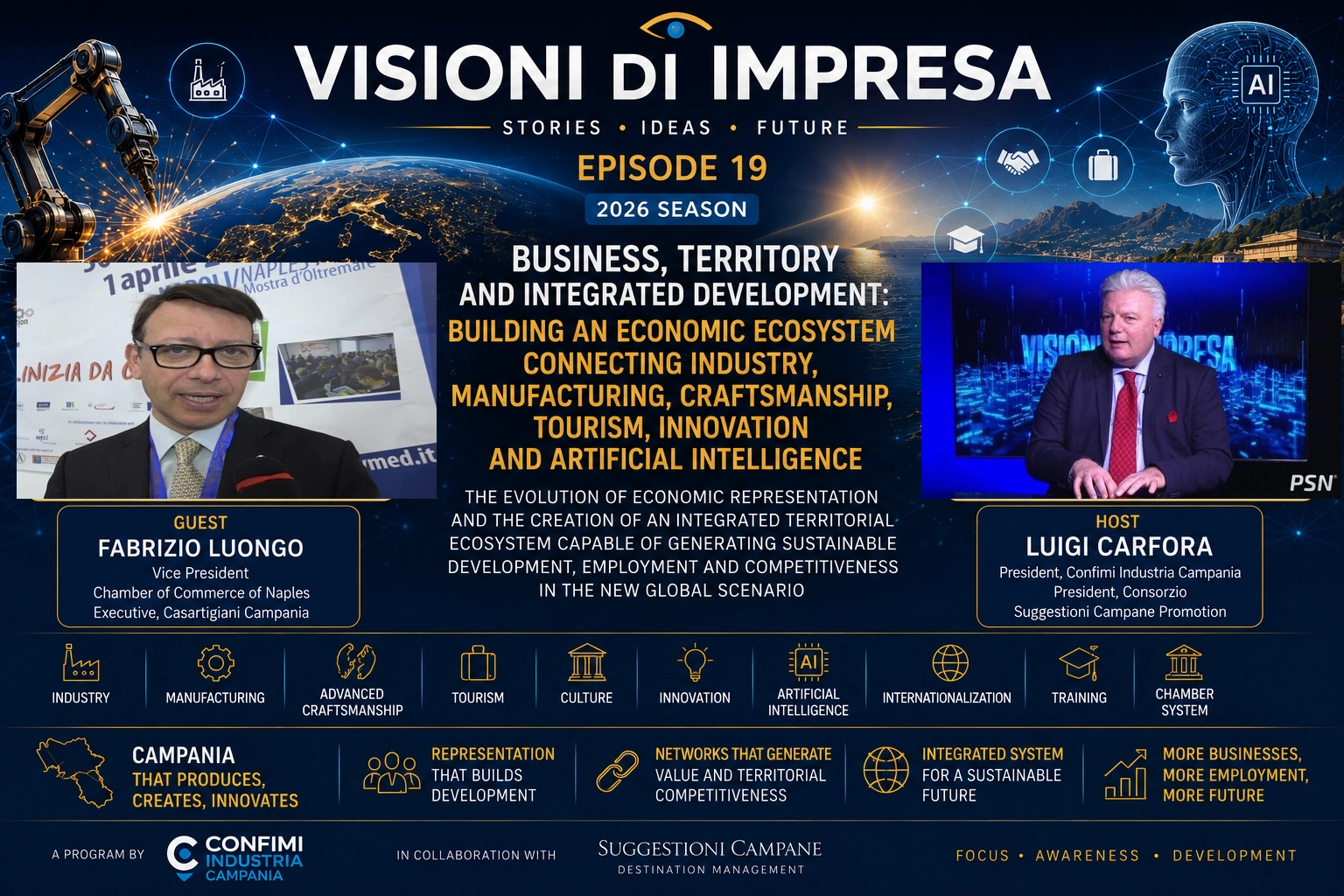
🎥 VISIONS OF ENTERPRISE – Episode 20 | 2026 Series
Research, Innovation and Development: Building the Future through Artificial Intelligence, Human Capital and Territorial Competitiveness in a Global Environment Where the Speed of Change Requires a Continuous Redefinition of Skills, Economic Models and the Very Role of Human Beings within Production Systems.
Topic: Scientific research, technology transfer, industrial innovation, regional policies and the role of business representation in building an ecosystem capable of transforming knowledge, skills and technology into enterprise, employment and sustainable development.
✦ Guiding Thought of the Episode
"The economies that will lead the future will not be those that simply use technologies developed by others, but those capable of creating them, governing them and transforming them into economic value, employment and human dignity."
Introduction
After exploring in previous episodes the themes of artificial intelligence, the transformation of work, lifelong learning, public administration, territorial supply chains, economic competitiveness and the centrality of the human person in the technological age, Visions of Enterprise now addresses one of the most decisive challenges for the future of Campania and Italy:
👉 the relationship between research, innovation and development.
For decades, economic growth was primarily associated with:
- investments
- infrastructure
- public incentives
- access to capital
Today, this paradigm is no longer sufficient.
Global competition is increasingly determined by the ability to generate knowledge, innovation and technology.
The nations leading change are investing heavily in:
- artificial intelligence
- advanced robotics
- biotechnology
- digital systems
- advanced materials
- applied research
because they have understood a fundamental truth:
👉 the most valuable raw material of the 21st century is not oil.
👉 it is knowledge.
👤 Guest Profiles
Prof. Mario Migliuolo
Prof. Mario Migliuolo is among the leading experts in technological innovation, advanced simulation and technology transfer between universities, research institutions and the productive system.
Throughout his career he has held positions of significant responsibility in:
- advanced computing
- simulation systems
- digital innovation
- specialist education
- applied research
He served as Director of the National Simulation Center, university professor and consultant to Unioncamere, contributing to innovation and competitiveness projects for economic systems.
His experience represents a natural bridge between:
👉 research
👉 innovation
👉 enterprise
👉 economic development
At a time when territorial competitiveness increasingly depends on transforming knowledge into practical applications, his expertise helps address one of the central issues of this episode:
👉 how to transfer research outcomes into production processes, ensuring that local knowledge, innovation and opportunities generate value within the territory rather than elsewhere.
In an era where innovation advances so rapidly that skills and production models risk becoming obsolete within a few years—or even months—technology transfer becomes a strategic necessity. Producing knowledge is no longer enough. It must become accessible, applicable and usable by enterprises in order to generate competitiveness, employment and development.
Franco Picarone
Franco Picarone is a Regional Councillor of Campania, currently serving his third consecutive term and recognized as one of the key figures in regional economic and financial planning.
During his institutional career, he served as Chairman of the Regional Budget Commission and participated in the principal processes of regional economic programming and planning.
He currently serves as Vice President of the VIII Permanent Commission of the Regional Council of Campania, dealing with agriculture, European resources and territorial development, continuing to contribute to the Region's strategic policy framework.
His work focuses particularly on:
- economic development
- territorial planning
- public investment
- business support
- innovation
- regional competitiveness
👉 Guiding Question of the Episode
"In a global economy driven by artificial intelligence, automation and continuous innovation, can Campania limit itself to using technologies developed by others, or must it build an ecosystem capable of producing research, retaining talent and transforming knowledge into enterprise, employment and development?"
The Speed of Change: The True Novelty of Our Time
Economic history has always experienced periods of transformation.
What distinguishes the era we are living in from any previous age is speed.
For entire generations, a skill acquired during education could accompany a person throughout an entire career.
Today, that model is obsolete.
Technologies evolve faster.
Production systems change rapidly.
Professions continuously transform.
Many skills that seem indispensable today may become outdated within a few years—and in some sectors, within just a few months.
For the first time in modern history, we are not preparing younger generations for a single profession that will last a lifetime.
We are preparing them to live within continuous transformation.
Not only work is changing.
👉 The very nature of competence is changing.
Knowledge is no longer a static asset acquired once and for all.
It becomes a permanent capacity for adaptation.
The economies of the future will not necessarily reward those who know the most.
👉 They will reward those who learn the fastest.
From Research to Global Competitiveness
International competition is no longer measured solely by:
- labor costs
- productive capacity
- availability of capital
Increasingly, it is measured by the ability to generate innovation.
The most advanced economies produce:
- patents
- algorithms
- technological platforms
- AI systems
- new industrial technologies
Those who do not participate in this race risk becoming mere users of solutions developed elsewhere.
Research cannot remain confined to:
- universities
- research centers
- laboratories
👉 it must enter businesses.
👉 it must become industrial development.
👉 it must generate competitiveness.
Research is not only an engine of growth.
It is also an instrument of economic defense.
In a global market characterized by accelerating competition and innovation, territories that fail to invest in knowledge production risk progressively losing:
- productive capacity
- investment attractiveness
- qualified employment
- economic autonomy
Research and innovation are therefore no longer simply development factors.
👉 They become instruments of territorial resilience and competitiveness.
Artificial Intelligences, Technological Sovereignty and Democracy
Previous episodes examined AI and humanoids.
Today, the discussion moves one step further.
The question is no longer:
👉 Will we use artificial intelligence?
The answer is already yes.
The real question is:
👉 Who will build the artificial intelligences that increasingly influence our economies, information systems and decision-making processes?
President Sergio Mattarella recently referred to "artificial intelligences" in the plural.
This choice was not accidental.
The issue is not one technology.
It concerns different systems reflecting:
- different economic models
- different geopolitical interests
- different industrial strategies
- different relationships between state, market and citizens
- different visions of humanity and society
Behind every AI system there is a governing structure.
Someone decides:
- how it is trained
- which data it uses
- which priorities it follows
- which information becomes visible and which remains marginal
For this reason, AI is not merely a technological issue.
👉 It is a sovereignty issue.
In the 21st century, sovereignty increasingly depends on the ability to control the technologies that organize knowledge, information and decision-making.
Research, innovation and technology transfer therefore become instruments of:
👉 freedom
👉 self-determination
👉 democracy.
Youth, Depopulation and Brain Drain
Campania continues to educate:
- students
- graduates
- researchers
- highly qualified professionals
Yet a significant portion of this human capital leaves the region.
Many young people seek opportunities elsewhere.
Many skills strengthen other economies.
The contradiction is evident:
👉 the territory trains talent but often fails to retain it.
When young people leave, more than individuals move away.
👉 skills move away.
👉 energy moves away.
👉 opportunities move away.
Ultimately, part of the territory's future moves away as well.
Brain drain is therefore not only an employment issue.
It is also an issue of economic and technological sovereignty.
AI, Humanoids and the Future of Work
If:
- population declines
- young people emigrate
- skills become scarce
while at the same time:
- advanced AI expands
- robotics advances
- humanoids become increasingly capable
what will the economic model of the future look like?
Many international observers, including Elon Musk, describe scenarios in which a growing share of productive activities will be performed by autonomous systems.
The issue is not technology itself.
👉 The issue is the role of human beings.
The risk is not the existence of AI.
👉 The risk is building systems that no longer require people as their central element.
A sustainable society cannot be judged solely by productivity.
It must also be evaluated by its ability to guarantee dignity, participation and opportunities for the communities that compose it.
The Role of Politics and the Campania Region
This is where institutions become decisive.
Politics must do more than fund projects.
It must govern transformations.
The Campania Region can contribute by building:
- innovation ecosystems
- university-business networks
- technology transfer programs
- advanced training pathways
- lifelong learning systems
while ensuring:
👉 development
👉 employment
👉 inclusion
👉 economic dignity
The success of transformation cannot be measured solely by economic growth.
👉 It must also be measured by the ability to distribute that growth throughout society, ensuring cohesion and inclusion in a context increasingly shaped by automation, AI and rapid changes in work.
The Role of Economic Representation
The role of representative organizations is also changing profoundly.
It is no longer enough to represent the businesses of today.
It is necessary to prepare them for tomorrow.
Confimi Industria Campania aims to position itself precisely in this space.
Not merely as a representative body.
But as a platform connecting:
- business
- research
- universities
- innovation
- institutions
- education
- territorial development
with the objective of creating ecosystems capable of:
- retaining talent
- attracting investment
- promoting technology transfer
- strengthening competitiveness
- generating qualified employment
- transforming knowledge into economic development
The economic representation of the future will not be measured only by its ability to defend what already exists.
👉 It will be measured by its ability to help build what does not yet exist.
From Technology to the Centrality of the Human Person
The reflections developed throughout previous episodes find a natural synthesis here.
From spirituality to artificial intelligence, from public administration to lifelong learning, one question emerges repeatedly:
👉 How can change be governed without losing the centrality of the human person?
Even the debate surrounding the forthcoming encyclical of Pope Leo XIV dedicated to artificial intelligence points in this direction.
The challenge is not to stop innovation.
👉 It is to prevent innovation from producing dehumanization.
Technology is a tool.
Research is a tool.
Artificial intelligence is a tool.
The ultimate purpose remains the human person.
If progress increases productivity while reducing dignity, freedom or people's ability to build their future, then we are not facing complete development.
Because true development does not consist merely in producing more.
👉 It consists in improving the human condition.
✦ Reflection of the Episode
"The future will not belong to the territories that possess the most technology, but to those capable of transforming research, innovation and knowledge into development, employment and dignity while keeping the human person at the center of economic and social processes. True progress does not consist in replacing human beings, but in enabling them to fully express their value."
🎙 EPISODE 20 – 2026 SERIES
🎙 Host and Creator of the Format
Luigi Carfora
President, Confimi Industria Campania
President, Suggestioni Campane Promotion Consortium
👤 Guests of the Episode
Prof. Mario Migliuolo
Expert in Technological Innovation, Applied Research and Technology Transfer
Franco Picarone
Regional Councillor of Campania
Vice President of the VIII Permanent Commission of the Regional Council of Campania
I would also like to extend my warm thanks to my friend Sandro Cardano, who was present in the studio and in the photo
🎬 Direction: Pino Fontana
📍 Broadcast on Per Sempre News
📍 Recorded at Per Sempre News Studios
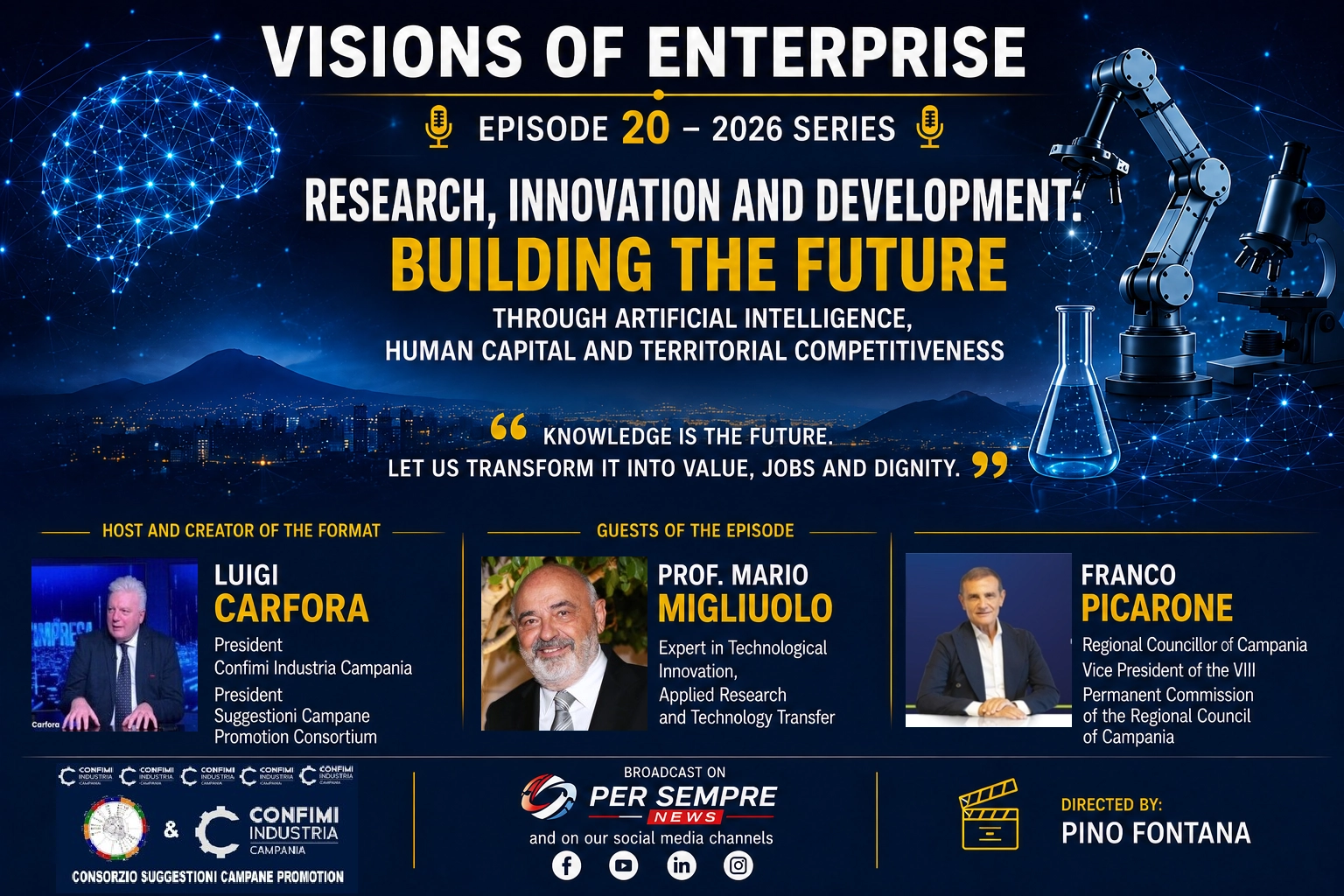
🎥 VISIONS OF ENTERPRISE – Episode 21 | 2026 Series
When Solidarity Becomes Economy
Volunteering, Work, Care Services and Human Dignity between Gratuity, Funding, New Social Vulnerabilities and the Challenges of Artificial Intelligence
Theme
Third Sector, volunteering, social economy, welfare, employment, human dignity, Catholic and secular volunteering, social enterprises, new social vulnerabilities and the challenges of artificial intelligence.
✦ Guiding Thought of the Episode
"A society is not measured solely by the wealth it produces, but by its ability to care for those who struggle to keep pace with change."
Introduction
After exploring in previous episodes artificial intelligence, education and training, employment, innovation, research, industrial transformation and the centrality of the human person, Visions of Enterprise turns its attention to a subject that often remains on the margins of economic debate despite mobilizing resources, employment and essential services for millions of citizens:
👉 the Third Sector.
When people speak about volunteering, the collective imagination still tends to associate it exclusively with unpaid service.
Many think of individuals who devote their time to helping others without receiving any form of compensation.
And that is certainly an important part of the reality.
But it is no longer the whole reality.
Today, the Third Sector also represents one of the largest organizational and economic systems in Italy.
According to the latest ISTAT data, as of 31 December 2023 there were 368,367 non-profit institutions operating in Italy, employing 949,200 paid workers.
This sector generates tens of billions of euros in economic activity and plays an increasingly important role in social assistance, inclusion, education, healthcare, disability support, poverty relief and the care of vulnerable individuals.
Today, the Italian Third Sector is not merely a system of organized solidarity.
It is also one of the country's largest social and economic infrastructures.
With nearly one million employees and an estimated annual economic volume exceeding €90 billion, the sector generates employment, services, project development, assistance programmes and activities that directly affect the quality of life of millions of citizens.
If considered as a single productive sector, it would rank among the largest employment-generating sectors in Italy.
Yet this economic dimension is often underestimated by public opinion, which continues to associate the Third Sector exclusively with unpaid volunteer work.
Campania is one of the Italian regions most affected by this phenomenon.
Thousands of associations, volunteer organizations, social cooperatives, foundations and Third Sector entities operate every day in the fields of social assistance, disability support, social inclusion, education, services for minors, elderly people and individuals experiencing various forms of vulnerability.
The Naples metropolitan area represents one of the country's leading hubs in terms of active organizations, assisted beneficiaries and social initiatives.
The Third Sector has become an integral part of the region's economic and social system.
In territories characterized by economic fragility, unemployment, an ageing population and new forms of social hardship, the Third Sector often performs a complementary role alongside public institutions, contributing not only to assistance but also to social cohesion and the resilience of local communities.
The question that inevitably emerges is therefore:
👉 How does the meaning of solidarity change when employment, services, funding and increasingly structured organizations enter the picture alongside unpaid volunteering?
👤 Episode Guests
Massimiliano Murolo
Journalist and communications professional.
For many years he has observed economic, social and territorial dynamics through the analysis of processes connecting business, communication, civil society and local development.
For many years, he has observed economic, social and territorial dynamics through the analysis of processes that connect business, communication, civil society and local development.
Throughout the episode, he will address one of the least discussed aspects of the Third Sector: its economic dimension.
Because understanding the Third Sector today also means understanding how economic resources are generated, distributed and utilized, and how they directly affect employment, welfare and territorial development.
Behind volunteering, there is in fact a system that generates jobs, professional expertise, services and significant financial flows.
Today, behind volunteering, there is also an organized system capable of generating employment, professional skills, services and substantial economic activity.
Antonio Gianfico
Secretary General of the International Confederation of the Society of Saint Vincent de Paul
President of the Society of Saint Vincent de Paul ODV – Central Council of Naples
President of the Ozanam Center of Sant'Antimo
Among the most representative figures of Catholic volunteering in Italy and internationally, he has spent decades working in the assistance of vulnerable individuals, the fight against poverty and the promotion of a culture of solidarity inspired by Christian values.
His experience is rooted in the Vincentian tradition founded by Saint Vincent de Paul and later organized by Blessed Frédéric Ozanam, who in 1833 established the Society of Saint Vincent de Paul with the aim of transforming Christian charity into a concrete presence alongside the poor, the elderly, struggling families and marginalized individuals.
Through the Ozanam Center and the activities of the Society of Saint Vincent de Paul, Antonio Gianfico represents a vision of volunteering that continues to be grounded in gratuity, human closeness and the centrality of the person, at a time when the Third Sector has also become an important economic and employment-generating system.
👉 KEY QUESTION OF THE EPISODE
"When assistance to vulnerable people becomes not only an act of solidarity but also a source of employment, social enterprise and the management of significant economic resources, how can the original values of solidarity, gratuity and the centrality of the human person be preserved?"
The Roots of the Third Sector: From Christian Charity to the Modern Welfare State
To understand the contemporary Third Sector, it is necessary to begin with its origins.
For many centuries, there was no organized public system of social assistance.
The State did not provide stable support for:
• the poor;
• the elderly;
• orphans;
• the sick;
• people with disabilities;
• families in difficulty.
Social assistance therefore initially emerged within religious and Christian communities.
From the earliest centuries of Christianity, charity was considered an integral part of faith.
Helping the poor was not simply regarded as an act of solidarity.
It was considered a moral and spiritual duty.
Over the centuries, various forms of assistance emerged:
• religious confraternities;
• charitable foundations;
• religious hospitals;
• assistance orders;
• charitable associations.
It is within this context that modern Catholic volunteering developed.
One of the most important figures was Saint Vincent de Paul (1581–1660), the French priest who dedicated his life to assisting the poor, orphans and marginalized people.
Later, in 1833, Blessed Frédéric Ozanam, a French university professor and Catholic layman, founded the Society of Saint Vincent de Paul with the aim of organizing young volunteers committed to visiting poor families directly and assisting the most vulnerable members of society.
Thus was born one of the most important Catholic charitable organizations in the world, now active in more than 150 countries.
The Emergence of Secular Volunteering
Alongside the tradition of Catholic volunteering, a secular form of volunteering gradually developed between the nineteenth and twentieth centuries.
It did not arise from religious motivations.
Rather, it was inspired by civic, mutual, solidarity-based and democratic principles.
Civil associations, cooperatives, mutual aid societies, social organizations and later non-governmental organizations contributed to the development of a culture of solidarity based on active citizenship and social participation.
Throughout the twentieth century, the religious and secular traditions often found themselves addressing the same social needs, despite being rooted in different visions of humanity, society and solidarity.
It is precisely this tradition that Antonio Gianfico continues to represent today at the international level.
Antonio Gianfico and the Legacy of Frédéric Ozanam
Antonio Gianfico currently serves as International Secretary General of the Society of Saint Vincent de Paul, one of the oldest Catholic volunteer organizations in existence.
Formerly President of the Italian Society of Saint Vincent de Paul, he has worked for decades within the movement founded by Blessed Frédéric Ozanam.
The Vincentian mission is based on a simple yet revolutionary principle:
👉 personally meeting those who live in situations of poverty or vulnerability.
Not merely by offering material support.
But by building a human relationship based on listening, closeness and respect for human dignity.
In an era in which assistance increasingly risks becoming an organized service, an administrative procedure or a professional intervention, the Vincentian experience continues to emphasize the value of gratuity and personal relationships.
From Ozanam to the Contemporary Third Sector
The figure of Frédéric Ozanam holds particular significance within the reflection proposed in this episode.
When he founded the Society of Saint Vincent de Paul in 1833, his goal was not to create an economic structure or a professional assistance organization.
His intention was profoundly different.
Ozanam believed that poverty could not be addressed solely through almsgiving or material aid.
A direct relationship between people had to be built.
For this reason, the first Vincentian volunteers personally visited families in need, entering their homes, listening to their difficulties and sharing the challenges of everyday life.
Thus emerged a model based on:
👉 gratuity
👉 closeness and personal presence
👉 listening
👉 human dignity
👉 individual responsibility
A model that still represents one of the principal references of international Catholic volunteering.
It is precisely by comparing these origins with the complexity of today's Third Sector that the central questions of this episode emerge.
How can the values of gratuity be preserved when the system generates employment, funding and increasingly complex organizational structures?
How can we prevent the management of vulnerability from becoming merely an economic activity?
And how can the human person remain at the center in a context where assistance has also become a significant component of the modern economy and welfare system?
The Emergence of the Professional and Paid Third Sector
For many decades, volunteering remained predominantly unpaid.
The situation changed profoundly during the second half of the twentieth century.
Following the Second World War, modern public welfare systems began to develop.
The State gradually assumed direct responsibilities in areas such as:
• healthcare;
• social assistance;
• education;
• social security.
As time passed, however, new forms of social vulnerability emerged:
• addictions;
• complex disabilities;
• mental health challenges;
• social exclusion;
• immigration;
• home care needs;
• population ageing.
The complexity of these challenges grew faster than the ability of the State to address them alone.
As a result, particularly between the 1970s and the 1990s, the modern organized Third Sector began to take shape.
New structures emerged, including:
• social cooperatives;
• foundations;
• accredited associations;
• social enterprises;
• organizations operating under agreements with public administrations.
Social assistance was no longer provided exclusively by volunteers.
Paid professionals entered the field:
• educators;
• psychologists;
• social workers;
• social and healthcare operators;
• cultural mediators;
• project managers;
• administrators.
Thus a sector emerged that maintained its social mission while also becoming:
👉 a source of employment;
👉 an organizational system;
👉 an economic sector;
👉 a provider of services;
👉 a recipient of funded projects.
It is through this evolution that the contemporary Third Sector was born.
The Principle of Subsidiarity
Alongside the evolution of the modern welfare system, the principle of subsidiarity gradually emerged, a principle now recognized both by the Italian Constitution and by European institutions.
According to this principle, the State does not necessarily have to carry out every activity of public interest directly.
Instead, it may encourage and support the initiatives of communities, associations, volunteer organizations, social entities and intermediary bodies.
The Third Sector developed within this framework.
Not as a replacement for the State.
Not as an alternative to public institutions.
But as a complementary actor capable of contributing to the response to the needs of individuals and communities.
This collaboration between public institutions, organized civil society and local communities constitutes one of the foundations of the modern welfare system.
The Central Question of the Episode
It is here that the most important question emerges.
Today, within the same universe, we find:
• the Catholic volunteer working without compensation for spiritual motivations;
• the secular volunteer dedicating time to civic and social causes;
• the social professional carrying out paid work;
• the social cooperative managing services;
• the association supported by donations;
• the organization receiving public funding;
• the social enterprise generating employment.
All of these realities are legitimate.
Yet they are profoundly different.
A fundamental distinction concerns the role of the people operating within the system.
The volunteer freely offers time, skills and personal commitment.
The social professional, on the other hand, performs paid work, often characterized by a high level of specialization and responsibility.
Both play important roles.
But they are not the same thing.
Understanding this distinction is essential to correctly interpreting the contemporary Third Sector.
Part of the difficulty arises because, in the public imagination, the term "volunteering" continues to be associated almost exclusively with unpaid service.
Many citizens do not distinguish between organizations supported entirely by volunteers, entities employing paid staff, social cooperatives, foundations or social enterprises.
This overlap often generates an oversimplified perception of a reality that is now highly complex both socially and economically.
It is precisely this complexity that Visions of Enterprise seeks to examine.
Not to question the value of the Third Sector.
But to understand how to reconcile:
👉 solidarity;
👉 transparency;
👉 economic sustainability;
👉 professionalism;
👉 gratuity;
👉 human dignity.
Lights and Shadows of a Growing Sector
The figures reveal a complex reality.
On one side, there are millions of volunteers working without any compensation.
On the other, there is a sector employing nearly one million paid workers.
The Third Sector also generates an estimated economic volume exceeding €90 billion and represents a significant component of the Italian economy.
When Solidarity Becomes Economy
When Solidarity Becomes Economy
The growth of the Third Sector raises a question that is rarely addressed in public debate.
If volunteering historically emerged as a free service to people in need, what happens when employment, funding, public agreements, project development and increasingly complex organizational structures grow around social needs?
The presence of economic resources is not a problem in itself.
Quite the opposite.
Many essential services could not exist without paid professionals.
The real issue concerns balance.
The question is not whether paid activities exist within the social sector. In many cases, they are indispensable.
The real question concerns the relationship between ends and means.
Should economic resources serve to solve social problems, or is there a risk that, over time, the management of those problems becomes a system that seeks to preserve itself?
How can we ensure that managing need does not take precedence over solving it?
This reflection does not concern only the Third Sector.
It concerns any organized system created to address a social problem.
A mature society does not measure the success of its institutions by their ability to perpetuate themselves over time, but by their ability to progressively reduce the conditions of vulnerability that made their existence necessary in the first place.
How can we ensure that assistance continues to place the person at its center rather than the survival of the structures that provide it?
Gratuity and Professionalism: A Necessary Distinction
The presence of paid professionals does not in itself contradict a social mission.
Many welfare, educational, healthcare and inclusion activities require specialized skills that cannot be entrusted exclusively to volunteers.
The real challenge is to maintain a clear distinction between the value of gratuity and the value of professionalism.
Because both represent precious resources for society.
But they become problematic when they are confused or overlapped in the public imagination.
The Case of the "5×1000": Citizens' Trust and the Need for Transparency
One of the most significant examples of the relationship between solidarity, economic resources and public trust is represented by Italy's "5×1000" system.
Every year, millions of taxpayers choose to allocate a portion of their taxes to Third Sector organizations, volunteer associations, foundations, research activities, social organizations and entities supporting vulnerable people.
In 2025, more than 18.4 million taxpayers signed a 5×1000 designation, confirming the continuous growth of citizen participation and public trust in the non-profit sector.
The resources allocated to eligible organizations exceeded €602 million, approaching the maximum spending limit established by current legislation.
In light of the increasing volume of resources involved, Italy's Minister of Economy and Finance, Giancarlo Giorgetti, announced his intention to promote regulatory measures aimed at strengthening monitoring procedures, verifying eligibility criteria and ensuring more rigorous oversight of how resources are used.
The stated objective is to prevent abuses and guarantee that taxpayers' choices effectively produce the social benefits for which they were intended.
The approximately €602 million distributed annually through the 5×1000 mechanism represent one of the most important sources of funding for organized solidarity in Italy.
Millions of citizens entrust part of their taxes to organizations that declare social, welfare, healthcare, cultural or research-related objectives.
The 5×1000 also represents a particular form of fiscal democracy, through which citizens do not simply pay taxes but actively help direct a portion of public resources toward social causes they consider worthy of support.
For this reason, transparency is not merely an administrative obligation.
It is a moral responsibility toward citizens who have made a conscious choice and who expect those resources to be used consistently with the purposes for which they were allocated.
This issue opens a broader reflection.
The greater the economic role of the Third Sector becomes, the more important the following elements become:
👉 transparency;
👉 accountability;
👉 oversight and controls;
👉 measurement of social impact;
👉 proper use of public and private resources.
Because trust is the true asset upon which the entire system of organized solidarity is built.
The growth of economic resources involved in the sector therefore raises questions that cannot be ignored.
When assistance, social inclusion and support for vulnerable individuals generate employment, services, public agreements and funding, it becomes necessary to ask how the person can always remain at the center rather than the organizational system itself.
This is not about questioning the value of the organizations operating within the Third Sector.
Rather, it is about understanding which mechanisms can ensure that social mission continues to prevail over the economic interests that inevitably develop around a sector of this magnitude.
This opens a number of legitimate questions:
👉 How can transparency be guaranteed?
👉 How can distortions be prevented?
👉 How can genuine service be distinguished from simple economic management?
👉 How can we prevent human need from becoming merely a market?
These questions do not challenge the value of the Third Sector.
Instead, they highlight the importance of maintaining high standards of transparency, oversight and responsibility toward citizens, donors and institutions that support these activities.
The issue is not whether the Third Sector is valuable.
The issue is how to reconcile economic sustainability, professionalism and social mission.
Artificial Intelligence, New Forms of Poverty and Emerging Vulnerabilities
Previous episodes explored artificial intelligence and the transformation of work.
But every innovation also creates new forms of vulnerability.
Automation.
Population ageing.
Declining birth rates.
Depopulation.
Loneliness.
Digital exclusion.
New forms of poverty.
The technological transformations examined throughout previous episodes are rapidly reshaping both the labor market and the organization of society.
Artificial intelligence, robotics and automation promise greater efficiency and productivity.
Yet they also raise profound questions.
Who will support those at risk of being excluded from these transformations?
Who will care for the elderly in an increasingly long-lived society?
Who will assist the new social and economic vulnerabilities emerging from these changes?
It is no coincidence that, in recent reflections on the relationship between technology and the human person, Pope Leo XIV strongly reaffirmed the principle that progress cannot be evaluated solely through efficiency or economic growth.
Every innovation must also be measured by its ability to protect human dignity and ensure that the most vulnerable are not left behind.
This reflection directly concerns the Third Sector as well.
Because the more technology becomes capable of performing operational tasks, the greater the irreplaceable value of human relationships, listening, proximity and solidarity becomes.
It is precisely here that personal relationships, volunteering and human closeness continue to represent a resource that no technology can fully replace.
The question therefore becomes even deeper:
👉 Who will care for those at risk of being left behind?
And what role will be played by volunteers, Third Sector organizations, religious communities, institutions and civil society?
Alongside these responsibilities stands the role of economic and social representative organizations, called upon to foster dialogue among businesses, institutions, Third Sector entities and local communities.
Because development cannot be viewed solely as an economic matter.
It must also be a social, cultural and human one.
And it is precisely our ability to build connections among these worlds that will determine the quality of the society we leave to future generations.
A Cultural Choice Before an Economic One
Ultimately, the question raised by this episode is not only about the Third Sector.
It concerns the kind of society we intend to build.
A society in which people are accompanied throughout every stage of life—from birth to old age, including moments of vulnerability—or a society in which an individual's value is measured exclusively by their ability to generate income, consume or remain competitive.
This is a cultural choice before it is an economic one.
Because the way a community cares for its most vulnerable members reveals far more than any economic indicator about its vision of humanity and its vision of the future.
It is the same question that, in different forms, runs throughout the entire Visions of Enterprise series:
How can innovation, research, artificial intelligence, economic development and social transformation be governed without losing sight of the centrality of the human person?
A society may become more efficient.
More technological.
More productive.
But if it ceases to care for people, it risks losing the very meaning of its development.
From this perspective, the Third Sector is not merely a response to social needs.
It is also a mirror through which a community measures its civil, social and moral maturity.
Because the way a society looks at its most vulnerable members always reveals how it understands humanity, work, the economy and its own future.
✦ Reflection of the Episode
"The future will not depend solely on our ability to generate wealth, technology and innovation. It will depend on our ability not to leave anyone behind as change accelerates. True progress is not measured by what a society possesses, but by how it treats its most vulnerable people."
🎙 EPISODE 21 – 2026 SERIES
🎙 Host and Creator of the Format
Luigi Carfora
President, Confimi Industria Campania
President, Suggestioni Campane Promotion Consortium
👤 Episode Guests
Massimiliano Murolo
Journalist and Communications Professional
Antonio Gianfico
Secretary General of the International Confederation of the Society of Saint Vincent de Paul
President, Society of Saint Vincent de Paul ODV – Central Council of Naples
President, Ozanam Center of Sant'Antimo
🎬 Directed by: Pino Fontana
📺 Broadcast on Per Sempre News
🎙 Recorded at Per Sempre News studios
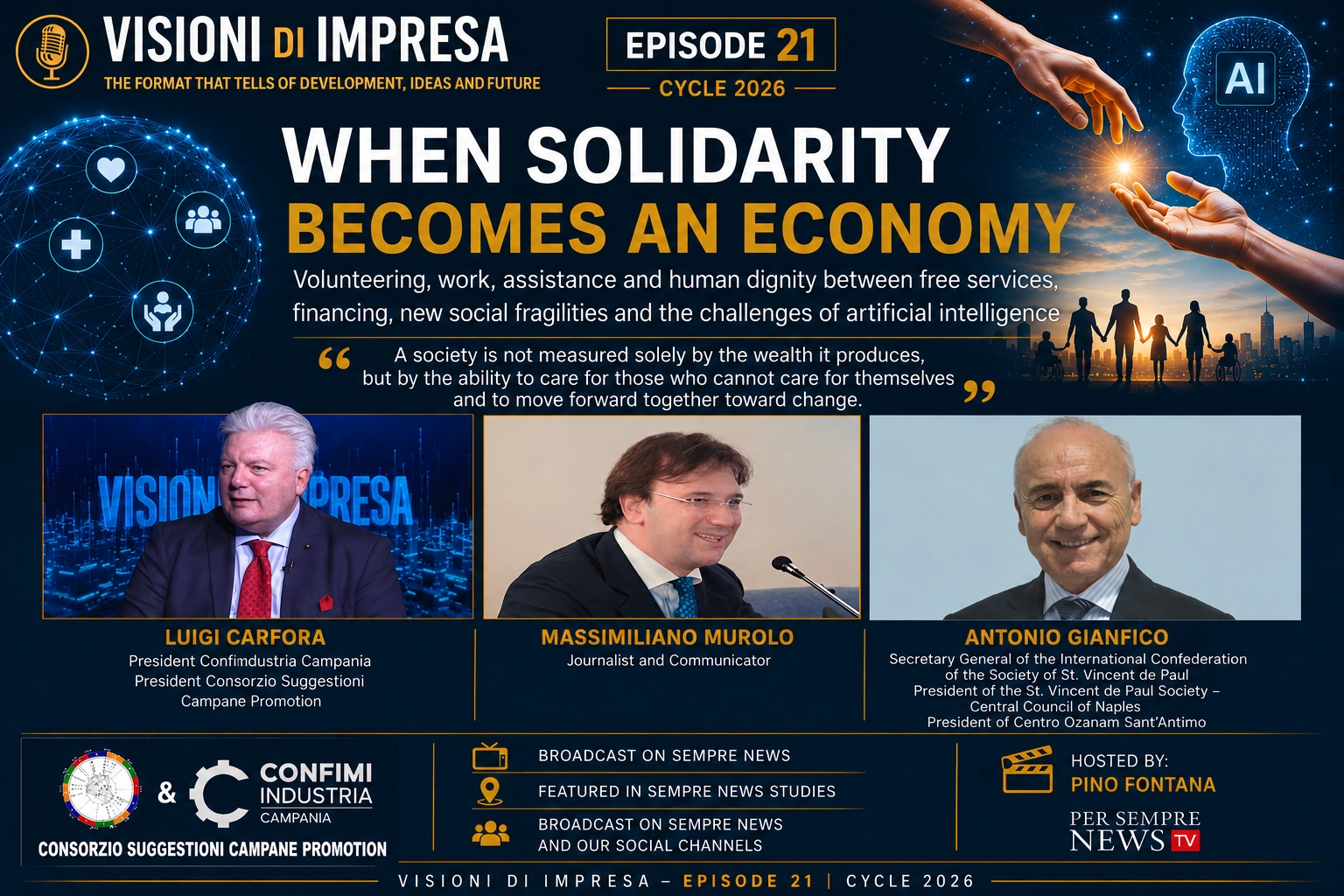
🎥 VISIONS OF ENTERPRISE – Episode 22 | 2026 Series
ENERGY, ARTIFICIAL INTELLIGENCE AND POWER
The New Global Competition Between Research, Technology and Sovereignty
Theme
Energy, scientific research, controlled thermonuclear fusion, artificial intelligence, data centers, robotics, industrial competitiveness, European strategic autonomy, universities, innovation and the future of work.
✦ Guiding Thought of the Episode
"Every civilization has been defined by the energy it has been able to control. Those who control the energy of the future will also influence the future of the economy, technology and the very organization of society."
Introduction
In previous episodes, we explored topics that may have appeared different, yet are deeply interconnected.
We discussed artificial intelligence.
Innovation.
Research.
Education.
Industrial transformation.
Employment.
The Third Sector.
The centrality of the human person.
Today, all these reflections converge into one fundamental question:
👉 What energy source will be capable of sustaining the world we are building?
Because every technological transformation has always depended on an invisible prerequisite:
energy.
Without energy, there are no industries.
There are no digital networks.
There are no data centers.
There are no artificial intelligence systems.
There are no advanced infrastructures.
There is no economic growth.
Every industrial revolution has first and foremost been an energy revolution.
Coal made the First Industrial Revolution possible.
Oil powered the twentieth century.
Electricity transformed production.
Computing built the digital society.
Today, however, we are entering an entirely new era.
Artificial intelligence, robotics, supercomputers, quantum networks and automation will require amounts of energy unprecedented in human history.
This is why energy is no longer merely a technical issue.
It is an industrial issue.
A geopolitical issue.
An economic issue.
A matter of sovereignty.
From Episode 11 to Episode 22: When a Vision Becomes Reality
Those who have followed Visions of Enterprise since its early episodes may recall that the issue of energy already emerged during our discussion with Engineer Agnelli in Episode 11.
At that time, we reflected on industrial competitiveness, energy costs for businesses and the need to address future energy sources without prejudice.
Only a few months later, that reflection has taken on an entirely different meaning.
We are no longer looking at a distant future scenario.
Energy security, next-generation nuclear technologies, controlled thermonuclear fusion and European strategic autonomy have become central topics in both national and international political debate.
European institutions are defining their energy strategies for the coming decades.
Italy has reopened the discussion on sustainable nuclear energy.
At the same time, major global technology companies are investing directly in new energy sources to support the growth of artificial intelligence and digital infrastructures.
From Theoretical Debate to Concrete Projects
The return of nuclear energy to the public debate is no longer confined to the research community.
In recent months, several proposals have emerged across Italy involving the integration of renewable energy sources and next-generation nuclear technologies, including Small Modular Reactors (SMRs), within broader regional energy strategies.
The debate is therefore not merely about choosing one technology over another.
It is about building energy systems capable of ensuring security of supply, industrial competitiveness and environmental sustainability in a context of rapidly growing energy demand.
The world's leading economies are investing billions of euros in energy research.
The energy challenge no longer concerns governments alone.
It increasingly involves global technology leaders that must support growing energy demand driven by artificial intelligence, data centers and digital infrastructures.
The energy crisis of recent years has clearly demonstrated how energy availability and costs directly affect business competitiveness, regional productivity and national economic stability.
For the first time in decades, energy has returned to the center of European industrial policy.
What once appeared to be a future possibility has become an issue of immediate relevance.
Guest of the Episode
Prof. Fabio Villone
Director of the Department of Electrical Engineering and Information Technologies (DIETI) at the University of Naples Federico II.
Full Professor of Electrical Engineering.
One of Italy's leading experts in the numerical modeling of complex electromagnetic systems and controlled thermonuclear fusion.
For many years he has collaborated with some of the world's most important fusion research programs, including ITER, Fusion for Energy (F4E), ENEA and numerous European and international research centers.
Author of hundreds of scientific publications and computational tools used by the global scientific community, he is among the Italian researchers most actively involved in developing technologies that may redefine the future of energy worldwide.
Italian Research and Global Challenges
Professor Fabio Villone's participation in this episode represents far more than the testimony of a scientist engaged in advanced research.
It also reflects the ability of the Italian university system to contribute concretely to major global challenges involving energy, innovation, sustainability and technological development.
The great transformations of the future will not emerge exclusively from political institutions or financial decision-making centers.
They will also arise in laboratories, universities and research centers that are currently building the knowledge needed to address the challenges of the coming decades.
Campania's Role in International Research
The presence of Professor Fabio Villone demonstrates that Campania is not merely a manufacturing, tourism or commercial region.
It is also a territory capable of producing advanced scientific research.
Through the University of Naples Federico II, the Department of Electrical Engineering and Information Technologies (DIETI), and numerous centers of excellence across the region, Campania actively participates in international scientific networks working on technologies that may help shape the future of global energy.
This dimension is often little known to the general public.
Yet the competitiveness of territories will not depend solely on their ability to attract investment.
It will increasingly depend on their ability to generate knowledge, innovation and applied research.
Because the future of the economy is born first in laboratories and universities, and only later in factories and markets.
The Talent Challenge
Producing knowledge does not simply mean building laboratories.
Above all, it means retaining the people capable of generating that knowledge.
Campania and Southern Italy continue to educate thousands of highly qualified young people who often find professional and scientific opportunities abroad that are difficult to replicate in their home territories.
The challenge is not merely to train talent.
It is to create the conditions that allow those talents to contribute to the development of the territory that educated them.
Added to this challenge is the demographic issue.
Italy and much of Europe are experiencing a gradual reduction in the active workforce and a growing aging population.
As a result, the availability of scientific and technological skills risks becoming one of the key strategic variables of future competitiveness.
For this reason, research, education, birth rates and talent attraction are now different aspects of the same challenge.
Demographics, Skills and Competitiveness
The demographic issue makes the talent challenge even more complex.
Declining birth rates and population aging are profoundly transforming the economic and social balance of developed nations.
Fewer young people means fewer students, fewer researchers, fewer specialized technicians and fewer skills available to sustain future innovation.
For this reason, the competitiveness of a territory will not depend solely on economic investment.
It will depend on its ability to attract, educate and retain highly qualified human capital.
Research, innovation, demographics and development are therefore not separate phenomena.
They are different dimensions of the same strategic challenge.
The Central Question of the Episode
For decades, humanity asked itself how to produce energy.
Today, the question is different.
👉 Will we be able to produce enough energy to sustain the future we are designing?
Every interaction with an artificial intelligence system requires energy.
Every data center requires energy.
Every humanoid robot requires energy.
Every automation system requires energy.
Every digital infrastructure requires energy.
Energy is becoming the true bottleneck of global technological transformation.
Why Artificial Intelligence Is Hungry for Energy
Data centers are rapidly becoming the new strategic infrastructures of the global economy.
Just as railways, ports, pipelines and large-scale energy networks shaped previous eras, today the ability to host and power advanced digital infrastructures is becoming an increasingly important factor in territorial and national competitiveness.
In recent years, the leading actors of global technological innovation have begun delivering the same message.
Artificial intelligence will require quantities of energy far greater than those used today.
The construction of new data centers.
The training of increasingly complex models.
The spread of advanced robotics.
The growth of computational capacity.
All of this is transforming energy into one of the most strategic resources of the twenty-first century.
The issue is therefore not merely technological.
It is energetic.
And this is precisely where research into controlled thermonuclear fusion acquires a significance that extends far beyond the scientific community.
Data Centers: The New Infrastructures of Economic Power
In the twenty-first century, data centers are assuming a role increasingly comparable to that once played by ports, railways, pipelines and major energy infrastructures.
They are the places where data is processed, artificial intelligence models are trained and ever-growing volumes of information are managed.
Their expansion requires enormous amounts of energy and highly advanced technological capabilities.
For this reason, global competition is not only about who will develop the best technologies.
It is also about who will be able to power them.
There Is Not Just One Artificial Intelligence
Recently, President of the Italian Republic Sergio Mattarella drew public attention by referring to "artificial intelligences" in the plural.
A linguistic choice that highlights a fundamental issue.
Behind technologies there are not only algorithms.
There are economic models.
Cultural visions.
Industrial strategies.
Geopolitical interests.
For this reason, the issue of energy inevitably intersects with that of technological sovereignty.
It is precisely within this competition between energy, technology and computing power that research into thermonuclear fusion assumes an unprecedented strategic relevance.
Fusion: Reproducing the Sun on Earth
For more than half a century, the international scientific community has been working on one of the most ambitious challenges ever undertaken by humanity:
reproducing on Earth the process that powers the Sun.
Controlled thermonuclear fusion promises virtually unlimited energy, without greenhouse gas emissions and with safety characteristics radically different from those of traditional nuclear fission.
But the real question is not only whether fusion will work.
The real question is:
👉 Who will control this technology?
Whoever Controls Energy Will Control the Future
For centuries, power was associated with the control of land.
Later, with the control of trade routes.
Then, with the control of raw materials and fossil fuels.
Today, power is increasingly concentrated around three fundamental elements:
👉 Energy
👉 Data
👉 Computing power
Artificial intelligence, robotics and digital infrastructures are creating a new form of dependency.
Not merely an energy dependency.
But an energy-digital dependency.
The real question is therefore not simply who will produce energy.
The real question is:
Who will control the energy required to power the artificial intelligences that will increasingly shape the global economy?
This is why the issue of nuclear fusion does not concern scientists alone.
It concerns businesses.
Governments.
Universities.
Territories.
And the future of new generations.
Energy and Sovereignty
In the twenty-first century, a nation's sovereignty no longer depends solely on its borders.
It depends on its ability to control:
• Energy
• Technology
• Data
• Research
• Skills
Those who depend on others for energy inevitably become dependent on their economic and geopolitical decisions as well.
For this reason, scientific research is not a luxury.
It is a strategic national infrastructure.
Energy and Industrial Competitiveness
For businesses, energy is not merely a cost.
It is a competitive factor.
The price of energy affects the ability to produce.
To export.
To invest.
To innovate.
To hire.
For this reason, the energy choices made today will directly influence industrial competitiveness for decades to come.
In this context, business representation organizations are assuming an increasingly important role.
Because energy transitions do not concern governments and research centers alone.
They involve thousands of companies that must invest, innovate and compete in increasingly global markets.
Understanding major technological trends means helping the productive system prepare for changes that are already reshaping the global economy.
Universities and the Future
In this scenario, the role of universities becomes extraordinarily important.
Universities do not simply educate students.
They develop the skills that will build the future.
They train engineers.
Researchers.
Innovators.
The people who will make the next energy revolution possible.
The challenge is that while the pace of change continues to accelerate, traditional education systems risk remaining anchored to models of the past.
Future generations will need to learn throughout their entire lives.
No longer an initial education expected to remain valid for forty years.
But continuous learning and constant adaptation.
Universities, Research and Human Capital
If the future will be determined by the ability to generate knowledge, energy and innovation, the most important asset will continue to be people.
Major scientific infrastructures do not emerge by chance.
They emerge where universities are capable of developing high-level skills.
They emerge where research meets industry.
They emerge where institutions understand that investing in knowledge means investing in the future.
In this context, the mission of universities goes beyond transmitting knowledge.
It consists of preparing generations capable of living in a world where change no longer occurs over a lifetime, but within a few years—or even a few months.
The Philosophical Question
Ultimately, this episode is not only about energy.
It is about the relationship between knowledge and power.
Every major technological revolution has transformed economic, political and social balances.
The question we must therefore ask is:
👉 Will the energy of the future serve to liberate humanity, or will it make people even more dependent on technological systems they do not control?
Because true progress does not simply consist of increasing the power of machines.
It consists of ensuring that technological growth remains at the service of the human person.
The Final Challenge: Technology at the Service of Humanity
Ultimately, this episode is not only about energy.
It is not only about fusion.
It is not only about artificial intelligence.
It is about the relationship between technological power and human responsibility.
Every major revolution in history has generated extraordinary opportunities.
But it has also generated new inequalities.
New dependencies.
New imbalances.
The challenge facing future generations will not simply be to build more powerful technologies.
It will be to ensure that such technologies remain at the service of humanity.
A society may become more efficient.
More automated.
More intelligent.
But if it loses sight of human dignity, it risks losing sight of the very meaning of progress.
Ultimately, the decisive question is not whether we will succeed in building more powerful machines.
We probably will.
The decisive question is whether we will succeed in building a society wise enough to govern them.
History teaches us that every technological advance creates new possibilities.
But only human responsibility determines how those possibilities are used.
The greatest challenge of the twenty-first century may therefore not be the production of energy itself.
It may be our ability to ethically govern the power that such energy will make possible.
Because every form of energy creates the capacity for transformation.
And every capacity for transformation creates responsibility.
The decisive question is therefore not simply how much energy we will have.
The decisive question is what kind of society we will choose to build with that energy.
Because, ultimately, no innovation derives its value solely from what it is technically capable of doing.
Its value lies in what it enables people to become.
This is the ultimate measure of progress.
Not the power of technologies.
Not the speed of transformation.
Not the quantity of energy available.
But the human quality of the society those technologies help create.
Every civilization has been defined by the energy it has learned to govern.
Ours will likely be judged by the wisdom with which it chooses to use that energy.
✦ Reflection of the Episode
"Every generation inherits the world built by those who came before it. Ours has the responsibility to decide whether the energy of the future will become merely a new source of power or a tool for development, freedom and dignity for all humanity."
🎙 EPISODE 22 – 2026 SERIES
🎙 Host and Creator of the Format
Luigi Carfora
President, Confimi Industria Campania
President, Suggestioni Campane Promotion Consortium
👤 Guest of the Episode
Prof. Fabio Villone
Director of the Department of Electrical Engineering and Information Technologies (DIETI)
University of Naples Federico II
Full Professor of Electrical Engineering
🎬 Directed by
Pino Fontana
📺 Broadcast on Per Sempre News
📍 Recorded at the Per Sempre News Studios
📺 Broadcast on Per Sempre News and on our social media channels
🎥 VISIONS OF BUSINESS – Episode 23 | 2026 Series
CULTIVATE ITALY
Defending Those Who Produce
Food Sovereignty, Made in Italy, Artificial Intelligence and the Centrality of the Human Person in 21st Century Agriculture
Theme
Cultivate Italy Decree, agriculture, food sovereignty, Made in Italy, dumping, unfair competition, counterfeiting, innovation, artificial intelligence, agricultural robotics, humanoids, food security, business competitiveness, generational turnover and the centrality of the human person.
✦ Guiding Thought of the Episode
"Defending Italian agriculture does not mean looking to the past. It means ensuring that Italy retains the ability to generate value, employment, quality and food security in the future.
A nation that loses the ability to produce its own food loses part of its freedom. But a nation that entrusts its future exclusively to technology also risks losing the centrality of the human person."
Introduction
After exploring research, innovation, artificial intelligence, energy and the centrality of the human person in previous episodes, Visions of Business now addresses one of the oldest and, at the same time, most contemporary issues in human history:
👉 food.
Italian agriculture is undergoing a profound transformation.
Agricultural enterprises must face rising costs, international competition, climate change, evolving European regulations and increasingly globalized markets.
In this context, agriculture is not merely a matter for those who work in the fields.
It concerns:
employment;
the economy;
product quality;
food security;
Italy's ability to continue generating value through one of its historic strengths.
It is within this challenge that the Cultivate Italy Decree takes shape.
The measure aims to support strategic supply chains, strengthen national productive capacity and contribute to the country's food security.
Just as in the previous episode we asked who will control the energy needed to power the world of artificial intelligence, today the question shifts to another essential resource:
👉 food.
Because no society can truly be sovereign if it is unable to guarantee energy, knowledge and food security.
Guest of the Episode
Hon. Marco Cerreto
Member of the Italian Parliament.
Group Leader of Brothers of Italy in the XIII Agriculture Committee of the Chamber of Deputies.
Jurist, PhD in Comparative Law, former official and legal advisor to the Italian Ministry of Agriculture.
For years he has been actively engaged in issues concerning food sovereignty, the protection of Made in Italy products, the competitiveness of agricultural enterprises and the promotion of Italian production excellence.
The Guiding Question of the Episode
👉 Is Italy still capable of defending its agricultural enterprises in an increasingly competitive global market, and what role can the Cultivate Italy Decree play in strengthening production, profitability and food sovereignty?
Why the Cultivate Italy Decree Was Created
In recent years Italian agriculture has faced increasingly complex challenges:
rising energy costs;
international competition;
climate change;
geopolitical crises;
increasing production costs;
declining profitability of agricultural businesses;
an aging farming population.
The Cultivate Italy Decree was conceived to strengthen national productive capacity and support strategic agricultural supply chains.
Food Sovereignty
For decades globalization encouraged the relocation of production and the integration of markets.
Today, however, a fundamental question has returned to the center of public debate:
👉 Is it wise to depend on foreign countries for a significant share of our food supply?
Recent international crises have shown how control over production chains is becoming a strategic issue.
Agriculture is therefore once again not only an economic sector but also a component of national security.
This issue is particularly relevant to Campania, a region known for internationally recognized agri-food excellence while also facing challenges related to depopulation, declining active populations and difficulties in generational renewal within agricultural enterprises.
Business Profitability
Any agricultural policy can succeed only if it guarantees the economic sustainability of businesses.
Behind every agricultural product stand companies, families, investments and jobs.
The real challenge is not simply producing more.
The challenge is enabling farmers to continue producing.
For this reason profitability is one of the central issues in the debate on the future of Italian agriculture.
Those Who Create Value Must Be Able to Live from Their Work
At the foundation of every agricultural policy lies a fundamental principle.
A business can continue investing only if it generates income.
Without profitability there can be no innovation, generational renewal, environmental sustainability or productive growth.
Defending agriculture therefore means first and foremost defending the possibility for farmers to earn a dignified living from their work.
Dumping and Unfair Competition
One of the concerns most frequently raised by agricultural enterprises involves international competition.
How can an Italian producer, who complies with strict environmental, health and social standards, compete against products originating from countries operating under entirely different rules?
The issue concerns:
👉 social dumping;
👉 environmental dumping;
👉 regulatory reciprocity;
👉 protection of the competitiveness of Italian enterprises.
Defending Made in Italy
The quality of Italian products is recognized throughout the world.
Yet counterfeiting and Italian Sounding continue to divert market share away from genuine Italian businesses.
This is not merely an economic loss.
What is at stake includes:
employment;
investment;
reputation;
production chains;
territorial identity.
Defending Made in Italy means defending value, employment and development.
It also means protecting a productive culture built over generations.
Behind every Italian product lie skills, traditions, territories, families and communities.
Counterfeiting harms not only a brand but also innovation, research, quality and intellectual property investments.
It harms the human work represented by that brand.
Agriculture and Artificial Intelligence
Agriculture is often perceived as a traditional sector.
The reality is very different.
Today artificial intelligence can:
monitor crops;
predict plant diseases;
optimize irrigation;
reduce waste;
increase productivity.
Agriculture is rapidly becoming one of the most technologically advanced sectors of the economy.
Humanoids and the Future of Agricultural Work
Robotics is progressively entering agricultural activities.
Several countries are already experimenting with:
harvesting robots;
autonomous handling systems;
intelligent crop-management platforms.
The question naturally arises:
👉 Will new technologies replace human labor, or will they help make it more skilled, safer and more efficient?
Young People, Skills and Generational Renewal
The agriculture of the future will require new skills.
Not only agronomists and entrepreneurs.
But also:
data specialists;
software experts;
AI professionals;
engineers;
researchers.
The challenge is not simply supporting existing businesses.
It is making agriculture attractive to future generations.
Declining Birth Rates, Depopulation and the Future of Work
The challenge of generational renewal concerns not only agriculture but the future of the entire Italian productive system.
Recent years have seen growing difficulties in finding workers willing to undertake physically demanding activities.
At the same time, Italy faces declining birth rates, population aging and the migration of young people to other regions and countries.
Many rural and inland areas risk losing not only population but also skills, productive activities and the social fabric that sustains local communities.
For this reason the future of agriculture depends not only on investment and innovation but also on the ability to create opportunities capable of attracting, training and retaining human capital.
The Centrality of the Human Person
This is where the episode reconnects with the guiding thread of the entire 2026 series.
The real issue is not technology.
It is not artificial intelligence.
It is not humanoids.
The real question is:
👉 What role will human beings continue to play in an increasingly automated productive system?
Technology can increase productivity.
It can reduce waste.
It can improve quality of life.
But progress retains its meaning only when it continues to place the human person at its center.
The Final Question of the Episode
👉 If energy, knowledge, technology, food and human capital represent the new dimensions of sovereignty in the 21st century, will we be able to defend those who produce, enhance the value of work, govern innovation and keep people at the center of development, or will we gradually lose control of the resources upon which our future depends?
✦ Reflection of the Episode
"Every civilization has been built by people capable of cultivating the land, producing knowledge and generating development. In the 21st century, the true challenge will not be choosing between human beings and technology, but using technology to strengthen work, defend the productive freedom of nations and continue placing the human person at the center of progress."
🎙 EPISODE 23 – 2026 SERIES
🎙 Host and Creator of the Format
Luigi Carfora
President, Confimi Industria Campania
President, Consorzio Suggestioni Campane Promotion
👤 Guest of the Episode
Hon. Marco Cerreto
Member of the Italian Parliament
Group Leader of Brothers of Italy in the XIII Agriculture Committee of the Chamber of Deputies
🎬 Directed by
Pino Fontana
📺 Broadcast on Per Sempre News
📍 Recorded at the Per Sempre News Studios
📺 Broadcast on Per Sempre News and on our social media channels
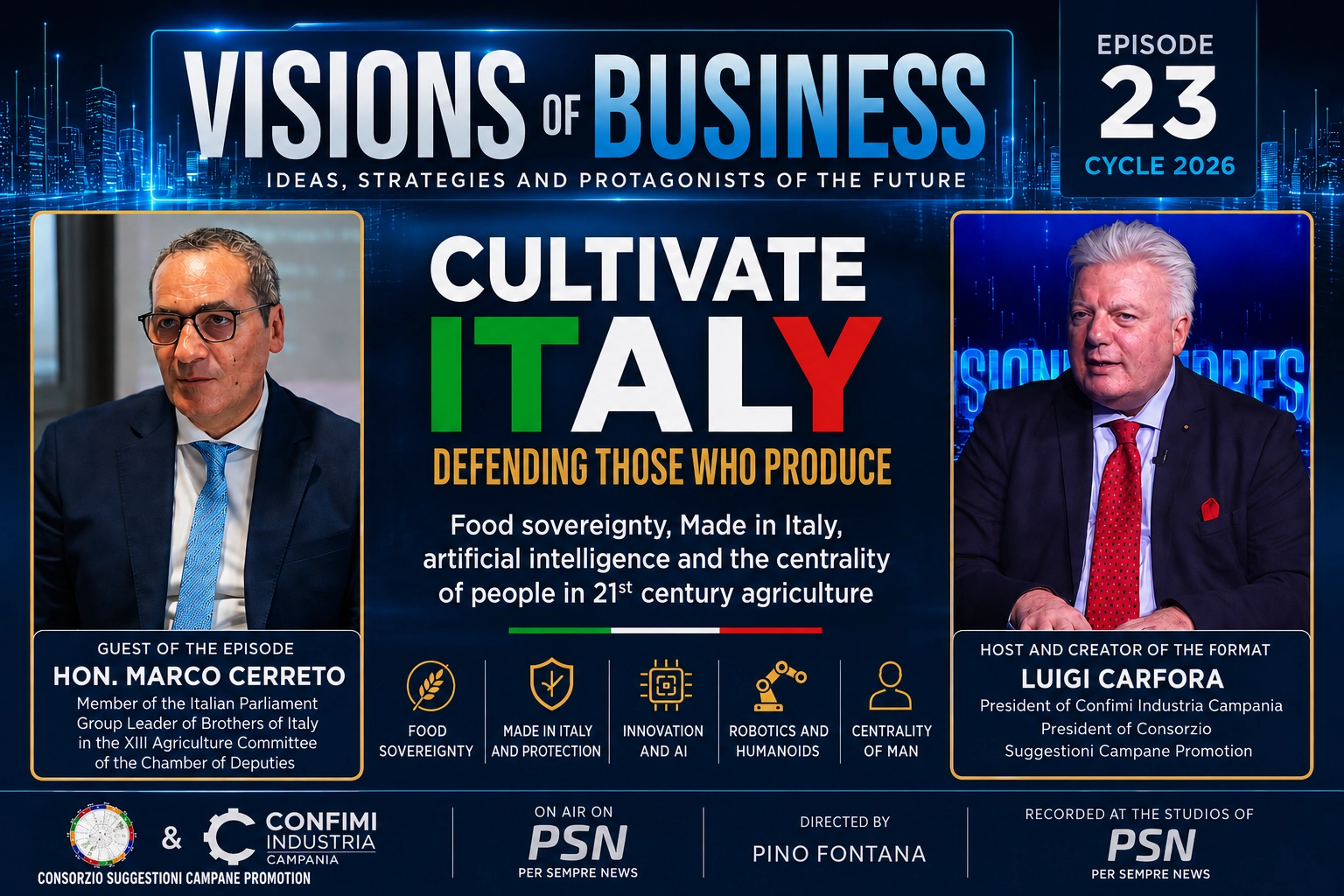
🎥 VISIONI DI IMPRESA – Episode 24 | 2026 Series
ARTIFICIAL INTELLIGENCE, DEMOCRACY AND THE SOVEREIGNTY OF KNOWLEDGE
Who will govern progress across research, business, institutions and society?
Theme
Artificial Intelligence, scientific research, technology transfer, innovation governance, knowledge sovereignty, digital democracy, universities, businesses, institutions, human capital, the common good, and the central role of the human person.
✦ Guiding Thought
"Every civilization has been built upon humanity's ability to create knowledge. Yet every new form of knowledge has also generated a new form of power. The true challenge of the 21st century will not be building increasingly powerful Artificial Intelligence systems, but ensuring that their development continues to be guided by human responsibility, democratic institutions, and the common good."
Introduction
Throughout the previous episodes of Visioni di Impresa, we have followed a journey designed to understand the major transformations shaping our time.
We have explored:
Scientific research.
Innovation.
Technology transfer.
Human capital.
Artificial Intelligence.
Energy.
Competitiveness.
Food sovereignty.
And the centrality of the human person.
At first glance, these may appear to be different subjects.
In reality, they all tell the same story.
The story of the relationship between knowledge, development, and responsibility.
Every great transformation in human civilization has originated from a new form of knowledge.
The discovery of fire.
Agriculture.
Writing.
Printing.
Electricity.
Computing.
The Internet.
Every time humanity has learned something new, it has transformed the way people live, produce, communicate and organize society.
Today we are experiencing a transformation unlike any before.
For the first time in history, we are no longer developing tools designed simply to amplify human physical capabilities.
We are creating systems capable of supporting increasingly complex cognitive activities.
This is what makes Artificial Intelligence one of the defining challenges of our era.
The issue is no longer technology alone.
It concerns the future of work.
Business.
Scientific research.
Education.
Institutions.
Democracy.
And, above all, the human person.
Episode Guests
In this episode, we have chosen to explore one of the most strategic and complex issues of our time through three distinct yet deeply complementary perspectives.
Artificial Intelligence is not merely about technology.
It concerns scientific research.
Business.
Institutions.
Education.
Competitiveness.
Democracy.
Society itself.
Understanding a transformation of this magnitude requires dialogue between different areas of expertise.
Prof. Aniello Murano
Full Professor of Computer Science and Artificial Intelligence
Recently elected Deputy Chair of EURAMAS – the European Association for Multi-Agent Systems, and one of Italy's leading scholars in Artificial Intelligence, computational logic, and multi-agent systems.
His scientific work contributes to the development of the technologies that are redefining the relationship between humanity, knowledge and innovation.
He represents the world of scientific research, where the future is conceived long before it becomes reality.
Prof. Mario Migliuolo
Chairman of the Scientific Committee of the AdAstra Foundation.
Former Director of the National Simulation Centre.
University professor and expert in innovation, advanced simulation and technology transfer.
His experience represents the vital link between universities, research, businesses and regional development.
Because knowledge creates value only when it is transformed into innovation, employment and sustainable economic growth.
Franco Picarone
Regional Councillor of Campania.
Vice-Chairman of the Eighth Standing Committee of the Regional Council of Campania.
Lead sponsor of the proposed legislation establishing the Campania Regional Observatory on Artificial Intelligence.
His presence represents the role of public institutions in governing technological transformation by developing policies capable of balancing innovation, fundamental rights, competitiveness and the public interest.
Three different experiences.
Three complementary responsibilities.
Three perspectives that together allow us to understand Artificial Intelligence not merely as a technological innovation, but as a scientific, economic, institutional and social transformation that will profoundly shape the future of our country.
Research.
Innovation.
Governance.
Three pillars that, together, contribute to building an Artificial Intelligence ecosystem that serves both people and sustainable territorial development.
From Knowledge to Power
For centuries, power was primarily associated with control over land.
Later, it became linked to control of trade routes.
Then to raw materials.
In the twentieth century, to energy.
Today, a new form of power is emerging.
👉 The ability to create, control and govern knowledge.
For this reason, Artificial Intelligence cannot be regarded merely as another technological innovation.
Artificial Intelligence is becoming a new infrastructure of knowledge.
And every infrastructure inevitably reshapes economic, political and social balances.
It is from this awareness that one of the most important questions of our time emerges:
👉 Who will govern Artificial Intelligence?
There Is No Single Artificial Intelligence
In a recent address devoted to Artificial Intelligence, the President of the Italian Republic, Sergio Mattarella, used a particularly meaningful expression.
He deliberately referred to "Artificial Intelligences" in the plural.
This linguistic choice reflects a fundamental reality.
There is no single Artificial Intelligence.
There are different models.
Different architectures.
Different industrial strategies.
Different cultural approaches.
Different economic interests.
Behind every AI system there are not only algorithms.
There are choices.
Values.
Priorities.
Development models.
This plurality requires us to reflect not only on the capabilities of technology, but also on the ways in which it is designed, developed and governed.
Two Visions of the Future
Recent international debate has highlighted profoundly different approaches to the use of Artificial Intelligence.
In some contexts, the prevailing objective appears to be the automation of an increasing number of human activities, reducing time, costs and production processes.
In others, a different vision is emerging.
Artificial Intelligence is conceived as a tool designed to support people, enhance human capabilities, improve decision-making and increase the quality of work without replacing human responsibility.
These are not simply two different technological models.
They represent two different visions of society.
This is precisely the perspective from which today's episode has been conceived.
We will not simply discuss what Artificial Intelligence is capable of doing.
We will seek to understand what kind of future we want to build.
Because every technology produces consequences.
Yet it is always human beings who decide the direction in which those consequences are guided.
Why This Episode Matters to Everyone
For many years, innovation was considered a subject reserved for specialists.
Engineers.
Computer scientists.
Researchers.
Today, this is no longer the case.
Artificial Intelligence is progressively entering businesses.
Hospitals.
Schools.
Universities.
Public administrations.
Courts.
Financial services.
The media.
And the everyday lives of millions of people.
Every citizen, often without even realizing it, already interacts daily with Artificial Intelligence systems.
For this reason, the real question is no longer limited to technological development.
It concerns the way these technologies will influence the quality of our democracy, our economy and our individual freedom.
From Energy Sovereignty to Knowledge Sovereignty
In the previous episode, we examined how energy and computing power are becoming two of the most strategic resources shaping the future of the global economy.
Without energy, there can be no data centres, Artificial Intelligence, advanced robotics or digital infrastructures.
Today we add another crucial element.
Energy powers machines.
Knowledge determines how those machines behave.
For this reason, the ability to develop and govern Artificial Intelligence platforms is becoming one of the defining forms of sovereignty in the twenty-first century.
Just as nations have historically invested in energy security, food security and industrial capacity, today they must also invest in scientific research, digital infrastructures and the skills required to understand and develop Artificial Intelligence.
Knowledge sovereignty does not mean isolating oneself from the world.
It means preserving the capacity to choose.
To understand.
To govern.
To decide.
A New Global Competition
Artificial Intelligence has become one of the world's foremost arenas of strategic competition.
Major technology companies are investing billions in increasingly advanced AI models.
Alongside them, many governments are developing national AI strategies, investing in scientific research, computing infrastructure, education and regulatory frameworks.
Europe itself has embarked upon a path aimed at promoting Artificial Intelligence founded upon the protection of fundamental rights, transparency and accountability.
This demonstrates that Artificial Intelligence is no longer merely a technological issue.
It is an economic issue.
An industrial issue.
A geopolitical issue.
A democratic issue.
A New Question
For many years we asked ourselves:
👉 How can we build increasingly powerful Artificial Intelligence?
Today, the question has changed.
👉 How can we govern increasingly powerful Artificial Intelligence?
Technology can become extraordinarily advanced.
Yet technology always remains a tool.
What ultimately determines its impact is not merely its technical capability.
It is the rules.
The institutions.
The responsibilities.
The values.
The purposes for which it is designed and employed.
This is the great challenge of our time:
Transforming technological progress into human progress.
The Role of Institutions
Every industrial revolution has required new rules.
The steam engine transformed labour.
Electricity transformed industry.
The Internet transformed communication.
Artificial Intelligence is now beginning to transform decision-making itself.
For this reason, growing attention is being devoted to governance mechanisms capable of accompanying this transition.
Within this context stands the proposed legislation establishing the Campania Regional Observatory on Artificial Intelligence (ORIAC).
Its purpose is not to slow innovation.
Its purpose is to understand it.
To monitor it.
To foster its responsible development.
To support businesses, public administrations and citizens.
To promote education and training.
To assess the economic, social and ethical impacts of emerging technologies.
Above all, however, it seeks to affirm one fundamental principle.
Decisions affecting people's rights must never be entrusted exclusively to automated systems.
Because ultimate responsibility must always remain in human hands.
The First Revolution of Intelligence
Every industrial revolution has transformed the relationship between people and work.
The steam engine multiplied physical strength.
Electricity made modern industrial production possible.
Computing accelerated information processing.
The Internet revolutionized global communication.
Artificial Intelligence introduces something unprecedented.
For the first time in history, humanity is developing tools designed not only to amplify physical capabilities, but also to assist increasingly complex cognitive activities.
Artificial Intelligence can analyse data.
Generate texts.
Interpret images.
Support medical diagnosis.
Write software.
Assist engineering and design.
Develop strategic solutions.
It does not replace human intelligence.
Rather, it enters a domain that, until only a few years ago, appeared to belong exclusively to human beings.
This is the true novelty of our age.
For this reason, the challenge is not simply technological innovation.
It concerns the very way society will organize work, knowledge and decision-making.
The Risk of Technological Dependence
Every major innovation creates new opportunities.
But it also creates new forms of dependence.
Throughout the twentieth century, many nations experienced what it meant to depend on other countries for energy.
Today, another form of dependence is emerging.
Technological dependence.
A significant share of today's most widely used Artificial Intelligence platforms has been developed within large private industrial ecosystems operating on a global scale.
This is not inherently negative.
It has enabled extraordinary technological progress.
Yet it also raises important questions.
Who controls these platforms?
Who determines their development priorities?
Who defines the criteria used to train AI models?
Who decides which data are used?
Who establishes the rules governing their algorithms?
These questions do not concern computer scientists alone.
They concern democratic institutions.
Businesses.
Universities.
Citizens.
Because an increasing share of economic, industrial and social decisions will be supported by Artificial Intelligence systems.
Digital Sovereignty
For decades, competitiveness was measured through GDP.
Labour costs.
Industrial capacity.
Exports.
Today, these indicators are no longer sufficient.
A nation must also develop:
• advanced skills;
• scientific research;
• computing infrastructure;
• data resources;
• Artificial Intelligence models;
• the capability to govern emerging technologies.
Digital sovereignty does not mean isolating oneself from the world.
It means being able to cooperate globally while preserving the ability to understand, develop and govern the strategic technologies that will shape the future.
It means having the freedom to choose.
To understand.
To contribute to technological development.
To participate in shaping the technologies that will influence tomorrow's economy.
For this reason, Artificial Intelligence is not simply about digital transformation.
It concerns the future model of democratic development in the twenty-first century.
From Economic Competition to Cognitive Competition
For centuries, economies competed primarily through the availability of material resources.
Later through industrial capacity.
Then through financial strength.
Today, a new form of competition is emerging.
Cognitive competition.
The ability to create knowledge.
To transform it into innovation.
To protect it.
To govern it.
To transfer it to businesses.
To make it a shared asset for society.
Within this new landscape, universities, research institutions, businesses and public institutions are called upon to work together more closely than ever before.
Not in order to control innovation.
But to govern it in the service of people and the common good.
A New Responsibility for Universities
Within this new scenario, the role of universities becomes even more significant.
Universities are not merely places where knowledge is transmitted.
They are where the skills that will shape tomorrow are developed.
They are where research begins.
Scientists are educated.
Engineers are trained.
Algorithms are created.
Above all, they educate the people who will be called upon to make increasingly complex decisions.
For this reason, scientific excellence represents one of the most strategic infrastructures of any nation.
No less important than energy networks.
Digital infrastructures.
Or transport systems.
Because every innovation ultimately begins with communities capable of generating new knowledge.
The Italian Approach
This is where a distinctive Italian perspective may emerge.
Throughout previous episodes of Visioni di Impresa, and particularly during our discussion with Professor Fabio Villone, a vision of Artificial Intelligence emerged in which technology is regarded as a tool designed to support human work, enhance human capabilities and strengthen decision-making.
This reflects a cultural tradition deeply rooted in Italy.
Technology as a means.
Not as an end.
Machines serving people.
Not people adapting themselves to machines.
This vision aligns closely with the European approach to trustworthy, transparent and human-centred Artificial Intelligence.
The challenge is not to slow innovation.
The challenge is to govern it in a way that continues to generate economic development while safeguarding human dignity.
Because true progress is not measured solely by the power of the technologies we create.
It is measured by the quality of the society those technologies help to build.
Businesses Facing a New Technological Revolution
Every industrial revolution has transformed the way goods are produced.
But every revolution has also reshaped competition among businesses.
Large corporations often possess the financial resources, specialised expertise and investment capacity needed to adopt emerging technologies more rapidly.
For small and medium-sized enterprises, however, the challenge is different.
It is not simply a matter of purchasing new technologies.
It is about integrating Artificial Intelligence into production processes without losing the experience, expertise and relationships built over decades.
Artificial Intelligence must never become a factor of exclusion.
It must become an accessible driver of competitiveness for SMEs, which remain the backbone of the Italian economy.
For this reason, scientific research, technology transfer and education become strategic priorities.
Businesses need more than technologies to purchase.
They need guidance.
Skills.
Practical tools enabling even smaller companies to access innovation.
Professional support.
Innovation ecosystems capable of transforming technological progress into sustainable growth.
This is where universities, research centres, business associations and public institutions can work together.
Because the competitiveness of a territory depends on the ability to strengthen the entire productive system, not only a limited number of large companies.
Campania: A Knowledge Ecosystem
It is no coincidence that many of the reflections developed throughout this series of Visioni di Impresa have featured professors and researchers from the University of Naples Federico II.
This demonstrates the University's continuing role as one of Southern Italy's leading centres of scientific research, innovation and advanced education.
For many years, Southern Italy has been described almost exclusively through its challenges.
Today, another narrative is emerging.
A narrative built upon knowledge.
Campania is home to some of Italy's most important institutions dedicated to scientific research, higher education and digital innovation.
The University of Naples Federico II.
DIETI (Department of Electrical Engineering and Information Technologies), one of Italy's leading research centres in engineering, Artificial Intelligence, digital technologies and innovation.
The Apple Developer Academy.
Public and private research centres.
Innovative companies.
Scientific expertise recognised internationally.
If this extraordinary ecosystem succeeds in establishing a lasting dialogue with the productive sector, Campania can become not only a region that uses Artificial Intelligence, but also one of the places where it is researched, developed and governed.
This scientific ecosystem is now complemented by an institutional reflection aimed at creating permanent instruments for the study, monitoring and governance of Artificial Intelligence through public policy.
When effectively connected, these elements can create an innovation ecosystem capable of attracting investment, retaining talent and fostering the creation of new high-tech enterprises.
The real challenge is not simply participating in the Artificial Intelligence revolution.
It is helping to define its model of development.
The competitiveness of a territory depends not only on the presence of large companies.
It depends on the ability to connect universities, research centres, public institutions, businesses, representative organisations and human capital.
This is the challenge Campania is now called upon to embrace.
Not merely to produce excellence.
But to build an ecosystem in which research, innovation and economic development continuously reinforce one another.
Because the true value of knowledge grows when it becomes a shared asset for the entire community.
Knowledge as Strategic Infrastructure
For a long time, infrastructure was understood exclusively as physical assets.
Roads.
Railways.
Ports.
Airports.
Energy networks.
Today, we must broaden that vision.
Knowledge itself is also an infrastructure.
Universities.
Laboratories.
Research centres.
Innovation networks.
Widely shared skills and expertise.
These are the invisible infrastructures upon which a nation's competitiveness is built.
Without research, there is no innovation.
Without innovation, businesses cannot grow.
And without businesses capable of innovating, knowledge risks remaining confined within laboratories instead of becoming economic development, employment and shared prosperity.
Without enterprise, there can be no sustainable development.
For this reason, investing in knowledge means investing in economic freedom and in the future of the next generations.
Artificial Intelligence and Democratic Responsibility
Every algorithm is the result of a choice.
Every model is designed.
Trained.
Updated.
Directed towards specific objectives.
For this reason, no technology is entirely neutral.
Every technology is developed by people, organisations and communities operating within specific cultural, economic and legal contexts.
Every algorithm inevitably reflects a particular vision of the world, a set of priorities and criteria established by those who design it.
The challenge is not to oppose different technological models.
The challenge is to ensure that innovation remains consistent with democratic principles, the protection of fundamental rights and the centrality of the human person.
Within this perspective, the role of public institutions becomes especially important.
Not to replace scientific research.
Not to slow innovation.
But to establish rules capable of guiding technological development with balance, transparency and responsibility.
Artificial Intelligence must never become an instrument that limits individual freedom.
It must expand human opportunities.
That is the true measure of progress.
The Brain Drain: A Challenge Beyond Salaries
When discussing the migration of highly skilled young professionals, public debate often focuses almost exclusively on salaries.
Compensation is certainly important.
But it is not the only factor.
Throughout the discussions developed in previous episodes of Visioni di Impresa, another significant reflection emerged.
Young researchers.
Engineers.
Computer scientists.
Highly qualified professionals.
They are not looking only for a job.
They seek a career path.
A long-term perspective.
Professional challenges.
The opportunity to participate in international projects.
To collaborate within multidisciplinary research teams.
To progressively assume greater responsibilities.
To contribute to technologies capable of shaping the future.
Large international companies often provide these opportunities.
Not only through competitive salaries.
But above all through structured career development, highly innovative environments and participation in projects of global significance.
Italy's productive system is largely composed of small and medium-sized enterprises.
An extraordinary strength in many respects.
Yet, because of their size, these companies sometimes face greater difficulties in offering career opportunities comparable to those available within large multinational organisations.
The issue, therefore, is not simply labour costs.
It is the ability of the entire economic system to build ecosystems in which talented young people can envision their future.
Retaining talent does not simply mean increasing salaries.
It means creating research.
Innovation.
Large-scale projects.
International cooperation.
Businesses capable of continuous growth.
Universities increasingly connected with the productive system.
This is precisely where technology transfer assumes an even deeper significance.
Every innovation successfully transformed into enterprise contributes not only to economic development.
It also creates the professional opportunities that allow young people to build their future without feeling compelled to seek it elsewhere.
From this perspective, the competitiveness of a territory is measured not only by its ability to attract investment.
It is also measured by its ability to retain its most talented people by offering purpose, responsibility and career opportunities worthy of their ambitions.
The real challenge, therefore, is not merely retaining young people.
It is creating an economic system that truly deserves to keep them.
Business Growth as an Investment in Talent
This reflection also highlights an important responsibility for the productive system.
Helping businesses grow does not simply mean increasing turnover or export capacity.
It means creating organisations in which young professionals can develop meaningful careers, assume increasing responsibilities and participate in projects of international relevance.
An economy built upon increasingly innovative, well-structured and competitive companies also provides one of the most effective responses to the brain drain.
Because business growth ultimately becomes human growth.
Artificial Intelligence Concerns Society as a Whole
For many years, innovation was regarded as a matter reserved for specialists.
Engineers.
Researchers.
Computer scientists.
Today, this is no longer the case.
Artificial Intelligence is progressively becoming part of the everyday lives of millions of people.
It supports medical diagnosis.
Assists industrial design.
Supports professionals.
Analyses data.
Organises production processes.
Contributes to scientific research.
Enhances education and training.
Increasingly, it also supports both public and private decision-making.
For this reason, Artificial Intelligence can no longer be viewed simply as another technology.
It is becoming a structural component of contemporary society.
And every structural transformation requires knowledge, responsibility and effective governance.
Trust Will Become the New Infrastructure
Every innovation is accepted by society only when it generates trust.
The steam engine required new regulations.
Electricity required new safety standards.
The Internet required new forms of privacy protection.
Artificial Intelligence will require something even more complex.
Trust.
People must know:
how their data are used;
who develops the algorithms;
which principles guide intelligent systems;
which responsibilities always remain in human hands.
Trust will also depend upon algorithmic transparency.
This does not mean disclosing every technical aspect of Artificial Intelligence systems.
It means enabling people, at least in their essential principles, to understand how algorithm-supported decisions are made and where ultimate human responsibility remains.
Without trust, no innovation can generate lasting development.
For this reason, technological progress must advance together with scientific culture, transparency and democratic participation.
Education Becomes Strategic Infrastructure
For many years, we believed that education ended with school or university.
The twenty-first century is demonstrating a different reality.
Skills must accompany people throughout their entire lives.
Artificial Intelligence will transform existing professions.
Create new ones.
Redefine skills.
Reshape organisations.
For this reason, lifelong learning is no longer merely an opportunity.
It has become a necessity.
Universities.
Schools.
Research centres.
Businesses.
Representative organisations.
Public institutions.
All will be called upon to build together a permanent ecosystem of knowledge.
Because the greatest risk is no longer merely technological delay.
It is cultural delay.
Businesses Must Lead the Transformation, Not Endure It
For Italy's productive system, the challenge is not competing with global technology platforms in terms of size.
The challenge is to strengthen what makes Italian enterprises unique:
creativity;
flexibility;
manufacturing excellence;
customisation;
and close relationships with customers.
Artificial Intelligence must reinforce these strengths, not standardise them.
Every industrial revolution inevitably creates both winners and those who struggle to adapt.
The risk is that Artificial Intelligence may further widen the gap between those with advanced skills and those left behind by transformation.
For this reason, small and medium-sized enterprises must not simply become recipients of innovation.
They must become its protagonists.
Innovation cannot remain the privilege of a few large industrial groups.
It must become a shared resource.
Accessible to artisans.
Family businesses.
Manufacturing companies.
Agricultural enterprises.
Professional practices.
Local administrations.
The true competitiveness of a territory will depend upon its ability to make innovation accessible throughout the entire productive system.
Technology must enable our businesses to express their identity even more effectively, not to lose it.
Artificial Intelligence should strengthen what makes the Italian production model unique: creativity, quality, manufacturing excellence, customisation and close customer relationships.
Innovation does not mean becoming all alike.
It means becoming even more competitive by strengthening our own productive identity.
Artificial Intelligence Does Not Diminish Human Value
Whenever a new technology emerges, the same question inevitably arises.
Will human beings be replaced?
History teaches us that progress transforms work.
But it does not diminish the value of the human person.
It changes skills.
Transforms professions.
Creates new opportunities.
Requires new learning.
Artificial Intelligence is no exception.
The real challenge is not choosing between humans and machines.
It is understanding which responsibilities will always remain uniquely human.
Creativity.
Ethics.
The ability to assume responsibility.
Sensitivity.
Empathy.
Vision.
The pursuit of the common good.
These are dimensions that no algorithm can replace.
This is precisely why human capital remains the most strategic resource of every society.
From the Algorithm to the Humanoid Robot
Today, Artificial Intelligence operates primarily through software.
In the years ahead, however, we will witness an increasingly close integration between AI algorithms and advanced robotics.
Humanoid robots represent one of the most significant developments of this transformation.
They will not simply be more sophisticated machines.
They will become intelligent systems capable of interacting within workplaces, public services, manufacturing, logistics, healthcare and personal assistance.
Once again, the essential question is not merely what these technologies will be capable of doing.
It is what responsibilities will continue to belong exclusively to human beings.
Every innovation changes the tools we use.
Human responsibility, however, remains irreplaceable.
Even in a society increasingly shaped by humanoid robots, the value of the individual will not be measured by the ability to compete with machines, but by the ability to guide them with intelligence, responsibility and conscience.
From the Centrality of the Human Person to the Responsibility of Progress
Throughout the entire Visioni di Impresa series we have explored subjects that, at first glance, appeared very different.
Innovation.
Scientific research.
Artificial Intelligence.
Energy.
Competitiveness.
The Third Sector.
Food sovereignty.
Business.
Employment.
Education.
Each episode examined one piece of a much larger picture.
Today, perhaps, we can finally understand its broader meaning.
Energy.
Knowledge.
Technology.
Food.
Enterprise.
These are not separate worlds.
They are the new infrastructures of contemporary civilisation.
Yet no infrastructure can determine the future by itself.
Every technology can be used either to build or to divide.
To expand opportunities.
Or to deepen inequalities.
To strengthen freedom.
Or to create new forms of dependence.
For this reason, the defining issue of the twenty-first century will not simply be the speed of innovation.
It will be the quality of the responsibility with which we choose to govern it.
The Three Sovereignties of the Twenty-First Century
Throughout this series we have explored three dimensions that, although belonging to different fields, are becoming increasingly strategic.
Energy sovereignty.
Food sovereignty.
Knowledge sovereignty.
Energy makes development possible.
Food guarantees the security of communities.
Knowledge guides decision-making.
Three different resources.
One shared responsibility.
To govern them in the interest of people, businesses and society.
Perhaps this is the greatest challenge facing the democracies of the twenty-first century.
It is important, however, to clarify what sovereignty truly means.
In this context, sovereignty does not imply isolation, protectionism or opposition to international markets.
Rather, it means the ability of governments, institutions, scientific research and the productive system to work together in understanding, developing and governing strategic technologies for the benefit of society.
It is not the State against the market.
Nor the market against the State.
It is the capacity to build lasting cooperation between scientific research, businesses and public institutions so that innovation continues to serve people, democracy and national development.
Progress Does Not Govern Itself
Progress is often perceived as an inevitable force.
As something destined to advance on its own.
History tells a different story.
Every industrial revolution has been shaped by choices.
By laws.
By institutions.
By universities.
By businesses.
By women and men willing to assume responsibility.
Artificial Intelligence will follow the same path.
Algorithms will not decide the future.
People will.
The people who design the algorithms.
The companies that deploy them.
The universities that educate future generations.
The institutions that establish the rules.
The citizens who decide how society will coexist with these technologies.
Responsibility can never be automated.
It will always remain profoundly human.
A New Alliance
Meeting this transformation will require more than financial investment.
More than new technologies.
More than new legislation.
It will require a new alliance.
Between universities.
Research.
Businesses.
Public institutions.
Schools.
Territories.
Civil society.
Representative organisations.
Because none of these actors possesses all the answers alone.
Artificial Intelligence does not belong exclusively to computer scientists.
Just as economics does not belong only to economists.
The future will become increasingly multidisciplinary.
It is precisely this collaboration that can transform innovation into an instrument of shared and sustainable growth.
A Challenge for Italy
Italy possesses a cultural tradition that, for centuries, has successfully combined science, law, humanism and entrepreneurial excellence.
That tradition remains one of our greatest strategic assets.
True competitiveness will not depend solely on developing increasingly sophisticated technologies.
It will depend on our ability to use them without losing sight of the human person.
Our strength should not lie in merely following models developed elsewhere.
It should lie in helping to build a distinctly European model of Artificial Intelligence—one capable of combining innovation, freedom, responsibility, scientific research, economic competitiveness and the protection of human dignity.
This is the challenge awaiting our universities.
Our businesses.
Our institutions.
And the next generation.
The Question That Will Shape the Future
Throughout history, humanity has learned to master fire.
To navigate the oceans.
To generate energy.
To communicate across the globe.
Today, we are learning to build Artificial Intelligence.
Perhaps the decisive question is not whether we will succeed in making it increasingly powerful.
We almost certainly will.
The real question is another.
👉 Will we become wise and responsible enough to govern the power that we ourselves are creating?
Every technological advance expands human possibilities.
Only responsibility transforms those possibilities into genuine human progress.
The Responsibility of Our Time
Every generation has had to learn how to govern its greatest achievements.
Our generation must learn how to govern knowledge.
Research.
Innovation.
Enterprise.
Institutions.
These are not separate worlds.
They are the four pillars upon which a society capable of embracing Artificial Intelligence—without sacrificing freedom, democracy and the centrality of the human person—must be built.
Progress is not born from technology alone.
It is born from the responsibility with which a community chooses to use it.
The Final Question
Future generations may not judge us by the power of the technologies we created.
They may judge us by the wisdom with which we chose to use them.
Because the future will not be determined by the most advanced technology.
It will be determined by the quality of the people entrusted with governing it.
✦ Episode Reflection
"Every generation inherits the achievements of those who came before. Ours bears the responsibility of governing one of the greatest revolutions in human history: Artificial Intelligence. True progress will not be measured by the power of algorithms, but by humanity's ability to direct them towards the common good, freedom, human dignity and the development of future generations. For no technology will ever be greater than the responsibility of those who choose how to use it."
🎙 EPISODE 24 – 2026 SERIES
Host and Executive Producer
Luigi Carfora
President, Confimi Industria Campania
President, Suggestioni Campane Promotion Consortium
Guests
Prof. Aniello Murano
Full Professor of Computer Science and Artificial Intelligence
Deputy Chair of EURAMAS – European Association for Multi-Agent Systems
One of Italy's leading scholars in Artificial Intelligence, Computational Logic and Intelligent Systems.
Prof. Mario Migliuolo
Chairman of the Scientific Committee, AdAstra Foundation
Former Director of the National Simulation Centre
Expert in technological innovation, advanced simulation and technology transfer.
Franco Picarone
Regional Councillor of Campania
Vice-Chairman of the Eighth Standing Committee of the Regional Council of Campania
Lead sponsor of the proposed legislation establishing the Campania Regional Observatory on Artificial Intelligence (ORIAC).
🎬 Directed by: Pino Fontana
📺 Broadcast on: Per Sempre News
📍 Recorded at the Per Sempre News studios
📺 Available on Per Sempre News and across our official social media channels.
🌐 All episodes of Visioni di Impresa are available on the official portal of the Suggestioni Campane Promotion Consortium and Confimi Industria Campania:
https://www.suggestioni.eu/visioni-di-impresa/
Because understanding change is the first step towards governing it.
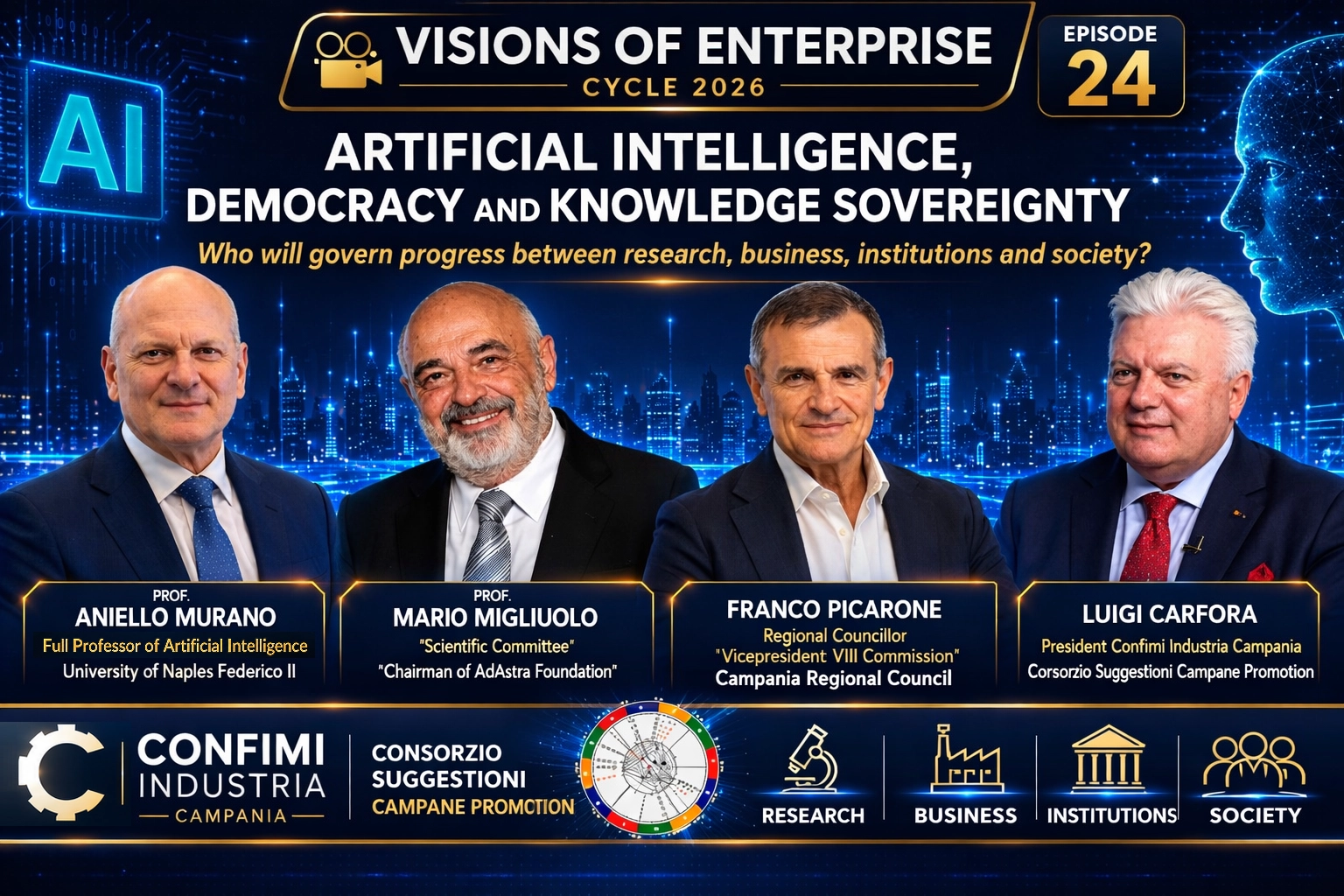
🎥 BUSINESS VISIONS – Episode 25 | 2026 Series
GLOBALIZATION, COOPERATION AND NEW SOVEREIGNTIES
From Raw Materials to Knowledge: Building a Shared Future between Europe, Africa and the Mediterranean
Theme
Globalization, international cooperation, economic diplomacy, sustainable development, technology transfer, raw materials, human capital, Europe–Africa relations, competitiveness, education, innovation, industrial development, new sovereignties, the common good and the centrality of the human person.
✦ Guiding Thought of the Episode
"Every nation possesses its own unique wealth. Some are rich in natural resources, others in knowledge, others in industrial capabilities. The true challenge of the twenty-first century is not to exploit these differences, but to transform them into opportunities for cooperation. Development does not arise from isolation, but from the ability to share knowledge, create value and build relationships based on mutual respect, human dignity and shared growth."
Introduction
Throughout the previous episodes of Business Visions, we have explored how the world is undergoing a profound transformation affecting the economy, society, technology and the relationships among nations.
We have discussed scientific research.
Innovation.
Energy.
Artificial Intelligence.
Technology transfer.
Human capital.
Competitiveness.
Food sovereignty.
Democracy.
Knowledge.
These may appear to be different topics.
In reality, they are all connected by a common thread.
Understanding how to build a model of development that places people, work, enterprise and the common good at its very center.
Today, we broaden our perspective even further.
We will not limit ourselves to observing the Italian or the European economic system.
Instead, we will look at the world from a wider perspective.
The perspective of relations among peoples.
Among economies.
Among cultures.
Among continents.
Because globalization is not only about trade.
It is about the way nations cooperate.
Share knowledge.
Transfer expertise.
Create development.
Generate opportunities.
Or, conversely, produce new inequalities.
Never before has Europe's future been so closely connected to Africa's future.
The Mediterranean is far more than a geographical space.
It is a natural bridge between civilizations, economies and cultures.
A place where different needs meet extraordinary opportunities for shared growth.
Within this context, Benin represents a particularly meaningful example.
A country with one of the youngest populations in West Africa.
Rich in natural resources and human capital.
With remarkable development potential.
Yet also facing major challenges in education, industrialization, economic growth and the enhancement of its human capital.
The question guiding this episode goes far beyond the specific case of Benin.
It is a question that concerns us all.
How can we build a model of globalization capable of generating shared development?
How can natural resources be transformed into added value?
How can knowledge become an instrument of freedom rather than a new source of inequality?
Because the future will not depend solely on what nations possess.
It will depend above all on their ability to transform their resources into knowledge, knowledge into enterprise, and enterprise into human, economic and social development.
Guest of the Episode
To explore a reflection of this magnitude, we have invited a guest whose institutional role offers a privileged perspective on the relationship between diplomacy, international cooperation, economic development and Europe–Africa relations.
Giuseppe Gambardella
Consul of the Republic of Benin
For many years he has been actively engaged in promoting institutional, economic, cultural and commercial relations between Benin and Italy, fostering dialogue among businesses, institutions and communities in both countries.
His work is a concrete example of how modern diplomacy is no longer limited to political relations between States.
Increasingly, it has become an instrument for economic cooperation, territorial development and the construction of international partnerships founded on mutual knowledge and trust.
His participation in this episode provides an opportunity to address some of the major challenges that will shape the future of the global economy.
The relationship between Europe and Africa.
The enhancement of natural resources.
Business development.
Technology and knowledge transfer.
The education of future generations.
International cooperation.
And the role that research, innovation and technological progress can play in fostering more balanced and inclusive development among nations.
Speaking about Benin today also means reflecting on a much broader issue.
The future relationship between mature economies and emerging economies.
A future that cannot be built solely through trade.
But through the sharing of knowledge.
Education.
Investment.
Business growth.
The enhancement of human potential.
Because every lasting economic relationship is built first and foremost on trust.
And every form of trust begins with mutual understanding.
Reciprocity as a New Model for Development
For many years, international cooperation was understood as a relationship between those who provided assistance and those who received it.
Today, this perspective is no longer sufficient.
The major challenges of the twenty-first century require a different approach.
Reciprocity.
Every nation possesses resources, skills, experience and knowledge that can contribute to the growth of others.
There are no longer economies that simply teach and economies that merely learn.
There are economies that can grow together by enhancing their respective strengths.
This is the new frontier of international cooperation.
Not creating dependence.
But building shared development.
A Changing Globalization
For many years, globalization was presented almost exclusively as an extraordinary opportunity for economic growth.
The opening of markets.
The free movement of goods.
The internationalization of businesses.
The expansion of global value chains.
All of this contributed to increasing international trade and accelerating the development of many economies.
At the same time, however, it also revealed new imbalances.
It concentrated productive capacity.
It created new forms of economic dependence.
It highlighted how the distribution of wealth remains deeply uneven.
It has also demonstrated that no economy can any longer be considered completely self-sufficient. Global supply chains, scientific research, technological innovation and strategic resources increasingly show that the future depends on the quality of the relationships built among nations.
Today, the international debate is no longer simply about globalization.
It is about the quality of globalization.
Are we moving toward a model capable of generating shared development?
Or toward a system in which value continues to be concentrated in only a few parts of the world while other territories remain primarily suppliers of raw materials?
This question concerns everyone.
Major economies.
Emerging countries.
Businesses.
Institutions.
But above all, people.
Because behind every economic statistic there are communities, families, workers and young people striving to build their future.
It is from this perspective that we wish to develop today's discussion.
From Raw Materials to Added Value
Economic history teaches us that no single resource, by itself, is sufficient to guarantee a country's development.
For centuries, wealth was associated with the availability of fertile land.
Minerals.
Forests.
Oil.
And abundant natural resources.
Even today, many economies rely significantly on the export of raw materials as a source of growth.
These are valuable resources.
Often indispensable.
Yet the twenty-first century is teaching us a fundamental lesson.
Real value does not arise simply from possessing a resource.
It comes from the ability to transform it.
To process it.
To industrialize it.
To innovate it.
To market it.
To integrate it into productive value chains capable of generating employment, skills and sustainable development.
Development is not achieved simply by extracting a resource.
It is achieved above all by retaining as much added value as possible within the country through research, industrial transformation, expertise and innovation.
Whenever a raw material leaves a country without being processed, a significant portion of its economic value is created elsewhere.
The territory that owns that natural resource certainly gains a benefit.
But it often gives up the most valuable part of the value chain.
Research.
Industry.
Design.
Innovation.
Distribution.
Brand development.
International marketing.
This is where one of the defining issues of our time emerges.
Raw materials are only the starting point.
Knowledge is the destination.
It is knowledge that transforms natural resources into economic development.
Education creates skills.
Research generates innovation.
Enterprise transforms innovation into employment.
And work restores dignity to people while enabling communities to shape their own future.
For this reason, the true wealth of a nation is no longer measured solely by what lies beneath its soil.
It is increasingly measured by what it is able to build through the talent, creativity and capabilities of its people.
The Value of Economic Cooperation
From this perspective, the very meaning of international cooperation also changes.
For many years, cooperation was understood primarily as providing assistance.
Today, cooperation means creating the conditions that enable every country to develop its own economy independently.
Supporting the creation of businesses.
Transferring expertise.
Sharing technologies.
Promoting investment.
Strengthening the rule of law.
Encouraging administrative transparency.
Creating an environment that fosters investment and business growth.
Because without reliable institutions, there can be no sustainable development.
Investing in human capital.
Supporting the strengthening of institutions.
The most effective form of cooperation is not the one that creates dependence.
It is the one that builds autonomy through co-development—a model of shared growth in which both partners strengthen their economic, productive and social capacities.
Every nation, above all, seeks the opportunity to build its own future through work, knowledge and the freedom to innovate and undertake.
This is the deepest meaning of economic diplomacy.
Not merely to promote trade.
But to build relationships capable of generating trust, investment, development and mutual growth.
The growth of one nation is never a loss for another.
When development is founded on cooperation, the rule of law, education and mutual respect, it becomes a shared opportunity for everyone.
From Knowledge to Freedom
In the previous episode, we reflected on how knowledge is becoming one of the principal forms of sovereignty in the twenty-first century.
We explored how Artificial Intelligence, scientific research and innovation are reshaping the balance of the global economy.
Today, we broaden that reflection even further.
Knowledge is not merely a source of competitiveness.
It is also an extraordinary instrument of freedom.
A nation becomes truly free when it possesses the ability to educate its people.
To develop its businesses.
To enhance its own resources.
To build its future without depending exclusively on the decisions of others.
For this reason, international cooperation cannot be limited to the transfer of financial resources.
Its greatest value lies in the transfer of knowledge.
Technology can be purchased.
Raw materials can be extracted.
Investments can be financed.
But only knowledge remains a lasting asset of a nation.
Knowledge creates new businesses.
New professions.
New opportunities.
New employment.
New prospects for future generations.
This is where universities, research institutions, businesses and public institutions become the true protagonists of development.
Europe and Africa: A Shared Responsibility
For many years, the Mediterranean has been portrayed primarily as a frontier.
A border.
At times even as a line of separation.
In reality, it has always been much more than that.
For centuries, it has been one of history's greatest meeting places.
A crossroads of civilizations.
Cultures.
Trade.
Knowledge.
Religions.
And peoples.
Today, this historic vocation is once again assuming strategic importance.
Europe and Africa are not opposing worlds.
They are deeply complementary realities.
Europe possesses an extraordinary heritage of scientific, industrial, technological and entrepreneurial expertise.
Both continents possess distinct capabilities, entrepreneurial strengths and resources that can become mutually complementary when developed through relationships founded on reciprocity.
Africa is home to one of the youngest populations in the world, abundant natural resources and enormous growth potential.
The real challenge is not to determine who should help whom.
It is to understand how to build development based on mutual cooperation.
Every nation possesses assets that can contribute to the growth of others.
Knowledge.
Work.
Creativity.
Natural resources.
Culture.
Entrepreneurship.
The capacity to innovate.
International cooperation therefore takes on a new meaning.
It is not merely an expression of solidarity.
It is the shared construction of the future.
Two Continents, Two Demographic Dynamics
Europe and Africa are experiencing profoundly different demographic trends.
Many European countries are facing declining birth rates, an ageing population and increasing difficulties in ensuring generational renewal within the workforce.
Many African countries, by contrast, have exceptionally young populations, accompanied by a growing demand for education, vocational training and employment opportunities.
These differences should not be interpreted as a problem on one side and a solution on the other.
Rather, they should be understood as one of the great challenges of the twenty-first century.
Only through balanced territorial development, business growth, education and the creation of local opportunities will it be possible to transform these differences into a source of stability and shared prosperity.
Human Capital as the Primary Infrastructure
Throughout every episode of Business Visions, we have sought to demonstrate a conviction that today emerges with even greater strength.
The first infrastructure of any nation is not its roads.
Its ports.
Its railways.
Or its data centres.
The first and most important infrastructure is its people.
Their level of education.
The quality of their training.
Their entrepreneurial spirit.
Their trust in institutions.
Their sense of responsibility.
Their commitment to the common good.
Every investment produces lasting results only when it is supported by well-prepared people, credible institutions and businesses capable of transforming opportunities into development.
For this reason, human capital remains the most valuable asset of every nation.
And it is probably the most important investment any society can make for its future.
Development Is Not Measured by GDP Alone
For many years, we measured a nation's progress almost exclusively through economic indicators.
Gross Domestic Product.
Exports.
Industrial production.
Investment.
These are essential indicators.
But today they are no longer sufficient.
Development cannot be measured simply by an increase in wealth.
It must also be measured by the ability of that wealth to improve people's quality of life.
To create jobs.
To reduce inequalities.
To expand access to education.
To strengthen healthcare.
To support businesses.
To nurture the talents of young people.
To provide opportunities even in the most vulnerable regions.
This is the true measure of development.
Because every economy exists to serve people.
Not the other way around.
The New Inequalities of the Twenty-First Century
For many decades, we focused primarily on the differences between wealthy and poorer nations.
Today, new forms of inequality are emerging.
Technological inequality.
Educational inequality.
Digital inequality.
Inequality in the capacity to generate knowledge.
Inequality in access to international markets.
This is where one of the defining challenges of the future will be decided.
A nation does not fall behind merely because it has fewer economic resources.
It falls behind when it cannot access knowledge.
When it cannot transform the talent of its young people into opportunity.
When its businesses are unable to grow.
When added value continues to be created elsewhere.
For this reason, international cooperation acquires an even deeper meaning.
It must not simply reduce economic disparities.
It must also help reduce the knowledge gap.
The Responsibility of Enterprise
Every business is naturally created to generate economic value.
But the strongest businesses are also those that create social value.
Every productive investment creates employment.
Every new enterprise develops skills.
Every industrial value chain builds professional expertise.
Every economic activity contributes to the growth of a community.
For this reason, enterprise is one of the most effective instruments for promoting stable and lasting development.
Business does not replace public institutions.
It does not replace schools.
It does not replace scientific research.
Instead, it works in partnership with all of them.
Only when the economy, education, research and institutions grow together can a truly sustainable model of development be achieved.
This is the real challenge of twenty-first century globalization.
Not simply to generate greater wealth.
But to generate wealth capable of creating employment, dignity, stability and hope.
Economic Diplomacy as a Builder of the Future
In today's world, diplomacy is no longer limited to relations between governments.
Increasingly, it builds economic partnerships.
Encourages investment.
Promotes collaboration among universities.
Facilitates technology transfer.
Supports the growth of small and medium-sized enterprises.
Encourages the development of new industrial value chains.
Promotes cultural exchange.
Fosters new economic partnerships.
Strengthens dialogue among territories and communities.
Today, economic diplomacy is one of the most effective tools for helping prevent conflict while promoting sustainable development.
The experience of Consul Giuseppe Gambardella clearly demonstrates how economic diplomacy can bring together institutions, businesses and local communities, fostering relationships that create opportunities for mutual growth between Italy and Benin.
Because nations that cooperate.
That trade.
That invest together.
That share knowledge.
Are also nations that come to understand one another more deeply.
Trust is the first investment in every international relationship.
And it is from trust that cooperation, development and peace emerge.
Peace is not built solely through political agreements.
It is also built by creating employment opportunities.
Enterprise.
Education.
Research.
Innovation.
Because wherever human dignity grows, the stability of communities grows as well.
And this is the highest expression of international cooperation.
A New Humanism of Cooperation
Every era in history has developed its own model of progress.
For centuries, the strength of a nation was measured by the size of its territory.
Later, by its industrial capacity.
Then by its access to energy.
Today, we are entering an entirely new phase.
The true wealth of a nation lies in its ability to transform knowledge, work and innovation into shared development.
For this reason, international cooperation takes on an entirely new meaning.
It is not only about aid.
It is not only about trade.
It is not only about investment.
It is about building a future in which every nation can become the protagonist of its own development.
Cooperation is not about creating dependence.
It is about building autonomy.
Transferring knowledge and expertise.
Encouraging the creation of businesses.
Supporting education and training.
Creating the conditions that enable every community to enhance its human, cultural and economic resources.
This is perhaps the highest expression of solidarity.
Because it restores dignity.
Freedom.
Responsibility.
And confidence in the future.
Africa Is Not Only Africa's Future
Too often, the African continent is portrayed exclusively through its challenges.
Crises.
Migration.
Poverty.
Conflict.
All of these realities exist.
But they represent only part of the picture.
Africa is also one of the world's greatest demographic, economic and social laboratories of the twenty-first century.
A young population.
An extraordinary wealth of natural resources.
A growing demand for education and professional training.
A rapidly evolving market.
A remarkable entrepreneurial spirit.
Across many sectors—from agribusiness and raw material processing to energy and infrastructure—new opportunities for cooperation with the European productive system are emerging, capable of generating mutual benefits.
To understand Africa is to understand an essential part of the world's future.
Because the destinies of Europe and Africa are becoming increasingly interconnected.
Environmental challenges.
Economic transformation.
Migration.
Food security.
Energy.
Strategic raw materials.
Innovation.
These are challenges that no country can face alone.
For this reason, the Mediterranean should not be perceived as a border.
It should once again become what history has always made it:
A bridge between peoples.
Between economies.
Between cultures.
Between knowledge systems.
The Role of Small and Medium-Sized Enterprises
Small and medium-sized enterprises represent one of the most effective instruments through which economic cooperation can be transformed into tangible development.
Technology.
Expertise.
Machinery.
Education and training.
Manufacturing excellence.
Engineering and design capabilities.
A culture of quality.
Production specialization.
These are the foundations of Italian industry.
Innovation.
They are assets built over generations that can contribute to the development of new productive systems, creating value both in partner countries and for Italian enterprises.
This is where economic cooperation meets the mission of SMEs.
Not to relocate knowledge.
But to share it.
Not to replace local economies.
But to help them grow.
The Responsibility of Future Generations
Every generation inherits a world built by those who came before it.
But it also bears the responsibility of improving it.
Future generations will face challenges very different from those of the past.
The Artificial Intelligence revolution.
Environmental sustainability.
Energy security.
The protection of natural resources.
International cooperation.
Major demographic transformations.
The development of increasingly interconnected economies.
In this context, education and lifelong learning become even more strategic.
Because no technology will ever replace humanity's ability to understand the complexity of the world.
To engage in dialogue.
To build relationships.
To assume responsibility.
To make informed choices.
To imagine the future.
This remains the greatest resource that every society must preserve.
The Question That Will Shape the Future
Throughout this episode we have discussed raw materials.
Development.
Diplomacy.
Enterprise.
Cooperation.
Knowledge.
Human capital.
These may appear to be different subjects.
In reality, they are deeply interconnected.
Because they all lead to the same fundamental question.
👉 Will we be capable of building a model of globalization founded on reciprocity, shared knowledge and common growth, rather than on economic dependence and inequality?
Perhaps this is the greatest challenge of the twenty-first century.
To transform globalization from a purely economic phenomenon into a genuine project of cooperation among nations.
A world where knowledge is shared.
Where businesses collaborate.
Where institutions engage in dialogue.
Where research creates opportunities.
And where development truly becomes a common heritage for all humanity.
Final Reflection
"Every nation preserves a unique part of humanity's wealth. Some possess abundant natural resources, others knowledge, others industrial capabilities, while others are distinguished by an extraordinary cultural and human heritage. The future will not belong to those who accumulate the greatest quantity of resources, but to those who are able to build stronger relationships, greater trust and broader shared knowledge.
The true wealth of the twenty-first century will not be measured solely by what a nation possesses, but by what it is capable of building together with other nations.
Because no nation truly grows alone. The most enduring progress is achieved when the development of one people also becomes an opportunity for the growth of others.
Understanding change means accepting the shared responsibility of guiding it together, recognizing the value of the differences among peoples—not as a cause of division, but as an opportunity for shared development."
📷 On the Sidelines of the Recording
At the conclusion of the recording, Giuseppe Gambardella, Consul of the Republic of Benin, presented President Luigi Carfora with symbolic gifts representing the culture of Benin: a traditional artistic drape from Benin, depicting the African continent, and a handcrafted mug inspired by the country's artisanal traditions.
A gesture of friendship and great symbolic value that reflects the spirit of dialogue and cooperation which characterized the meeting.
It is our shared hope that this exchange will represent a further step towards strengthening the institutional, economic, cultural, and entrepreneurial relations between Italy and Benin, fostering new opportunities for cooperation, shared growth, and sustainable development.
🎙 EPISODE 25 – 2026 SERIES
🎙 Hosted and Produced by
Luigi Carfora
President, Confimi Industria Campania
President, Suggestioni Campane Promotion Consortium
👤 Guest
Giuseppe Gambardella
Consul of the Republic of Benin
🎬 Director: Pino Fontana
📺 Broadcast on Per Sempre News
📍 Recorded at the Per Sempre News Studios
📺 Available on Per Sempre News and across our social media channels
🌐 All episodes of Business Visions are available on the official portal of the Suggestioni Campane Promotion Consortium and Confimi Industria Campania:
https://www.suggestioni.eu/en/business-visions/
Because understanding change is the first step toward shaping it.
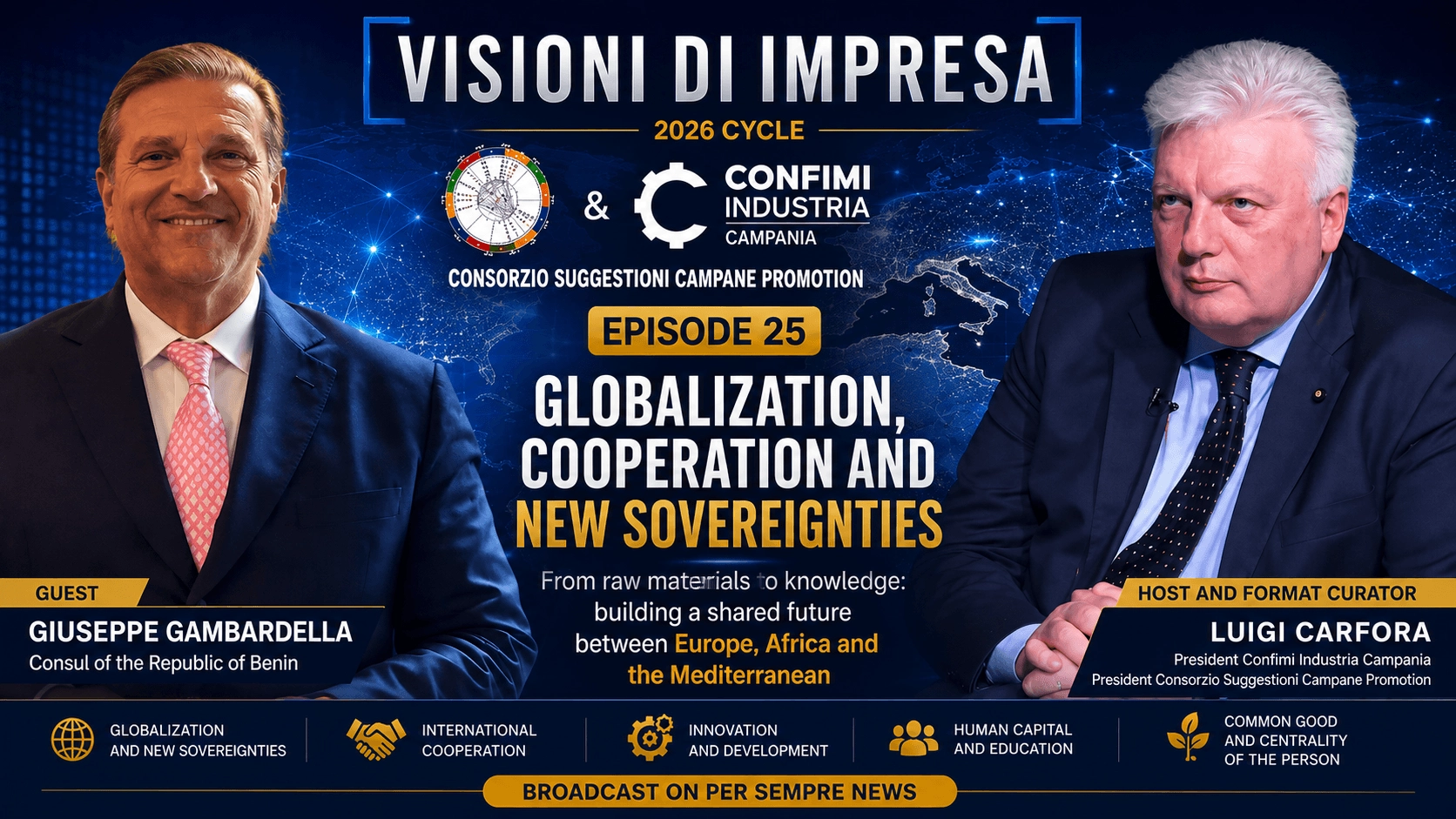
,🎥 BUSINESS VISIONS – Episode 26 | 2026 Series
UNIVERSITIES, THE STATE AND KNOWLEDGE SOVEREIGNTY
Who Will Govern Knowledge in the Age of Artificial Intelligences?
In this episode, we use the term "sovereignty" not as a synonym for isolation or self-sufficiency, but as the ability of a democratic community to participate—through competence, responsibility, and autonomy—in the creation of knowledge and scientific innovation.
Theme
Universities, scientific research, Artificial Intelligence, knowledge sovereignty, strategic autonomy, the national innovation ecosystem, technology transfer, public governance, human capital, digital transformation, democracy, freedom, the common good, and the centrality of the human person.
✦ Guiding Thought
"For centuries, the strength of nations was measured by their control over territory, natural resources, and energy. Today, a new dimension of sovereignty is emerging: the ability to generate, develop, and govern knowledge. Artificial Intelligence represents the greatest scientific and technological revolution of our time, but also one of its greatest democratic challenges. The freedom of individuals, the competitiveness of businesses, and the strategic autonomy of nations will increasingly depend on their ability to build a knowledge ecosystem founded on scientific research, strong institutions, innovation, and the centrality of the human person."
Introduction
Throughout the previous episodes of Business Visions, we have followed a journey that, episode after episode, has sought to understand the major transformations shaping the twenty-first century.
We have explored energy.
Scientific research.
Innovation.
Technology transfer.
Artificial Intelligence.
Human capital.
Industrial development.
International cooperation.
New forms of sovereignty.
These may appear to be different topics.
In reality, they are deeply interconnected.
They all describe the same transformation.
The gradual emergence of knowledge as the primary driver of economic, social, and institutional development.
For centuries, the wealth of nations was measured by the availability of land.
Later, by their industrial capacity.
Then, by access to energy.
Today, a new form of power is emerging.
The ability to generate knowledge.
To govern it.
To transform it into innovation.
To turn it into economic development.
To protect it as a strategic asset.
Never before have universities, scientific research, businesses, and public institutions become such essential components of a single ecosystem.
An ecosystem whose mission is not only to foster economic growth,
but also to safeguard freedom,
democracy,
competitiveness,
and strategic autonomy.
This episode is inspired by a question that will likely accompany us throughout the twenty-first century:
Who will govern knowledge?
In the twenty-first century, the real competition will not simply be about who develops the most powerful algorithms.
It will be about who succeeds in building the most effective ecosystems for generating knowledge, innovation, and responsibility.
For many years, Artificial Intelligence was regarded merely as another technological advancement.
Today we understand that it represents far more than that.
It is transforming the way we produce.
The way we study.
The way we communicate.
The way we work.
The way we conduct research.
The way we make decisions.
The way we organize our institutions.
And even the way we imagine the future.
This is precisely why the debate on Artificial Intelligence can no longer be confined to algorithms alone.
It must also involve universities.
Scientific research.
Businesses.
The State.
Democratic institutions.
Society as a whole.
Because every major technological revolution also brings about a profound cultural transformation.
And every cultural transformation reshapes economic, political, and social balances.
Artificial Intelligences
In several of his public addresses, the President of the Italian Republic, Sergio Mattarella, has deliberately used the expression "Artificial Intelligences" rather than the singular form.
A linguistic choice that may appear merely formal.
Yet it carries a much deeper meaning.
It reminds us that there is no single Artificial Intelligence.
There are different models.
Different approaches to the governance of knowledge.
Different technological architectures.
Different scientific strategies.
Different cultural perspectives.
Different economic interests.
Every Artificial Intelligence system reflects design choices, training methodologies, objectives, and application contexts that influence both its behaviour and its impact.
For this reason, discussing Artificial Intelligence today means not only examining the capabilities of machines,
but above all reflecting on the values that guide their development.
From Technology to Sovereignty
For many years we regarded technology simply as a tool.
Today it is increasingly becoming a strategic infrastructure.
Just as energy represented one of the fundamental pillars of economic sovereignty during the twentieth century, in the twenty-first century knowledge and Artificial Intelligence are assuming a comparable role.
Those who design algorithms.
Those who control computing infrastructures.
Those who develop large language models.
Those who own data.
Those who control computing capacity.
Those who possess the infrastructures required to train increasingly advanced AI models.
Those who educate researchers.
Those who finance scientific research.
Are playing an ever-growing role in shaping the economic, industrial and cultural balances of the future.
The issue, therefore, is not merely one of competitiveness.
It concerns the ability of a nation to preserve strategic autonomy in its long-term choices.
Knowledge as a Public Good
For centuries, knowledge was primarily preserved within universities.
Later, it spread to research centres.
Businesses.
Industrial laboratories.
Today we are witnessing another major transformation.
An increasingly significant share of applied research and Artificial Intelligence development is carried out by large private organisations operating on a global scale.
Many of these organisations are making extraordinary contributions to the advancement of Artificial Intelligence.
For this very reason, it is becoming even more important for universities, public institutions and publicly funded research to continue playing a central role in producing open knowledge in the public interest.
Today, collaboration between the public and private sectors represents one of the main drivers of innovation, provided that scientific pluralism, transparency and the protection of the public interest remain fully safeguarded.
This evolution has dramatically accelerated scientific progress.
Yet it also raises new questions.
How can we ensure that knowledge continues to serve the common good?
How can we prevent the scientific heritage generated through public research from losing its capacity to foster territorial development?
How can we encourage effective cooperation between universities, businesses and public institutions while preserving the primacy of the public interest?
These questions do not concern scientists alone.
They concern society as a whole.
The Strategic Autonomy of Knowledge
In recent years, a new concept has progressively emerged within the European debate:
Strategic autonomy.
Initially associated with energy.
Later with critical raw materials.
Digital infrastructures.
Cybersecurity.
Today, this reflection increasingly encompasses knowledge itself.
A truly autonomous nation is not one that produces everything on its own.
It is one that preserves the ability to understand.
To make informed choices.
To design.
To innovate.
To educate its own talent.
To develop scientific research.
To participate, as a leading actor, in shaping the technologies of the future.
The strategic autonomy of knowledge does not mean isolating oneself from the world.
It means engaging with the world while preserving the capacity to contribute independently to scientific, industrial and cultural progress.
Guests of the Episode
To address a reflection of such significance, we have brought together four distinguished personalities whose experiences are remarkably different, yet profoundly complementary.
Because knowledge sovereignty cannot depend on a single actor.
It requires dialogue among universities.
Scientific research.
Businesses.
Public institutions.
These are the four pillars upon which every nation builds its capacity to innovate.
To compete.
To govern change.
And to transform knowledge into development.
Prof. Virgilio D'Antonio
Rector of the University of Salerno
Full Professor of Comparative Private Law.
A distinguished scholar specialising in the relationship between law, innovation, communication and digital transformation, with particular expertise in the legal dimensions of technological innovation and digital communication.
His presence highlights the University's role as the place where knowledge is preserved, generated and passed on to future generations.
Today, however, universities are entrusted with an even broader responsibility.
Not merely to educate.
But to contribute to shaping the future of society.
Because the quality of scientific research increasingly determines the quality of a nation's economic and democratic development.
Prof. Mario Vento
Full Professor at the University of Salerno
Professor of Artificial Intelligence and Intelligent Robotics.
Director of the Artificial Intelligence and Intelligent Machines Laboratory.
Rector's Delegate for ICT and Digital Transformation.
One of Italy's leading scholars in Artificial Intelligence, Computer Vision and Intelligent Systems.
His scientific work represents one of the most significant bridges between fundamental research and technological applications.
Because every major innovation begins with research capable of anticipating the future.
Prof. Mario Migliuolo
President of the Scientific Committee of the AdAstra Foundation.
Former Director of the National Simulation Centre.
For many years actively engaged in promoting technology transfer between scientific research and industry.
Expert in technological innovation, advanced simulation and technology transfer.
His experience demonstrates that research creates value only when it moves beyond laboratories.
When it meets businesses.
When it becomes industrial innovation.
When it creates employment.
When it strengthens the competitiveness of the productive system.
Franco Picarone
Member of the Regional Council of Campania.
Vice-Chair of the VIII Standing Committee of the Regional Council of Campania.
Lead sponsor of the legislative proposal establishing the Campania Regional Observatory on Artificial Intelligence (ORIAC), promoting an institutional reflection on the governance of Artificial Intelligence at regional level.
His presence represents the role of democratic institutions.
Because every major technological transformation also requires effective governance.
Capable of guiding innovation.
Understanding its impact.
Promoting its development.
And protecting people's rights.
The National Knowledge Ecosystem
No great innovation is born by chance.
Every innovative ecosystem emerges from the interaction of different areas of expertise.
Universities.
Research centres.
Businesses.
Public administration.
Digital infrastructures.
Human capital.
High-performance computing infrastructures.
Financial resources.
Public institutions.
When these elements work together, knowledge generates development.
When they remain disconnected, knowledge risks never becoming innovation.
Italy possesses outstanding scientific expertise.
Researchers who are recognised throughout the world.
Universities of excellence.
Businesses capable of innovation.
The real challenge is to connect this extraordinary heritage.
Because the competitiveness of the future will depend less and less on the quantity of available resources,
and increasingly on the quality of the connections between those who generate knowledge and those who transform it into development.
Europe and Knowledge Sovereignty
In recent years, the European Union has also launched a profound reflection on the role of knowledge as a strategic asset for its future.
For many years, competitiveness was measured primarily by industrial capacity, access to energy, and the strength of markets.
Today these factors remain fundamental.
But they are no longer sufficient.
Artificial Intelligence, high-performance computing, digital infrastructures, scientific research, and the ability to develop advanced technologies are becoming new dimensions of international competitiveness.
For this reason, Europe is investing in scientific research, universities, high-performance computing infrastructures, digital skills, and the development of an innovation ecosystem capable of strengthening its strategic autonomy.
Through programmes dedicated to research, digital infrastructures, supercomputing, and the development of a European Artificial Intelligence ecosystem.
This is not about building a closed model.
Nor about opposing the rest of the world.
Rather, it is about ensuring that Europe continues to contribute to the advancement of knowledge by playing a leading role in shaping the technologies of the future while preserving the ability to make autonomous choices in strategic sectors.
Italy, too, is called upon to play a full part in this challenge.
Through its universities.
Its research centres.
Its businesses.
Its public institutions.
Because no European strategy can produce tangible results without the contribution of each Member State and its own knowledge ecosystem.
Within this context, universities assume an even broader responsibility.
Not only to educate professionals.
Not only to produce research.
But also to contribute to building a European knowledge network in which expertise, innovation, and technology transfer become a shared heritage, strengthening both regional competitiveness and Europe's capacity to address the major challenges of the twenty-first century.
For this reason, knowledge sovereignty should not be interpreted as a form of isolation.
Quite the opposite.
It is the ability to engage with the world while preserving scientific, cultural, and technological autonomy.
Because only those who contribute to the creation of knowledge can truly participate in shaping the future.
From this perspective, cooperation among universities, businesses, public institutions, and research centres represents one of the most effective ways to strengthen Europe's competitiveness and contribute to international scientific progress.
Brain Drain and the Loss of Knowledge
In the previous episode, we addressed the issue of young people leaving their home country.
We recognised that many talented individuals choose to pursue their professional careers abroad not only for economic reasons.
But because they seek environments where they can grow.
Experiment.
Conduct research.
Take on major challenges.
Today we can add a further reflection.
When a country loses its researchers.
When it loses its brightest young minds.
When it fails to retain highly qualified talent.
It does not simply lose people.
It loses part of its ability to build the future.
It loses research.
It loses innovation.
It loses competitiveness.
It loses autonomy.
Every young researcher who chooses to work abroad undoubtedly represents a valuable contribution to the international scientific community.
But it also raises an important question that Italy must have the courage to ask itself.
How can we build an ecosystem capable of offering our brightest talents the opportunity to pursue their research and life projects here at home?
Universities and Businesses: Two Worlds That Must Work Together
For many years, universities and businesses were regarded as separate worlds.
One dedicated to knowledge.
The other to production.
Today this distinction is becoming increasingly outdated.
Research generates innovation.
Innovation creates businesses.
Businesses finance new research.
Research develops new skills.
Thus, a virtuous cycle is created.
Knowledge becomes development.
Development creates new opportunities.
New opportunities stimulate further research.
This is the model that has enabled some of the world's most advanced economies to build ecosystems capable of attracting talent, investment, and innovation.
Italy's challenge is to strengthen this dialogue.
Not because we should imitate others.
But because we must enhance our own strengths.
Our scientific excellence.
Our entrepreneurial culture.
Our creativity.
Our manufacturing tradition.
Artificial Intelligence as a Common Good: Responsibility and Transparency
Every innovation can be used in different ways.
Artificial Intelligence is no exception.
It can increase productivity.
Improve scientific research.
Enhance the efficiency of public services.
Support healthcare.
Industry.
Agriculture.
Education.
But all of this will depend on one fundamental choice.
Our ability to combine innovation with responsibility, transparency, and the protection of fundamental rights.
Should Artificial Intelligence be regarded solely as a market-driven technology?
Or as a strategic technology to be developed within an ecosystem where universities, research institutions, businesses, and public authorities work together for the common good?
This is the challenge that will accompany our country in the decades ahead.
From Research to a Knowledge Civilization
Throughout this episode we have discussed universities.
Scientific research.
Artificial Intelligence.
Technology transfer.
Public institutions.
Development.
Topics that may appear different.
Yet they are profoundly interconnected.
Because they all describe the same transformation.
For the first time in human history, the greatest wealth of nations no longer lies primarily in what they possess.
It increasingly lies in what they are capable of creating.
In the quality of their universities.
In the strength of scientific research.
In the talent of their people.
In the vitality of their businesses.
In the credibility of their institutions.
And in their ability to transform knowledge into innovation.
A New Dimension of Sovereignty
For centuries, sovereignty was defended through military power.
Later, through industrial capacity.
Then through energy.
Today, none of these dimensions has disappeared.
But they all appear to converge towards a new one.
Knowledge sovereignty.
A sovereignty that is not measured by the ability to isolate oneself.
But by the ability to participate as a leading actor in global scientific progress.
To produce research.
To educate talent.
To develop technologies.
To create businesses.
To attract talent.
To retain the next generation.
And to contribute to the progress of humanity without sacrificing scientific, cultural, and intellectual autonomy.
From Knowledge Sovereignty to Cognitive Sovereignty
This is intended as a cultural reflection on the relationship between knowledge, scientific research, academic freedom, and the ability of democratic institutions to guide technological development in the public interest.
Throughout the previous episodes, we have reflected on energy sovereignty.
Then on food sovereignty.
Later on knowledge sovereignty.
Today, an even broader reflection emerges.
The twenty-first century may witness the rise of a new dimension of sovereignty.
Cognitive sovereignty.
By this expression, we do not intend to introduce an already established legal concept.
Rather, we propose a cultural perspective describing the ability of a democratic community to continue producing knowledge, research, and innovation freely and independently.
It is not about controlling thought.
Quite the opposite.
It is about preserving a society's capacity to build its own body of knowledge.
To develop scientific research.
To educate talent.
To prepare future generations.
To foster innovation.
To safeguard academic freedom.
To critically understand the technologies it adopts.
A truly free society is not one that merely uses Artificial Intelligence.
It is one that continues to understand it.
To develop it.
To govern it.
And to direct it towards the common good.
Cognitive sovereignty, therefore, does not imply isolation from the world.
It represents the ability to participate in the global creation of knowledge while preserving scientific, cultural, and democratic autonomy.
This will likely become one of the major challenges facing both Europe and Italy in the decades ahead.
The University as the Conscience of the Future
Universities are among the places where societies imagine their future.
They educate new generations.
They generate scientific research.
They nurture ideas.
They bring together different disciplines.
They cultivate critical thinking.
Artificial Intelligence will undoubtedly accelerate the production of knowledge.
Yet it will never replace humanity's ability to question the meaning and purpose of knowledge itself.
Because every scientific breakthrough brings new responsibilities.
And it is precisely within universities that these responsibilities are understood, studied, and passed on to future generations.
The Role of the State
The State is not called upon to replace scientific research.
Nor businesses.
Nor universities.
Its responsibility is to create the conditions that allow these worlds to work together.
So that talent can find opportunities.
Research can become innovation.
Innovation can become development.
And development can generate prosperity.
Ultimately, the future competitiveness of our country will depend on its ability to build a strong and resilient knowledge ecosystem.
The Question That Will Shape the Future
Throughout this series we have explored energy.
Businesses.
Scientific research.
Artificial Intelligence.
Human capital.
International cooperation.
New forms of sovereignty.
Today we can add one further reflection.
The defining question of the twenty-first century will not simply be:
How intelligent will Artificial Intelligence become?
The real question will be:
Will we be capable of building a society sufficiently aware and responsible to govern Artificial Intelligences wisely?
Because no algorithm can replace the responsibility of public institutions.
No machine can replace the freedom of scientific research.
No technology can replace the value of democracy.
No innovation can replace the dignity of the human person.
✦ Final Reflection
"Every era in history has been remembered for the resource it transformed into progress. Land gave rise to agricultural civilizations. Energy powered the Industrial Revolution. Today, knowledge is shaping the civilization of the twenty-first century. Yet knowledge alone is not enough. It must be accompanied by academic freedom, responsible institutions, the ability of businesses to innovate, and the centrality of the human person. Technological innovation acquires its true value only when it contributes to making society freer, more aware, and more responsible. The future will not belong to those nations that possess the most powerful technologies, but to those capable of governing them with greater wisdom, responsibility, and humanity. For knowledge generates true progress only when it remains at the service of humanity, freedom, and the common good."
🎙 EPISODE 26 – 2026 SERIES
🎙 Hosted and Produced by
Luigi Carfora
President, Confimi Industria Campania
President, Suggestioni Campane Promotion Consortium
👥 Featured Guests
Prof. Virgilio D'Antonio
Rector of the University of Salerno
Prof. Mario Vento
Full Professor at the University of Salerno
Professor of Artificial Intelligence and Intelligent Robotics
Director of the Artificial Intelligence and Intelligent Machines Laboratory
Rector's Delegate for ICT and Digital Transformation
Prof. Mario Migliuolo
President of the Scientific Committee of the AdAstra Foundation
Former Director of the National Simulation Centre
Expert in Technological Innovation, Advanced Simulation, and Technology Transfer
Franco Picarone
Member of the Regional Council of Campania
Vice-Chair of the VIII Standing Committee of the Regional Council of Campania
Lead sponsor of the legislative proposal establishing the Campania Regional Observatory on Artificial Intelligence (ORIAC)
🎬 Directed by: Pino Fontana
📺 Broadcast on Per Sempre News
📍 Recorded at the Per Sempre News Studios
📺 Available on Per Sempre News and across our social media channels
🌐 All episodes of Business Visions are available on the official portal of the Suggestioni Campane Promotion Consortium and Confimi Industria Campania:
https://www.suggestioni.eu/visioni-di-impresa/
At the top of the page, an interactive index allows readers to access each episode directly with a single click or to explore the entire editorial journey of the 2026 Series.
✦ Closing Reflection
Every era is called upon to govern its own transformations.
We have chosen to understand them.
Because understanding change is the first step toward governing it.
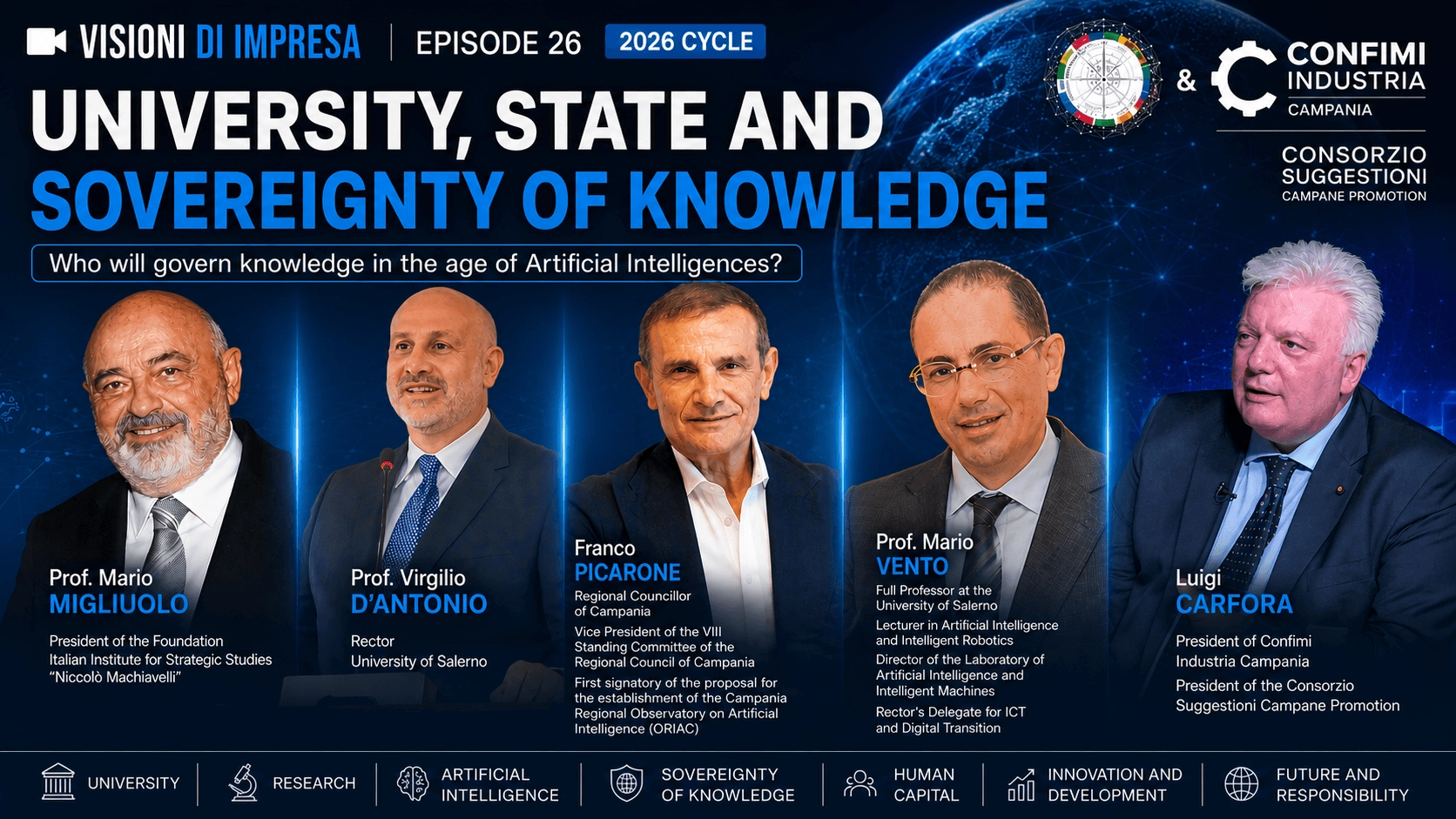
The cycle continues
Enterprise Visions does not end with these episodes.
The journey will continue with new appointments dedicated to the transformations affecting enterprises, work and society, keeping responsibility at the centre as the key to understanding change.
The upcoming episodes will further explore:
– the evolution of skills and training in the future of work
– the impact of intelligent technologies on production systems and services
– the relationship between innovation, territory and sustainable development
– the role of institutions, enterprise and research in building new economic and social balances
The objective is not to close a cycle, but to nurture an ongoing dialogue among entrepreneurs, professionals, academia and institutional representatives, accompanying over time the transformations already underway.
Enterprise Visions will therefore continue to tell the story of real enterprise — the one that produces, invests, hires and faces with responsibility the challenges of the present and the future.
✦ In-depth Insight Connected to the "Business Visions" Program
The Business Visions cycle was created as part of a broader reflection on the role of enterprises and the organizations that represent them. Alongside the episodes of the format, a parallel line of thought continues—focused on the evolution of associations and the need to build stronger, more transparent, and development‑oriented models of representation.
👉 Read the full insight: Associations, lobbying, and business development: why stronger representation and concrete services are needed
Associations, lobbying, and business development: why stronger representation and concrete services are needed Luigi Carfora
A coherent vision
The Enterprise Visions cycle starts from a simple conviction:
safety is the starting point.
sustainability is the criterion for continuity.
innovation is a tool, not an end.
responsibility is the thread that holds everything together.
This is why we continue the path started in 2025.
This is why we broaden the perspective in 2026, moving across enterprise, technology, tourism, law and institutions.
This is why we always begin from real enterprise — the one that produces, invests and creates work.
Each episode does not represent a conclusion, but a step within a dialogue destined to continue over time, accompanying the transformations of the economy and society.
Without enterprise there is no work.
And without work there is no sustainability.
Enterprise Visions was created to tell the present of real enterprise and to interpret change, placing it in dialogue with the responsibility of those who today are building the future of work, the economy, development and enterprise.
📌 The Journey Continues
This page brings together the first 27 episodes of the Visioni di Impresa 2026 series.
The Visioni di Impresa master index will be continuously updated, allowing visitors to access every episode of the 2026 series, even as the project expands across additional pages of the website.
To continue exploring the series, simply proceed to the next page.
▶ Continue to Visioni di Impresa – 2026 Series | Page II (Episodes 27–50)